
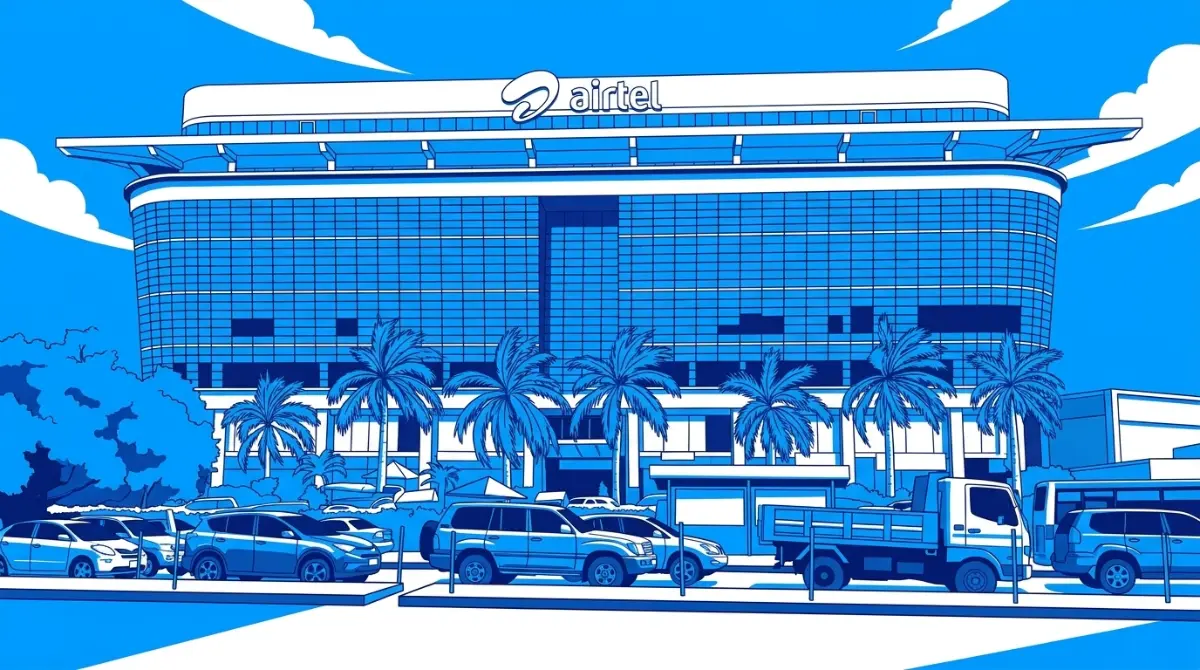


Airtel Money Cuts London IPO Goal to $800M
Airtel Africa reduced the fundraising target for Airtel Money London public listing to $800M following investor feedback on emerging market valuations.
Inioluwa Ademidun | 21 Sept. 2026 · 5 min read

Public equity markets are forcing African financial technology leaders to adjust their valuation expectations before ringing opening bells. For over eighteen months, telecommunications executives and investment bankers pitched the separation of continental mobile wallets from parent network infrastructure as the definitive validation of emerging market digital payments. The plan was straightforward: spin out fast-growing payment rails, list them on international exchanges in London or New York, and capture valuation multiples matching European and American payment processors. That optimism has run into economic reality. On Monday, September 21, 2026, financial disclosures confirmed that Airtel Africa cut the planned capital raise for the initial public offering of its fintech arm, Airtel Money, slashing its target to at least $800M after institutional investors pushed back on earlier targets that ranged between $1.5B and $2B.
The revised target represents an admission that public market liquidity remains selective regarding emerging market balance sheets. When executive leadership initially outlined the standalone listing on the London Stock Exchange, investment bankers floated enterprise valuations as high as $10B. Following feedback sessions with European institutions and sovereign funds, the company adjusted its anticipated valuation range down to between $8B and $9B. While securing $800M still positions the transaction as one of the largest first-time public listings on the London Stock Exchange this year, trimming the capital target by as much as 60% shows how macro uncertainties shape institutional check writing. We examined how continental telecommunications operators allocate capital to meet digital demand across regional markets in our report on Airtel Africa directing $1.1B toward data demand and network expansion.
The Financial Engine Behind the Spinoff
To understand why Airtel Africa is proceeding with the public listing despite valuation haircuts, one must inspect the balance sheet separation taking place inside the company. Historically, telecommunications giants bundled mobile money revenues into consolidated telephone statements, causing investors to value high-margin digital payment transactions at the same low price-to-earnings multiples assigned to physical radio masts and copper lines.
Airtel Money operates on an entirely different financial trajectory than standard voice networks. For the financial year ending March 31, 2026, the financial services unit generated $1.36B in revenue on a constant-currency basis, expanding more than 28% year over year. The platform processed $196B in transaction value across fourteen national markets, supported by an active user base of 54.1 million registered accounts and a physical merchant network spanning 2.4 million cash agents. Operating profits across the fintech division routinely outpace traditional cellular operations, contributing approximately 17% of group revenues while accounting for an outsized portion of operating margins. Carving out the fintech division allows the parent company to highlight those cash generation metrics to equity funds that are barred from buying traditional telecommunications stocks. How regulatory policies attempt to balance financial dominance with local market competition was analyzed when we covered central bank payment rules targeting fintech market concentration.
London Search for Marquee Equity Listings
The transaction carries deep institutional significance for the London Stock Exchange itself. Since 2022, London financial markets have endured an extended listing drought, watching technology unicorns and multinational corporations migrate to New York exchanges to chase deeper capital pools and higher valuation multiples. British regulators introduced reforms to domestic listing rules earlier this year, cutting administrative hurdles to attract fast-growing cross-border companies.
Airtel Africa Chief Executive Officer Sunil Taldar confirmed London as the preferred listing destination because the city offers access to international fund managers who hold experience with African assets. Minority shareholders in the fintech unit, including American payments network Mastercard and the sovereign Qatar Investment Authority, also favor London for secondary liquidity. However, institutional asset managers in London remain cautious. Investors are navigating elevated energy expenses, geopolitical friction, and currency depreciations across African economies, making them hesitant to pay peak multiples for emerging market payment volumes. Trimming the offering size to $800M allows underwriters to build a fully covered order book without discounting share prices on the open market.
The Structural Burden of Foreign Exchange Swings
The primary factor pushing institutional investors to demand lower entry valuations is foreign exchange volatility. Airtel Money collects fees in local currencies, including the Nigerian naira, Kenyan shilling, Ugandan shilling, and Central African CFA franc. Yet when the company reports consolidated earnings to international investors in London, those revenues must be translated into United States dollars and British pounds.
Over the past eighteen months, currency depreciations across West and East Africa erased hundreds of millions of dollars in translated corporate earnings. Even when local transaction counts surge by 30%, converting those fees into hard currencies often leaves dollar revenues flat. Institutional investors buying shares in London are pricing in this structural exchange risk. Fund managers are unwilling to value African transaction volumes at the same multiples granted to European payment firms that collect revenues in stable currencies. The company must prove that local transaction volumes can grow fast enough to outrun regional currency devaluations. We monitored how mobile transaction platforms adapt to regional economic realities when Mastercard and Flowcart launched WhatsApp payments in Kenya.
Setting the Valuation Benchmark for African Tech
The outcome of this London public debut will reverberate far beyond Airtel Africa boardroom. Across the continent, mature fintech ventures like Flutterwave, OPay, and PalmPay have spent years preparing their own public listings on Western exchanges. Venture capital firms that funded early-stage payment rounds need liquid public markets to return capital to their limited partners.
If Airtel Money successfully floats at an $8B to $9B valuation, it will establish an audited public pricing benchmark for the entire African fintech sector. A solid trading performance will prove that scaled African digital payment infrastructure can attract international capital during difficult market cycles. Conversely, if trading stumbles or underwriters are forced to cut share prices further, private tech companies will face down-rounds and postponed public offerings. By testing public market appetite with a realistic $800M capital raise, Airtel Money is acknowledging that the era of speculative, inflated valuations is over. Modern markets reward real operational cash flow and pragmatic pricing over marketing hype.
Read More on TechRobust:

Inioluwa Ademidun
 LinkedIn
Inioluwa Ademidun
Expertise:African Tech Ecosystem, Early-Stage Startups, Emerging Market Dynamics, Venture Capital & Tech Reporting, Product Management
Award:TechRobust Contributor of the Year 2025
Inioluwa is a Senior Product Manager by day and an investigative technology reporter by night, bridging the gap between scalable software architecture and high-impact journalism. She delivers deep-dive analysis on venture-backed founders, regulatory shifts, and grassroots tech ecosystems across Africa and global emerging markets.