
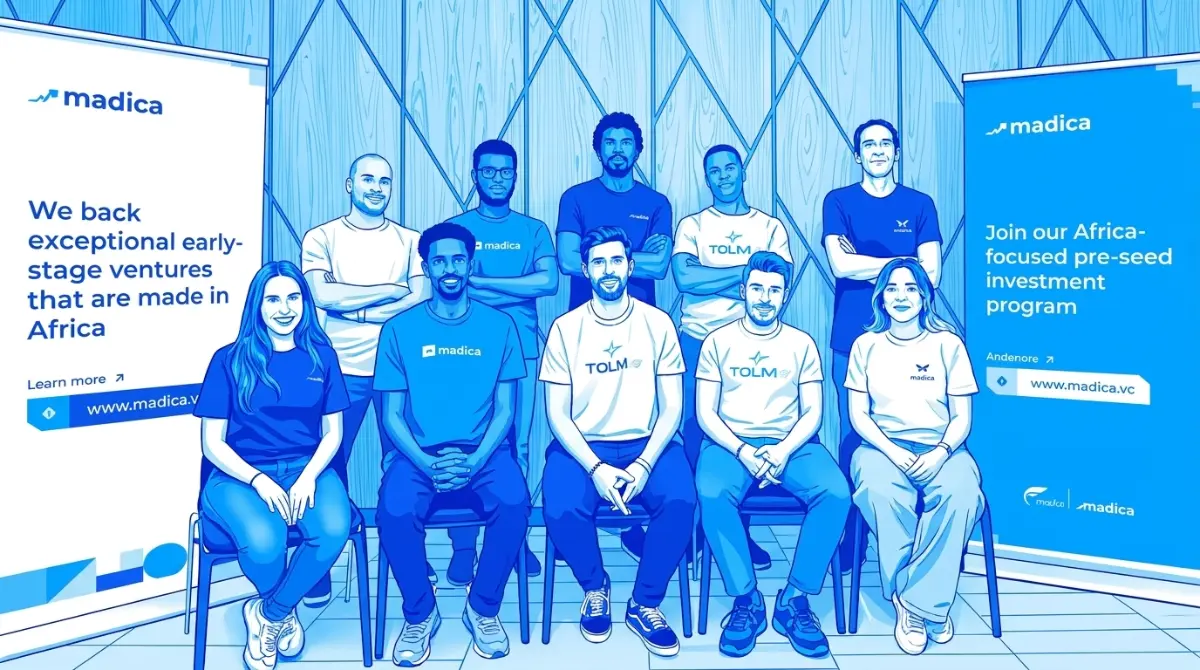


Madica Invests $200,000 in Five African Tech Startups
Pre-seed investment platform Madica injected two hundred thousand dollars into five regional ventures, expanding its portfolio footprint into overlooked hubs in Algeria and Cameroon.
Inioluwa Ademidun | 15 Sept. 2026

Walk through the innovation hubs in Algiers or stand in the tech co-working spaces of Douala, and you quickly notice how detached continental venture capital has remained from regional ground truth. For years, international investment syndicates treated Africa like a club of four nations. If a startup did not establish headquarters in Lagos, Nairobi, Cairo, or Cape Town, foreign fund managers rarely looked at their pitch decks. Pitching outside those favored corridors meant pitching into an institutional void. Talented engineers across Central and Francophone Africa built real products, secured paying clients, and then watched their operational runway run dry simply because they operated outside the traditional flight paths of Silicon Valley check writers. On Tuesday, September 15, 2026, pan-African pre-seed investment vehicle Madica made a direct move to challenge that geographical bias, injecting up to $200,000 each into five technology enterprises, including its first investments in Algeria and Cameroon.
The capital deployment, backed by global venture firm Flourish Ventures, expands Madica's operating portfolio to eighteen companies across ten African countries. Beyond writing initial checks, the initiative admits each founding team into an eighteen-month immersion framework providing structured executive coaching, operational mentorship, and introductions to international institutional syndicates. Chief executive officer Emmanuel Adegboye stated that the mandate remains centered on proving that viable commercial platforms emerge far outside traditional metropolitan hubs. Yet the cohort arrives amid an intense contraction across early-stage capital, an environment where capital scarcity forces institutional operators to rethink risk. We documented how regional funds formulate localized investment strategies across African technology markets when reporting on how Grindstone Ventures debuted a $31M fund to back African startups.
Challenging the Big Four Concentration
To grasp why these initial bets in Algeria and Cameroon matter, you have to look at the severe geographical imbalance that dominates continental venture statistics. Historically, upwards of 75% of all equity checks cut for African technology firms have flowed into just four nations: Nigeria, Kenya, Egypt, and South Africa. This heavy concentration starved surrounding economies of seed funding, leaving large commercial populations across the Maghreb and Central Africa with limited local digital infrastructure.
Madica's arrival in Algiers and Douala bridges that regional divide. In Algeria, the firm backed Talenteo, a cloud human resources and automated payroll platform led by Louai Djaffer and Tarik Metnani that serves mid-market enterprises across Francophone Africa. In Cameroon, capital went to Paysika, a digital banking platform co-founded by Roger Nengwe and Stezen Bisselou that issues mobile payment cards to underbanked consumers and small merchants across Central Africa. Deploying capital into these overlooked territories provides local founders with validation that institutional investors recognize their domestic markets. We analyzed how sovereign governments and local regulators construct digital compliance frameworks across the continent in our review of how Africa data protection rules reshape regional tech regulation.
The Shift Toward Seasoned Operators
While the investment program highlights its geographical expansion, an examination of the funded ventures reveals a notable shift in how early-stage risk is managed. None of the five startups selected is a first-time fundraiser. In an unforgiving macroeconomic environment, capital is flowing toward teams that have previously navigated financial survival.
In Nigeria, the platform participated with a $200,000 check in a $1.9M seed round for ChipMango, a semiconductor design and hardware engineering startup co-founded by Ola Fadiran and Jovan Andjelich, joining lead investor Atlantica Ventures alongside DFS Labs. In Egypt, the accelerator backed two established circular economy operators: Delta Oil, an industrial aggregator of used cooking oil for renewable biofuels led by Serag Moussa, and Bekia, a waste recycling platform founded by Alaa Afifi that has processed over a thousand metric tons of waste. Backing experienced teams that already completed initial equity rounds or accelerator programs illustrates how early-stage investors are prioritizing operational endurance over raw exploratory concepts. We explored how founders navigate early operational hurdles and funding demands in our feature on Norwest partners evaluating founder commercial execution before backing.
Navigating the Early-Stage Funding Winter
The timing of these investments aligns with sharp headwinds across the continental financing market. Disclosed venture funding in Africa dropped roughly 17% year-over-year in the first half of 2026, totaling $1.21B across 151 transactions. Even more telling, median deal sizes fell from $4.65M to $2.65M over the same period, while debt financing expanded to represent more than a third of all incoming capital. Foreign venture institutions have largely pulled back to their home markets, leaving local ecosystems dependent on specialized seed vehicles.
This capital drought makes hands-on operational assistance as valuable as the money itself. For a young company operating out of Yaoundé or Algiers, accessing global follow-on capital requires mastering corporate governance, financial auditing, and cross-border currency hedging. By combining structured executive coaching with funded immersion trips to international technology centers, the program aims to prepare regional businesses to withstand due diligence from institutional Series A funds. The struggle to secure sovereign computing capacity and venture backing reflects hurdles we detailed when Saudi Humain sought outside capital as state spending shifted.
The Path Forward for Distributed African Innovation
The broader lesson from Madica's latest deployment extends far beyond individual balance sheets. The future of the African digital economy cannot be built exclusively within three or four coastal capitals. A sustainable continental market requires vibrant digital commerce in Douala, automated payroll systems in Algiers, hardware design labs in Lagos, and clean fuel logistics in Cairo.
By placing structured capital into overlooked markets and backing founders who build solutions for everyday logistical realities, forward-looking investors are proving that geographical origin does not dictate commercial ceiling. The coming quarters will test whether these regional teams can scale their models into neighboring markets, but one reality is clear: the borders that once confined African technology investing are finally beginning to break down.
To review the original reporting detailing these investments and regional expansions, you can visit TechCabal.
Read More on TechRobust:

Inioluwa Ademidun
 LinkedIn
Inioluwa Ademidun
Expertise:African Tech Ecosystem, Early-Stage Startups, Emerging Market Dynamics, Venture Capital & Tech Reporting, Product Management
Award:TechRobust Contributor of the Year 2025
Inioluwa is a Senior Product Manager by day and an investigative technology reporter by night, bridging the gap between scalable software architecture and high-impact journalism. She delivers deep-dive analysis on venture-backed founders, regulatory shifts, and grassroots tech ecosystems across Africa and global emerging markets.