
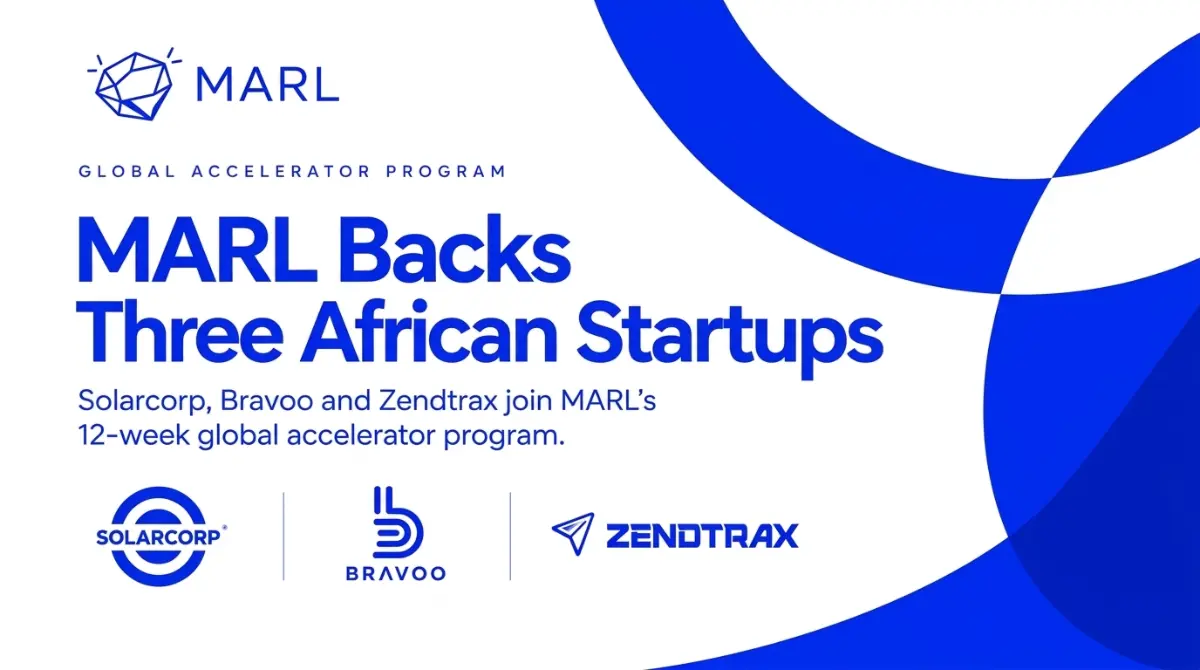


3 Nigerian Startups Picked for MARL Global Accelerator
Three Nigerian technology ventures secured spots in the fourteenth cohort of MARL global accelerator, securing $50,000 in early cash along with hands-on corporate mentorship to scale clean energy distribution, digital merchant retail, and logistics automation ahead of Demo Day.
Inioluwa Ademidun | · 10 min read

Securing early institutional backing across West Africa has turned into an unforgiving trial of endurance. Over the past twenty-four months, international venture capital pulled back from frontier tech hubs, leaving local entrepreneurs stranded without pre-seed checks. Founders who previously secured funding on pitch decks alone now face investors who demand audited sales receipts, verified customer retention curves, and positive operating cash flow before opening checkbooks. In Lagos, where electricity grids cut out without warning and currency values slide against foreign denominations, building a sustainable software or hardware venture requires exceptional grit. American early-stage venture investor MARL is stepping forward to inject fresh momentum into the local scene. On Wednesday, October 21, 2026, Disrupt Africa reported that MARL selected three Nigerian technology ventures: Solarcorp, Bravoo, and Zendtrax: for the fourteenth cohort of its global accelerator initiative. Each company receives $50,000 in upfront cash, paired with dedicated executive guidance, corporate networking access, and direct preparation for an international Demo Day scheduled for November 12. The selection highlights how localized problem solvers are attracting international attention, an investment pattern visible when African tech ventures reported quarterly funding figures.
The injection of international capital arrives at an opportune moment for the Nigerian tech community. While late-stage valuations for regional unicorns cooled, early-stage incubators and accelerators remain active gateways for capital infusion. MARL, an early-stage investor based in the United States, focuses its accelerator on scalable ventures working across mobility, connectivity, autonomous systems, and enterprise services. The three selected Nigerian companies address specific structural bottlenecks across the regional economy: clean electricity shortages, fragmented neighborhood retail distribution, and broken freight transit tracking. Rather than copying Western consumer software gimmicks, these teams built practical operational tools tailored to emerging market realities. The focus on foundational industrial infrastructure matches development themes we followed when Grindstone Ventures debuted a dedicated fund for African startups.
Solarcorp Tackles Distributed Clean Power
Electricity supply remains the single greatest operational headache for commercial enterprises and households throughout Nigeria. National transmission grids collapse repeatedly, leaving businesses dependent on loud, expensive diesel generators that burn valuable cash reserves. Fuel price increases have made running private petroleum generators unsustainable for neighborhood shops, medical clinics, and cold-chain operators. Solarcorp entered the market to provide decentralized solar energy installations through flexible commercial purchase models.
The company designs, distributes, and maintains modular solar installations equipped with lithium-iron-phosphate battery storage banks and automated remote monitoring microchips. Instead of demanding millions of naira in upfront capital from cash-strapped small business owners, Solarcorp deploys energy-as-a-service contracts. Clients pay predictable monthly utility subscriptions that undercut the running expenses of diesel engines by more than forty percent. The startup software platform continuously tracks battery health, inverter performance, and solar panel dust buildup over cellular internet-of-things links, sending maintenance technicians to replace degraded parts before electrical blackouts hit client freezers. Joining the MARL accelerator grants Solarcorp technical access to global hardware suppliers and advanced energy storage systems, strengthening its distribution footprint across southwestern industrial zones. The growing corporate appetite for decentralized clean energy was explored in our analysis of how Flowt raised capital for climate-focused commercial businesses.
Bravoo Rebuilds Informal Retail Supply Chains
Neighborhood corner shops, open-air kiosks, and local provision markets account for more than eighty percent of consumer retail sales across Nigerian cities. Still, informal traders operate under massive logistical handicaps. Store owners wake up before dawn, spend hours traveling to congested wholesale depots in central Lagos or Onitsha, negotiate prices in crowded aisles, and transport heavy sacks of goods back on passenger minibuses, losing productive sales hours while absorbing transit losses. Bravoo built an automated B2B marketplace to digitize this purchasing workflow.
Through a lightweight mobile application and conversational WhatsApp shopping bots, neighborhood grocers browse catalog prices, order inventory from major consumer goods manufacturers, and receive doorstep deliveries within twenty-four hours. Bravoo combines predictive purchasing software with localized micro-distribution hubs, pooling orders across entire city wards to secure bulk discounts from corporate manufacturers. The software captures transaction histories, creating verified credit scores that enable partner microfinance lenders to extend working capital loans to reliable shopkeepers. By helping informal merchants restock shelves without abandoning their counters, Bravoo increases retailer revenues while lowering stockout frequencies. The platform commercial expansion mirrors merchant digitization models we documented when Remita expanded consumer mobile services.
Zendtrax Brings Automated Intelligence to Commercial Logistics
Moving freight across Nigerian highways is notoriously volatile. Long-haul truck drivers navigate poorly paved roadways, police inspection checkpoints, fuel shortages, and cargo theft threats without reliable communication tools. Fleet managers at commercial manufacturing firms routinely lose contact with multi-million-naira cargo shipments for days, guessing vehicle locations through sporadic phone calls. Zendtrax built a unified fleet management and logistics software platform to bring visibility to commercial transit corridors.
The company installs rugged telematics hardware inside commercial trucks, linking engine diagnostics, GPS coordinates, fuel tank sensors, and driver cabin cameras directly to a centralized cloud dashboard. Zendtrax software uses route monitoring algorithms to flag abnormal stops, alert dispatchers to unauthorized fuel drainage, and score driver behavior to reduce road accidents. When a vehicle breaks down on an interstate highway, the platform automatically dispatches mobile mechanic teams from nearby service hubs, minimizing delivery delays. Corporate logistics directors use the system to verify cargo arrival times, automate invoicing, and cut transport insurance premiums. With MARL mentorship, Zendtrax plans to integrate satellite connectivity protocols into its telematics units, ensuring freight visibility continues even when trucks pass through rural cellular dead zones. The commercial race to automate supply chain tracking matches software approaches we evaluated when Air raised seed funding to protect enterprise supply networks.
Profiles of the Cohort 14 Nigerian Finalists
| Startup Name | Market Sector | Operational Problem Solved | Key Technical Approach | Target Cohort Milestone |
|---|---|---|---|---|
| Solarcorp | Clean Energy / Cleantech | Grid power blackouts and expensive diesel fuel | Modular solar storage with IoT monitoring | Securing hardware supply contracts |
| Bravoo | B2B Retail Commerce | Disorganized wholesale stock procurement | WhatsApp commerce bots and micro-warehouses | Expanding merchant working capital credit |
| Zendtrax | Logistics & Fleet Tech | Cargo theft, fuel fraud, and freight blind spots | Vehicle telematics with engine diagnostics | Integrating satellite-linked sensors |
The comparison table demonstrates that MARL selection strategy prioritized companies solving immediate physical bottlenecks over speculative consumer novelties. Clean energy, retail stock procurement, and freight transit represent non-negotiable economic activities that continue expanding regardless of broader macroeconomic shocks.
The MARL Global Accelerator Methodology
The MARL accelerator operates on a structured, high-intensity model designed to prepare seed-stage startups for international expansion. Unlike generic local incubators that focus on broad slide deck preparation, the program pairs each founding team with seasoned corporate executives, technical architects, and product strategists from major technology hubs.
Throughout the multi-week program, founders participate in intensive masterclasses covering customer acquisition economics, enterprise sales negotiations, intellectual property protection, and regulatory management across multiple jurisdictions. The $50,000 cash injection gives early-stage teams immediate working capital to hire critical engineering talent, purchase physical prototype components, and expand field sales operations. The program emphasizes unit economics over vanity user growth, forcing founders to prove that every dollar spent yields measurable, repeatable gross profit. By testing business models against rigorous international benchmarks, MARL helps African founders bridge the credibility divide that often separates local innovators from foreign capital syndicates. How early technology ventures navigate founder testing before raising institutional rounds was examined in our report on venture investors evaluating founder sales performance before committing capital.
Surviving the Local Currency Squeeze
A central challenge facing Nigerian technology startups is the ongoing volatility of the domestic foreign exchange market. Over the preceding two years, central banking reforms eliminated artificial currency pegs, leading to sharp declines in the purchasing power of the naira. This macroeconomic adjustment creates a difficult operational divide for tech ventures.
Software developers, cloud hosting servers, and specialized electronics parts are priced in American dollars, while customer revenues are collected in depreciating local currency. A startup that charges clients in naira must continuously increase retail prices merely to keep pace with soaring software subscription fees and imported equipment expenses. Receiving $50,000 in American dollar capital provides an invaluable financial cushion for Solarcorp, Bravoo, and Zendtrax. The foreign currency holding allows them to pay for international server infrastructure, secure overseas equipment shipments, and recruit specialized developers without watching their cash reserves get eaten away by domestic inflation. The structural difficulties of managing foreign exchange exposure across African tech hubs match issues we documented when Onafriq shut down Baxi agent banking in Nigeria.
The Missing Middle in African Seed Financing
The acceptance of three Nigerian ventures into an American accelerator also shines a light on a chronic structural flaw inside the regional startup ecosystem: the missing middle of venture capital. While international development organizations and local business competitions distribute small grants between $5,000 and $10,000, and established private equity syndicates write multi-million-dollar checks to late-stage fintechs, funding for early-stage companies needing between $50,000 and $250,000 remains scarce.
This capital gap causes hundreds of promising startups to collapse inside the valley of death: the difficult transitional period between building a working product prototype and achieving sustainable operational scale. Without early institutional bridge checks, founders spend their days pitching angel investors rather than refining software code or visiting merchant clients. Accelerators like MARL provide the vital financial stepping stones that keep early-stage companies alive until they qualify for formal institutional seed rounds. The critical importance of mid-tier venture funding was analyzed in our review of how African funding totals conceal the missing middle for growing startups.
The Road to Demo Day on November 12
The immediate operational priority for the three founding teams is fine-tuning their commercial pitches ahead of Demo Day on November 12. During the virtual showcase, Solarcorp, Bravoo, and Zendtrax will present their traction metrics, customer retention data, and three-year growth projections to an audience of international venture capital partners, family office managers, and corporate development executives.
Securing a strong audience at Demo Day can lead to competitive term sheets that fund regional expansion into neighboring West African markets like Ghana, Côte d'Ivoire, and Senegal. Founding teams are practicing their product demonstrations, auditing financial projections, and verifying customer case studies to prove their business models can succeed beyond Lagos borders. The preparation demanded for competitive startup pitch showcases was explored in our guide to startup grant and pitch competitions open for global founders, while broader strategies for long-term African startup success were detailed when Tomiwa Aladekomo outlined the next decade for African startups.
Building Durable Infrastructure for the Next Decade
The selection of Solarcorp, Bravoo, and Zendtrax marks a healthy maturation in African technology entrepreneurship. The era when founders could raise capital simply by pitching a clone of an American consumer app is finished. International investors want to see practical, resilient businesses that solve deep physical problems, generate dependable revenues, and build defensible operational moats.
Whether providing clean solar power to suburban businesses, delivering wholesale groceries to neighborhood shops, or tracking commercial freight across long highways, these three companies represent the new wave of African innovation. Their success will not be measured by speculative private market valuations, but by the tangible efficiency they bring to everyday Nigerian commerce. As they prepare to take the stage at MARL Demo Day, the founders of Solarcorp, Bravoo, and Zendtrax are proving that real entrepreneurial value is created not by dodging difficult local realities, but by building the physical and digital infrastructure that turns those challenges into lasting business triumphs. Cross-border payment expansions across regional commercial networks were also examined when Yellow Card expanded digital financial operations, alongside institutional funding rounds tracked when Ventures Platform closed an $84M fund for African startups, and industrial engineering workflows analyzed when Flow Engineering secured growth capital.
Read More on TechRobust:

Inioluwa Ademidun
 LinkedIn
Inioluwa Ademidun
Expertise:African Tech Ecosystem, Early-Stage Startups, Emerging Market Dynamics, Venture Capital & Tech Reporting, Product Management
Award:TechRobust Contributor of the Year 2025
Inioluwa is a Senior Product Manager by day and an investigative technology reporter by night, bridging the gap between scalable software architecture and high-impact journalism. She delivers deep-dive analysis on venture-backed founders, regulatory shifts, and grassroots tech ecosystems across Africa and global emerging markets.