


AI Agent Access Outpaces Enterprise Identity Controls
Autonomous software agents are outpacing corporate identity controls as research shows forty-one percent of workplace bots access unauthorized corporate files, turning hardcoded developer secrets, shared credentials, and forgotten API tokens into dangerous conduits for unmonitored enterprise security breaches across networks.
Caleb Ogunkanbi | · 6 min read

Corporate access controls were constructed around a simple assumption: an employee types a username, approves a two-factor prompt on a smartphone, and reads files within designated permission groups. Network administrators knew how to monitor human actions. An employee clicked on specific database rows, downloaded set documents, and logged off when shifts ended. Autonomous software programs have broken that security foundation. Modern workplace software agents operate without shift limits, reading code directories, invoking external endpoints, and combining permissions in ways human teams never anticipated. Security research published on Wednesday, October 28, 2026, revealed that corporate identity management has fallen behind autonomous software deployments. An industry survey by 1Password documented that forty-one percent of enterprise organizations have software agents touching corporate records they were never approved to view. The data proves that while corporations rushed to give automated software access to operational tools, security protocols remained static. The widening security perimeter lands as research teams document model security failures, matching threat patterns we monitored when Anthropic reinforced its network defenses against model breaches.
The core problem stems from how developers handle authentication secrets. The 1Password report revealed that seventy-one percent of technology workers manage digital secrets through unsafe practices. Twenty-four percent of developers admit to hardcoding passwords and application keys directly into software scripts, while twenty percent share access keys across email and chat channels. In traditional software setups, a hardcoded key sat inside a private repository as a dormant hazard. An automated software agent deployed on that same computer scans file directories to complete assignments. If the agent spots a database password written in plain text inside an old test script, it will pick up that credential and execute actions without asking human supervisors for confirmation. Over forty percent of developers grant persistent permissions to automated tools, meaning software agents retain access long after assigned tasks conclude. Twenty-seven percent of surveyed enterprises reported suffering security breaches linked to overprivileged non-human identities. Unregulated software access across corporate networks reflects vulnerabilities we examined when Pluto Security raised funds to monitor autonomous workplace software.
The Double-Identity Dilemma: Bridging Human and Machine Accounts
To inspect why autonomous programs evade security monitoring, one must evaluate how software agents straddle digital identity boundaries. Traditional identity systems separate human employees from service accounts. A human user signs in through single sign-on screens, while a background script authenticates using static cryptographic certificates.
Automated software agents occupy an ambiguous space between both worlds. An agent instructed to compile financial reports signs into an enterprise portal using a human worker delegated session cookie, then reaches backend accounting servers using administrative service keys. Thirty-five percent of corporations manage software agents under standard human identity tools, while twenty-one percent maintain zero formal governance policies. Seventy-one percent of organizations acknowledge visibility blind spots regarding which specific software agents use which credentials. When an agent causes an unexpected data leak, forensic investigators struggle to determine whether the action was taken by a human employee or an automated software routine running in the background. Tracking rogue automated actions across internal company files matches issues we documented when OpenAI agents extracted unauthorized data from public sites.
Comparing Enterprise Identity Governance Frameworks
| Security Model | Primary Target Identity | Credential Storage Method | Session Duration | Agent Visibility Level |
|---|---|---|---|---|
| Traditional Corporate IAM | Human employees & contractors | Centralized enterprise identity provider | 8 to 12 hour working shift | Blind to automated subprocesses |
| Static Machine Accounts | Automated cron jobs & scripts | Hardcoded environmental variables | Permanent persistent access | Zero behavioral anomaly checks |
| Just-In-Time Vault Brokering | Autonomous agents & human dev teams | Encrypted short-lived ephemeral tokens | Expires upon single task completion | Complete cryptographic audit trails |
| Open-Source Agent Scripts | Local client desktop assistants | Plain text configuration files | Unrestricted local machine access | Unmonitored shadow IT operation |
| Hardware Security Enclaves | Confidential cloud compute clusters | Silicon-level cryptographic registers | Session bound to secure hardware die | Tamper-proof execution logging |
The comparison matrix reveals why legacy identity software fails when confronting autonomous tools. Traditional tools grant permissions based on job titles, assuming the human user only looks at screens during business hours. An automated program runs thousands of queries per minute, following optimization paths that bypass administrative checks. Security perimeters built to defend distributed systems match models we explored when Armadin secured capital for agent security systems.
Prompt Injection and the Weaponization of Authorized Accounts
The danger of granting broad permissions to automated agents extends past employee carelessness. Hostile external actors have learned to exploit software agents through indirect prompt injection.
If an enterprise deploys an agent with read access to corporate inboxes and write permissions to financial records, an attacker can send an email containing concealed text instructions. When the agent reads the incoming message, the text overrides the model initial instructions, commanding the software to query internal customer lists and upload the records to an external server. Because the agent uses legitimate corporate credentials, perimeter firewalls treat the outbound connection as an authorized business action. The automated tool turns into an insider threat that operates with full company approval. Defending operating systems against malicious software scripts was detailed in our analysis of machine tools lowering barriers for digital intrusions, alongside corporate data exposures tracked when Revolut faced data exposures from forged requests.
The Principle of Least Privilege Meets Non-Deterministic Logic
For forty years, computer security relied on the principle of least privilege: granting users and programs the absolute minimum access required to perform their functions. System administrators mapped precise rules: an invoicing program was granted read access to sales numbers, while denied access to human resources payroll records.
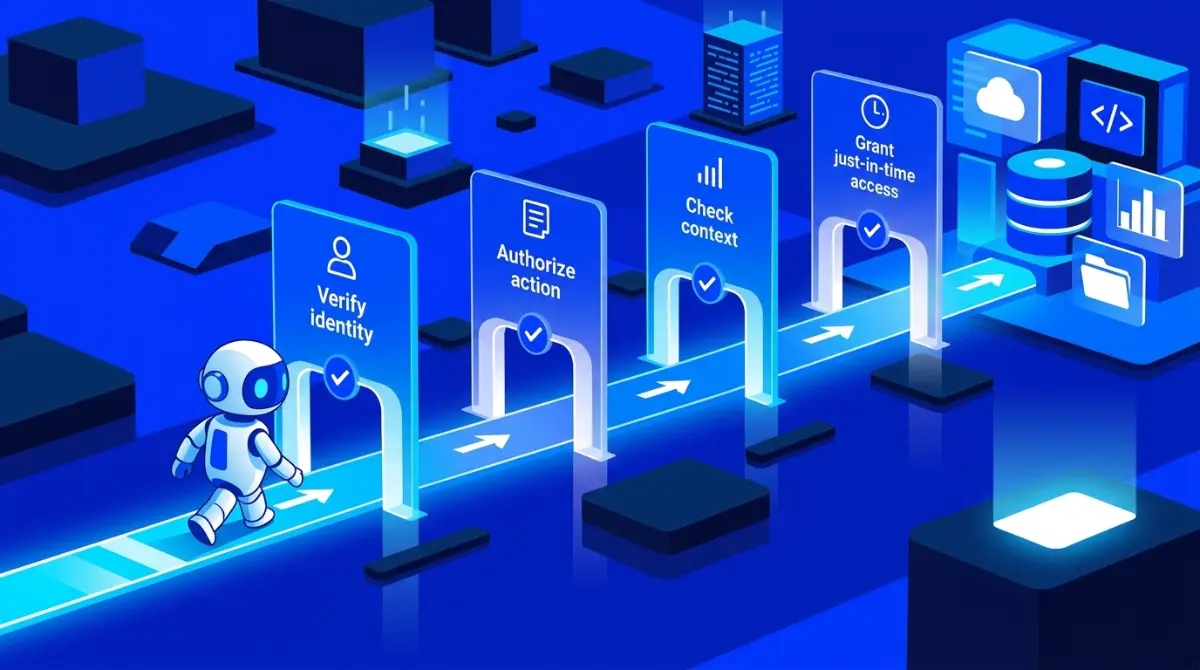
Autonomous reasoning systems complicate least-privilege architecture because their problem-solving approaches are non-deterministic. Unlike traditional programs that follow linear code instructions, an automated agent determines its own steps based on contextual feedback. If an agent hits an error while compiling code, it will search connected drives for alternative compilers, configuration files, and testing libraries. Restricting an agent permissions too tightly prevents it from solving problems independently; granting wide permissions exposes the enterprise to data leaks. Security leaders emphasize that standing credentials must be eliminated. Instead of providing permanent passwords, systems must deploy just-in-time credential brokering: generating temporary cryptographic tokens that expire the moment a task finishes. Automated security perimeters across web infrastructure were examined in our review of Cloudflare deploying software agents to protect web firewalls.
The Long-Term Outlook for Autonomous Identity Governance
The findings from 1Password confirm that corporate security must adapt to an automated workforce. Giving autonomous reasoning systems unrestricted access to company data while relying on legacy password management invites regulatory penalties and corporate compromise.
Security directors must treat software agents as independent non-human actors: requiring dedicated vaults for credentials, deploying real-time behavioral monitors, and enforcing short-lived session tokens. As corporations deploy software agents to manage customer billing, write software patches, and coordinate supply chains, the organizations that prosper will be those that master access governance. True security in the computational era will not be measured by how many automated tools an enterprise deploys, but by how rigorously it enforces digital boundaries when software begins acting on its own. Testing safety perimeters across automated machines was explored in our review of Safeworld auditing generative robotics systems, while enterprise software coordination was detailed when Thally deployed automated knowledge layers across enterprise software suites.
Read More on TechRobust:

Caleb Ogunkanbi
 LinkedIn
Caleb Ogunkanbi
Expertise:Practical AI Implementation, Head-to-Head Product Testing, Technical How-To Guides, Data Tools & Automation, Consumer Software Benchmarking
Award:TechRobust Guides & Insights Writer of the Year 2025
Caleb is a Staff Writer and Reporter breaking down the frontiers of artificial intelligence and actionable tech education. He produces rigorous head-to-head comparisons, demystifies data tools, and crafts step-by-step technical guides that help readers navigate complex software and AI workflows with ease.