
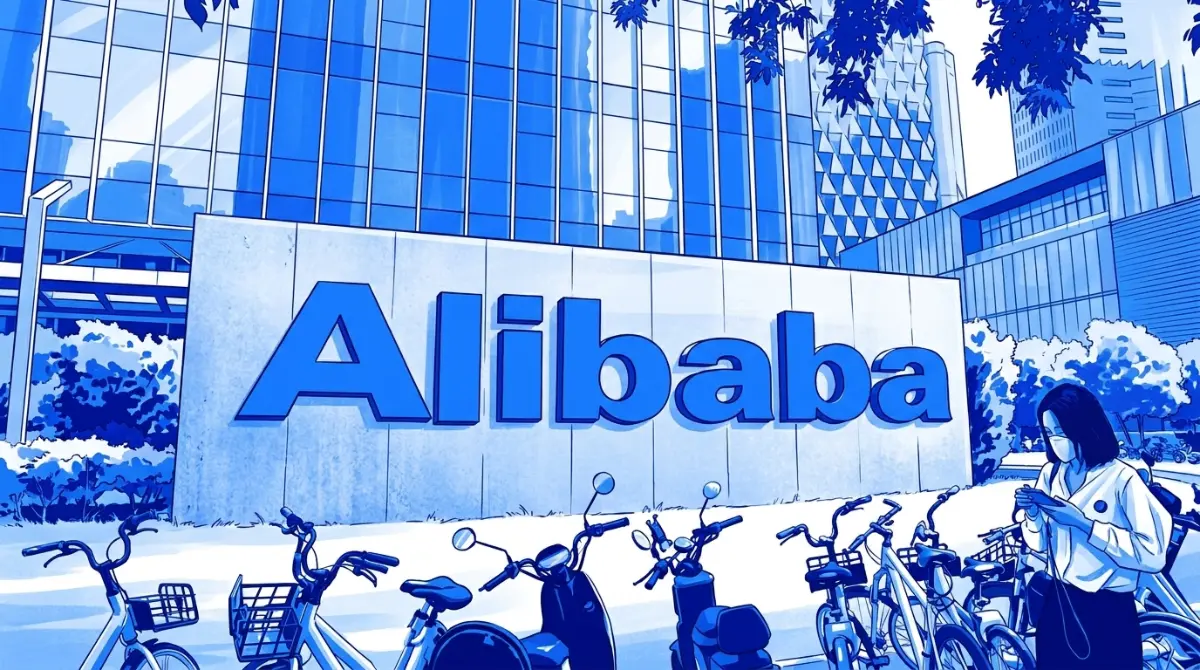


Alibaba Unveils Zhenwu V900 AI Chip to Challenge Nvidia
Alibaba introduced the Zhenwu V900 processor alongside plans to massively expand global data center capacity, actively challenging American semiconductor dominance amid tight export restrictions.
Umar Abubakar | 22 Sept. 2026 · 7 min read

The global race to control artificial intelligence hardware just escalated dramatically. Eddie Wu, the chief executive officer of Alibaba Group, took the stage at the annual Apsara Conference in Hangzhou today to make a massive announcement. He officially unveiled the Zhenwu V900, a processor he proudly described as the most powerful artificial intelligence chip ever built inside China. The timing of this release carries heavy geopolitical weight. The United States government continues to tighten export restrictions on advanced American processors. Those strict trade rules created a massive vacuum in the Asian technology market. Alibaba is now stepping into that exact vacuum, proving that Chinese engineers can design and deploy top tier silicon without relying entirely on foreign imports.
The financial markets reacted immediately to the news. Shares of Alibaba jumped more than five percent in Hong Kong shortly after the presentation concluded. Investors clearly see the immense financial upside of total hardware independence. The new processor comes directly from T-Head, the internal semiconductor division of the company. The engineering specifications reveal a highly capable piece of hardware designed specifically for heavy computational workloads. The V900 packs 216 gigabytes of onboard memory and boasts an inter-chip communication speed of 1,200 gigabytes per second. It natively supports the exact precision formats needed to train massive language models quickly. According to the engineering team, this new version triples the raw computational performance of the older M890 model released just a few months ago.
Scaling the Infrastructure
Building a fast processor is only the first step. You need a place to plug it in. Wu spent a large portion of his keynote discussing the physical realities of running these advanced systems. He set an incredibly aggressive target for Alibaba Cloud. The company intends to push its global data center capacity past 20 gigawatts by the year 2032. To put that number into perspective, it equals the energy output of several large nuclear power plants. This massive expansion is completely necessary to meet the exploding demand for computational power. We recently saw similar aggressive forecasts when analysts predicted global artificial intelligence infrastructure spending will reach $31 trillion by 2050. Every major technology firm understands that the winner of the current software war will be the company that owns the most electricity and the largest server farms.
The new silicon integrates directly into a newly upgraded supernode server architecture. This setup allows the company to connect up to 500,000 individual accelerator cards into a single cohesive cluster. When you string that many processors together, you can process information at speeds that were physically impossible just three years ago. The T-Head division already shipped hundreds of thousands of older generation chips to outside clients. Major corporations across the automotive, finance, and manufacturing sectors use this proprietary hardware to run automated supply chains and process financial risk calculations. By keeping the manufacturing process localized, Alibaba protects its clients from sudden supply chain shocks caused by international trade disputes.
The Push for Artificial Superintelligence
The hardware upgrades serve a very specific software goal. Alibaba is actively training its next generation of language models. The company confirmed that Qwen 4 is currently under development. The roadmap extends even further, with Qwen 4.5 and Qwen 5 projected to scale up to between five and ten trillion parameters. This represents a staggering leap in computational complexity. Their current top model operates on roughly 2.4 trillion parameters. Expanding the size of the neural network allows the software to handle much longer, highly complicated tasks without human intervention.
Wu spoke openly about the concept of recursive self-improvement. This occurs when a machine learning model becomes smart enough to identify its own programming flaws. The software then designs experiments to test new solutions, writes corrected code, and actively upgrades itself. During a recent internal test, an Alibaba model ran continuously for sixty hours, making tens of thousands of automated tool calls to reduce the physical design area of a new microchip by forty percent. A human engineering team would need months to achieve the exact same result.
The philosophical vision presented in Hangzhou is quite striking. Wu predicted that machines will eventually produce more than a thousand times the total cognitive output of all humanity combined. He stated that machine thinking currently accounts for less than three percent of global thought processing. He fully expects that number to eventually reach 99.9 percent. This open embrace of artificial superintelligence contrasts sharply with the cautious approach taken by some American researchers. For instance, top scientists recently warned against pushing model scaling to maximum speeds without proper safety guardrails in place. Alibaba is making it perfectly clear that they have zero intention of slowing down.
Financial Commitments and Market Strategy
Funding this level of rapid expansion requires very deep pockets. Alibaba already committed over $53B toward artificial intelligence research and deployment over a three year period. In August, they raised an additional $10.2B through a share offering in Hong Kong to ensure they have enough liquid capital to buy server equipment and secure power contracts. The company relies on a hybrid approach for now. While they aggressively push their own Zhenwu chips, their cloud division continues to buy and operate Nvidia graphics processing units. This hybrid strategy allows them to service international clients who still demand established American software tools, while slowly migrating domestic clients over to the homegrown alternative.
The overarching strategy points toward total vertical integration. When a company controls the custom silicon, the server racks, the cloud distribution network, and the foundational language models, they capture the entire profit margin. They no longer have to pay massive licensing fees or purchase marked up hardware from overseas vendors. If a trade embargo completely blocks American chips from entering Chinese ports tomorrow, Alibaba Cloud will simply continue operating using its own internal supply lines.
Global Repercussions
This announcement sends a direct message to Washington and Silicon Valley. The attempt to stall Chinese technology development through strict export bans is yielding unintended consequences. Instead of slowing down the competition, the restrictions forced Chinese conglomerates to massively accelerate their internal hardware programs. T-Head is no longer a small experimental division. It is a genuine competitor in the global semiconductor space, ready for mass commercial production by early 2027.
The sheer scale of the 20-gigawatt power goal also raises serious environmental and logistical questions. Securing that much electricity will require close cooperation with state-owned energy providers. It will likely require building dedicated power plants just to keep the server cooling fans running. The physical footprint of the internet is expanding at a terrifying rate, and the environmental cost of training ten trillion parameter models remains largely unknown.
The industry is watching a dramatic shift in the balance of computing power. For decades, American firms dictated the pace of silicon advancements. Today, a Chinese retail and cloud giant is setting its own timeline, building its own architecture, and boldly predicting an era where machines handle almost all planetary thinking. The launch of the Zhenwu V900 proves that the race to control the future of computing will not be won simply through trade policies. It will be won by the engineers who can build the fastest hardware and the companies willing to spend tens of billions of dollars to plug it in.
As we approach the end of the decade, the corporate battleground will increasingly focus on raw infrastructure. Software companies that do not manufacture their own chips will find themselves at the mercy of massive hardware giants. Alibaba understands this reality perfectly. By heavily funding T-Head and setting decade-long targets for energy consumption, the leadership team in Hangzhou is ensuring their absolute dominance in the Asian market. The success of the V900 processor acts as a loud declaration of independence, permanently altering the geopolitical layout of the technology sector.
Read More on TechRobust:
Umar Abubakar
 LinkedIn
Umar Abubakar
Expertise:Editorial Leadership, Product Design (UI/UX), Digital Media Strategy, Technology Systems, Product Architecture
Award:TechRobust Visionary Leader of the Year 2025
Umar serves as Editor-In-Chief and CEO of TechRobust, combining editorial vision with senior product design expertise to shape how modern technology stories are built, packaged, and told. Overseeing all editorial verticals, he directs coverage across global and regional tech landscapes while applying deep design thinking to publication strategy and reader experience.