
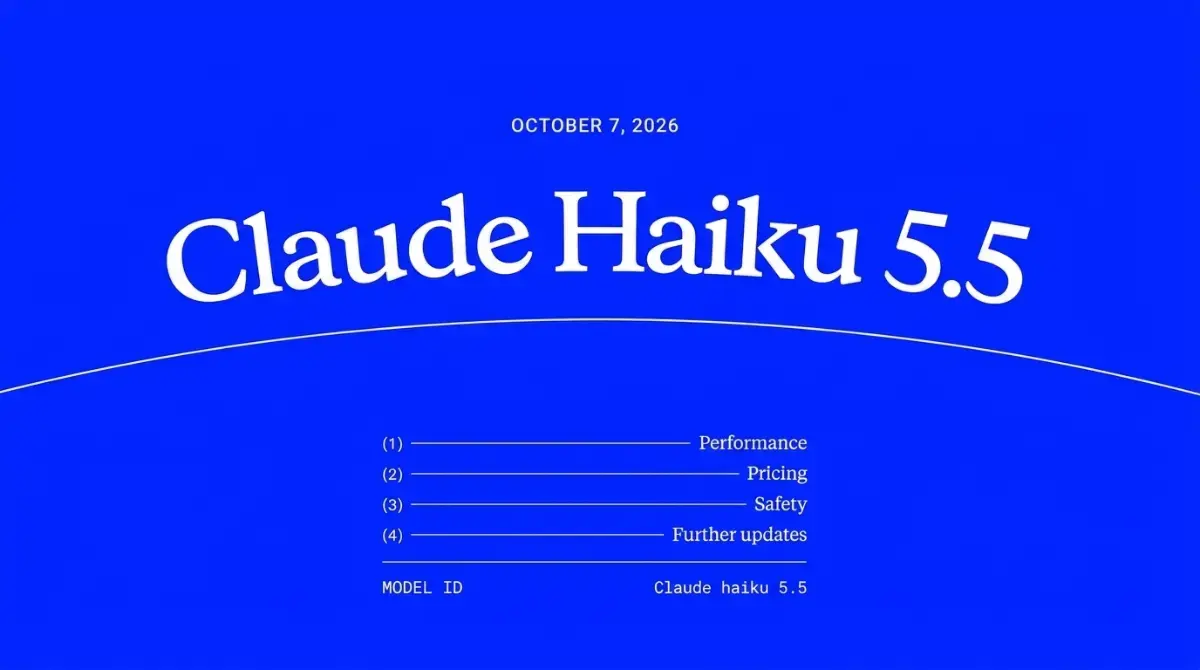


Anthropic Cuts Claude Haiku 5.5 API Costs by 90 Percent
Anthropic unveiled Claude Haiku 5.5 with a ninety percent price cut on prompts under one hundred thousand tokens, pricing input at ten cents per million to match rival GPT-6 Luna for high-volume corporate tasks.
Oladipupo Ajayi | 7 Oct. 2026, 6:51 AM · 7 min read

Running autonomous software at enterprise scale remains an expensive accounting hurdle. When engineering teams build autonomous agent pipelines, document extraction services, or high-volume customer triage bots, using frontier reasoning models quickly drains corporate bank accounts. Querying flagship neural networks for every minor database lookup or routing decision produces astronomical monthly cloud invoices. On Wednesday, October 7, 2026, San Francisco laboratory Anthropic tackled this commercial friction directly. The company rolled out Claude Haiku 5.5, slashing application programming interface charges by 90% for requests containing fewer than 100,000 tokens. The pricing structure matches OpenAI recently launched GPT-6 Luna, bringing intense competition to the budget computing market. The move follows rapid price adjustments across global developer platforms, a trend we tracked when reporting on Anthropic launching Claude Sonnet 5.5 with substantial cost reductions.
The revised pricing model changes how technical founders plan their software budgets. For prompts below the 100,000 token threshold, developers pay $0.10 per million input tokens and $0.50 per million output tokens. That matches the baseline rates set by OpenAI, ending the historical price premium Anthropic charged for its lightweight tier. According to internal benchmarks shared by company researchers, running standard enterprise workflows on the new release costs approximately 75% less overall than executing identical tasks on Claude Haiku 4.5, after factoring in updated token usage and request sizes. For requests exceeding the 100,000 token boundary, rates scale to $0.50 per million input tokens and $2.50 per million output tokens, still offering a 50% discount compared to previous generation benchmarks. The race to make enterprise machine learning financially sustainable mirrors corporate shifts we detailed in our report on Numeral securing $100M to automate financial compliance.
The Rise of Worker Subagents in Automated Workflows
The architectural logic behind this aggressive price reduction centers on the shift toward multi-agent computing. In modern software engineering, companies rarely task a single massive foundation model with handling an entire workflow from start to finish. Doing so is slow, computationally wasteful, and prone to system halts. Instead, software architects build hierarchical systems: a heavy model handles top-level planning and reasoning, while swarms of smaller subagents execute repetitive operational tasks in parallel.
Haiku 5.5 was designed specifically to serve as that cheap, high-speed worker layer. The system handles routine natural language tasks such as sorting inbound sales leads, extracting tabular records from PDFs, checking syntax errors in pull requests, and scraping web structures. On the OSWorld 2.1 evaluation suite, which measures an agent ability to interact with desktop computer interfaces, Haiku 5.5 achieved a 72.4% success score, compared to 48.9% for GPT-6 Luna. On Terminal-Bench 4.0, which tracks command-line execution, the model recorded 39.2% against 16.4% for its OpenAI counterpart. By offering high speed alongside dependable code execution, Anthropic provides developers with a reliable subordinate model that keeps operational costs low. We analyzed how automated workflows alter white-collar productivity in our review of corporate technology deployments freeing thousands of administrative work hours.
Pairing Fast Worker Nodes With Frontier Reasoners
The commercial rollout also changes how Anthropic sells its higher-end reasoning tools. Rather than pitching Claude Opus 5.5 as an all-in-one solution, the company is encouraging enterprise software clients to pair Opus and Haiku together. In this setup, Opus acts as the primary architect, breaking complex project briefs down into clear sub-tasks. It then delegates those pieces to dozens of Haiku 5.5 workers running concurrently across cloud servers.
This division of labor preserves expensive tokens on the primary model while accelerating execution speeds for the entire system. Haiku 5.5 carries a 1,000,000 token context window and supports output generations up to 128,000 tokens, giving it the capacity to absorb long legal contracts or complex codebases in a single call. The model also introduces an adjustable effort setting, allowing engineers to toggle reasoning depth between low, medium, and high settings depending on task difficulty. For simple document categorization, developers can select low effort to minimize compute latency; for subtle code refactoring, raising effort gives the subagent room to think before executing changes. The corporate demand for modular software tools matches trends we examined when covering Thally launching automated knowledge layers for software teams.
Defending Margins in a Brutal Price War
The 90% price cut underscores an intensifying price war among Western artificial intelligence laboratories. For eighteen months, Silicon Valley companies enjoyed fat software margins on developer tokens. But as model architectures converge and open-weight models from Asian research labs match Western benchmarks at lower price points, proprietary software builders are forced to defend their developer market share by cutting prices toward near-commodity levels.
OpenAI aggressive rollout of GPT-6 Luna forced Anthropic hand. Had the Dario Amodei-led company kept Haiku at its older pricing tier, startup developers building SaaS tools would have migrated their backend plumbing to OpenAI developer consoles. In the software platform business, losing early-stage developer mindshare is fatal. Once a startup builds its production code around a specific provider API, moving that code to a rival platform requires expensive re-engineering. By matching OpenAI at $0.10 per million input tokens, Anthropic prevents developer flight while locking software teams into its broader platform tools. We explored how aggressive pricing strategies alter corporate market valuations in our analysis of Anthropic preparing its initial public offering valuation.
Targeted Safety Rails for Network Requests
Deploying small, low-cost models into automated workflows introduces specific security challenges. Lightweight models are traditionally easier to jailbreak than heavily guarded flagship systems, raising fears that bad actors could abuse cheap tokens to orchestrate automated cyberattacks, run credential-stuffing campaigns, or generate polymorphic malware at scale.
Anthropic confirmed that Haiku 5.5 is the first model in its lightweight class to include built-in safety filters specifically targeting high-risk cybersecurity requests. The model inspects incoming prompts for malicious exploit scripts and network infiltration instructions, rejecting requests that cross high-risk safety thresholds while allowing legitimate penetration testers to continue normal security evaluations. Incorporating security guardrails directly into budget tiers reflects heightened public concern over autonomous cyber tools, an operational challenge we detailed when reporting on Anthropic warning that machine tools lower attack expenses for hackers.
Ecosystem Subsidies and Cloud Distribution
To accelerate commercial adoption, Anthropic is distributing Haiku 5.5 across all major enterprise cloud providers simultaneously. The model launched immediately on the Claude Platform, Amazon Bedrock, Google Cloud Vertex AI, and Microsoft Azure under the claude-haiku-5-5 identifier. Distributing the model across all three primary Western hyperscalers ensures that enterprise clients can deploy the silicon within their existing corporate cloud agreements without signing new data vendor paperwork.
Anthropic also introduced monthly API credits for subscribers on its Max and Team subscription plans, offering between $100 and $500 in monthly platform credits to encourage subscribers to test automated agent integrations. By subsidizing early enterprise experimentation, the company hopes to hook corporate software teams on its agentic tooling before competitors can pitch alternative suites. The company also rolled out discounted prompt caching for Sonnet 5.5, further lowering the barrier to entry for developers managing large context pools. We tracked how cloud partnerships shape enterprise software dominance in our report on major corporate partnerships expanding digital payment infrastructure.
The Road to Sustainable Enterprise Software
The launch of Claude Haiku 5.5 marks an important maturation point for the enterprise software sector. The period of pitching generative models as expensive, standalone novelties is coming to an end. Corporate buyers are no longer impressed by chat windows that merely generate clever sentences; they demand cost-efficient tools that run thousands of automated clerical tasks reliably within strict operational budgets.
By bringing frontier agent scores down to $0.10 per million tokens, Anthropic has eliminated one of the largest financial barriers preventing startups and corporate IT teams from deploying autonomous workflows at massive scale. As developers integrate these lightweight worker nodes into customer support desks, codebases, and financial auditing software, the battle for dominance in modern software will be decided not by which laboratory builds the largest neural model, but by which provider makes running intelligent software affordable for everyday businesses. How developers deploy low-cost compute across emerging economies was explored in our analysis of global workers building digital platforms across international markets.
Read More on TechRobust:
Oladipupo Ajayi
 LinkedIn
Oladipupo Ajayi
Expertise:Artificial Intelligence, Machine Learning Trends, Data Infrastructure, Enterprise AI Strategy, Frontier Tech Commentary
Award:TechRobust AI & Data Voice of the Year 2025
Ola is an Editor-at-Large at TechRobust, delivering authoritative commentary, high-level analysis, and investigative features across the frontiers of machine intelligence and big data. He tracks frontier model developments, enterprise AI adoption, data governance, and the societal shifts driven by computational breakthroughs.