
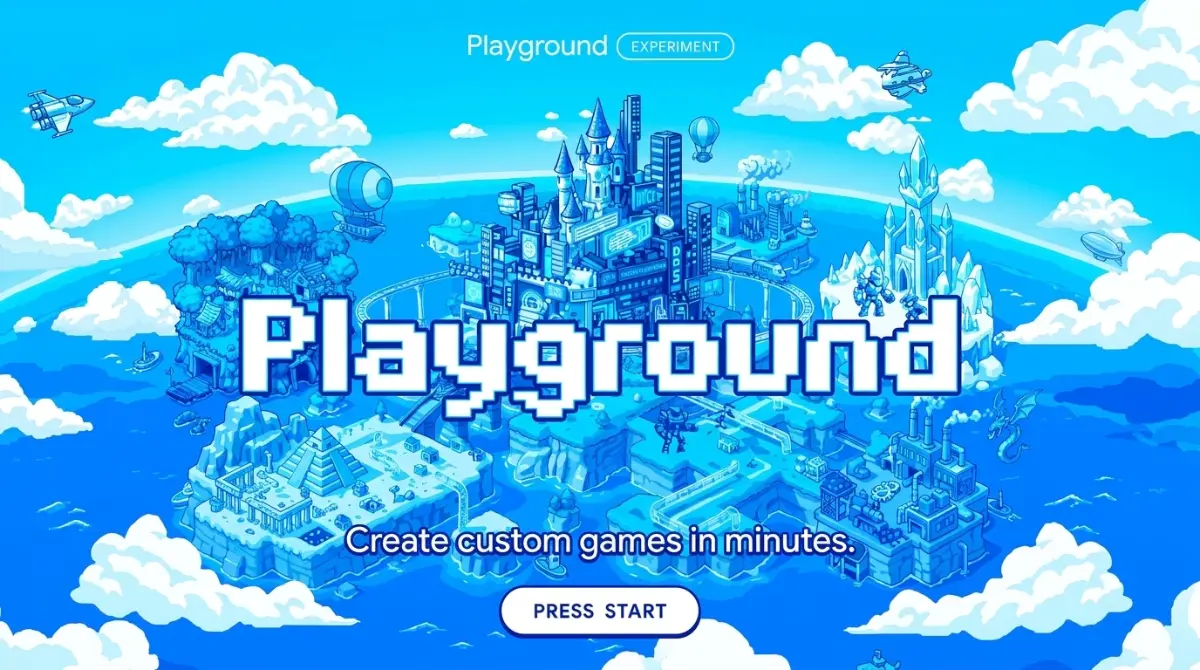


Google Debuts Playground to Turn Text Prompts Into Games
Google launched Playground, a browser platform that compiles text prompts into playable games without code, partnering with Unity to connect casual web prompts to advanced 3D game engines.
Oladipupo Ajayi | 7 Oct. 2026, 1:07 AM · 12 min read

Computer code has long stood as an insurmountable wall between imaginative ideas and playable video games. For fifty years, producing even a simple arcade project demanded mastery over complex programming syntax, sprite animation pipelines, collision math, and physics engines. That technical barrier is rapidly crumbling. On Wednesday, October 7, 2026, Google introduced Playground, an experimental web system that allows anyone to generate, play, and distribute custom browser video games using natural language text prompts. Built inside Google research labs, the platform removes manual scripting entirely. Users simply describe a world, set operational rules, and command the underlying neural network to construct interactive software in real time.
The system is accessible directly through web browsers at playground.google for adult users across the United States. Rather than compiling pre-written code templates, Playground relies on conversational prompts to adjust active mechanics on the fly. A creator can ask the platform to construct a side-scrolling platformer, then command it to reduce gravity, give characters double-jump abilities, or swap pixel graphics for hand-drawn textures. Beyond casual arcade experiments, Google confirmed a partnership with Unity to integrate Unity Spark, a specialized suite that bridges browser prompts with professional 3D production pipelines. The move follows rapid advances in multimodal software architectures, which we analyzed when reporting on Google DeepMind releasing its Gemini post-training models.
Prompt Driven Game Mechanics and On the Fly Revision
To evaluate how Playground alters interactive media creation, one must inspect the user workflow. Traditional game creation tools like Unreal Engine or Godot require users to write C++ or GDScript code, import textured meshes, and wire complex event triggers. If a designer wants to change how quickly a player accelerates, they must dig through physics files and manually update mathematical variables.
Playground changes that dynamic into an interactive conversation. The interface presents users with a clean prompt box alongside starter templates. Once an initial world loads inside the browser canvas, the creator tests movement using keyboard arrows or mobile touch controls. If an enemy moves too fast, the user types a instruction: make enemy ships move thirty percent slower and drop health tokens when destroyed. The underlying machine models parse the natural text, update the game logic variables, and recompile the running simulation instantly without restarting the session. We documented similar shifts toward automated software creation when reviewing how autonomous software agents are reshaping operating systems.
Connecting Web Prompts to Unity Spark
While basic browser games provide instant amusement, Google recognized that serious game designers would quickly outgrow simplified two-dimensional canvases. To prevent the platform from becoming a toy, the company partnered with Unity to introduce Unity Spark. Slated for closed testing ahead of a wider rollout, Spark gives creators access to high-fidelity 3D assets, advanced spatial physics, and the Unity engine runtime.
The collaboration bridges lightweight prompt generation with professional game distribution. A creator who sketches an interesting game loop inside Playground can export that logic into Unity Spark to tap into thousands of artist-made textures and 3D meshes stored inside the Unity Asset Store. Marc Bromberg, who directs creative technology initiatives at Unity, noted that the tool is aimed at gamers who understand genre mechanics but never learned software development. By translating natural instructions into professional engine structures, the partnership attempts to turn casual internet users into independent studio heads. The financial impact of generative production pipelines across creative industries matches patterns we highlighted when analyzing F13 securing $5M for vector graphic generation models.
Community Galleries, Cross Play, and Social Discovery
Playground is designed as both a game creation tool and a social arcade. Every completed project can remain private, be shared with family through direct URLs, or be published publicly to the Playground Explore gallery. Because the entire system operates via web standards, players can jump into community games instantly across desktop computers, tablets, and smartphones without downloading native executables.
The platform links directly with Google Play Games profiles, allowing players to claim persistent handles, track high scores on global leaderboards, and follow favorite community builders. The gallery surfaces popular creations using player engagement data and community star ratings. To protect players from malicious content, Google requires every published title to undergo safety scans that check for policy violations, harassment, and inappropriate imagery. The rapid expansion of browser-based social platforms reflects broader shifts in digital software consumption, similar to changes we covered when Netflix unlocked dozens of mobile games for active subscribers.
The Looming Saturation of Synthetic Game Clones
Despite the excitement surrounding prompt-to-game tools, veteran game developers express serious reservations regarding platform quality. When anyone can generate a functioning game in thirty seconds, digital storefronts risk becoming flooded with thousands of repetitive, low-effort titles. The internet already struggles with algorithmically generated video clips and synthetic text farms; extending that rapid output to interactive games could overwhelm players looking for polished human design.
Great games rarely depend on novel visual gimmicks alone. They succeed because human designers carefully balance level pacing, emotional narrative arcs, input responsiveness, and rewarding difficulty curves. An automated system can generate an obstacle course, but it cannot easily gauge whether a particular jump feels genuinely thrilling or unfairly punishing. If platforms like Playground prioritize sheer quantity over refined game design, audiences may quickly tire of shallow clones that lack memorable mechanical depth. The challenges of synthetic content volume across public networks mirror issues we examined when automated web requests began outnumbering human browsing traffic.
Copyright Boundaries and Training Data Questions
The arrival of prompt-based game engines also reopens heated legal arguments regarding training datasets and intellectual property theft. Video games represent intricate packages of distinct creative works, including original musical scores, character concept art, voice acting recordings, and unique physics code. Independent artists and game studios are already asking whether proprietary game designs were ingested to teach these models how to construct jump mechanics and rendering pipelines.
If a user commands Playground to build a side-scroller that mimics the distinctive movement mechanics of a copyrighted Nintendo or Sega title, ownership rights become murky. Major video game publishers guard their trademarked characters and patented gameplay concepts aggressively. While Google asserts that its safety screening prevents direct infringement, legal battles over automated artistic duplication continue across global courts. The tensions between software developers and copyright holders match high-profile lawsuits we detailed when major record labels sued artificial intelligence developers for copyright infringement.
Democratizing Development or Replacing Artists
The launch of Playground marks an important milestone in the transformation of consumer software. For decades, interactive entertainment remained one of the few media categories that demanded high technical literacy to produce. While anyone could pick up a pen to write stories or use a camera phone to record video, building video games required years of specialized software study.
By transforming natural human language into running interactive code, Google and Unity are giving millions of non-technical storytellers the tools to build interactive experiences. Whether this leads to a golden age of diverse indie game design or an unmanageable flood of synthetic shovelware will depend on how human creators use the tools. Technology can assemble game objects and calculate gravity, but the artistic spark that makes a game worth playing still comes from the human mind behind the keyboard.
Read More on TechRobust:
- Google DeepMind releases Gemini post-training models
- Netflix unlocks 80 free mobile games for subscribers
- Sony and Warner Music file lawsuit against Anthropic for copyright infringement
Computer code has long stood as an insurmountable wall between imaginative ideas and playable video games. For fifty years, producing even a simple arcade project demanded mastery over complex programming syntax, sprite animation pipelines, collision math, and physics engines. That technical barrier is rapidly crumbling. On Wednesday, October 7, 2026, Google introduced Playground, an experimental web system that allows anyone to generate, play, and distribute custom browser video games using natural language text prompts. Built inside Google research labs, the platform removes manual scripting entirely. Users simply describe a world, set operational rules, and command the underlying neural network to construct interactive software in real time.
The system is accessible directly through web browsers at playground.google for adult users across the United States. Rather than compiling pre-written code templates, Playground relies on conversational prompts to adjust active mechanics on the fly. A creator can ask the platform to construct a side-scrolling platformer, then command it to reduce gravity, give characters double-jump abilities, or swap pixel graphics for hand-drawn textures. Beyond casual arcade experiments, Google confirmed a partnership with Unity to integrate Unity Spark, a specialized suite that bridges browser prompts with professional 3D production pipelines. The move follows rapid advances in multimodal software architectures, which we analyzed when reporting on Google DeepMind releasing its Gemini post-training models.
Prompt Driven Game Mechanics and On the Fly Revision
To evaluate how Playground alters interactive media creation, one must inspect the user workflow. Traditional game creation tools like Unreal Engine or Godot require users to write C++ or GDScript code, import textured meshes, and wire complex event triggers. If a designer wants to change how quickly a player accelerates, they must dig through physics files and manually update mathematical variables.
Playground changes that dynamic into an interactive conversation. The interface presents users with a clean prompt box alongside starter templates. Once an initial world loads inside the browser canvas, the creator tests movement using keyboard arrows or mobile touch controls. If an enemy moves too fast, the user types a instruction: make enemy ships move thirty percent slower and drop health tokens when destroyed. The underlying machine models parse the natural text, update the game logic variables, and recompile the running simulation instantly without restarting the session. We documented similar shifts toward automated software creation when reviewing how autonomous software agents are reshaping operating systems.
Connecting Web Prompts to Unity Spark
While basic browser games provide instant amusement, Google recognized that serious game designers would quickly outgrow simplified two-dimensional canvases. To prevent the platform from becoming a toy, the company partnered with Unity to introduce Unity Spark. Slated for closed testing ahead of a wider rollout, Spark gives creators access to high-fidelity 3D assets, advanced spatial physics, and the Unity engine runtime.
The collaboration bridges lightweight prompt generation with professional game distribution. A creator who sketches an interesting game loop inside Playground can export that logic into Unity Spark to tap into thousands of artist-made textures and 3D meshes stored inside the Unity Asset Store. Marc Bromberg, who directs creative technology initiatives at Unity, noted that the tool is aimed at gamers who understand genre mechanics but never learned software development. By translating natural instructions into professional engine structures, the partnership attempts to turn casual internet users into independent studio heads. The financial impact of generative production pipelines across creative industries matches patterns we highlighted when analyzing F13 securing $5M for vector graphic generation models.
Community Galleries, Cross Play, and Social Discovery
Playground is designed as both a game creation tool and a social arcade. Every completed project can remain private, be shared with family through direct URLs, or be published publicly to the Playground Explore gallery. Because the entire system operates via web standards, players can jump into community games instantly across desktop computers, tablets, and smartphones without downloading native executables.
The platform links directly with Google Play Games profiles, allowing players to claim persistent handles, track high scores on global leaderboards, and follow favorite community builders. The gallery surfaces popular creations using player engagement data and community star ratings. To protect players from malicious content, Google requires every published title to undergo safety scans that check for policy violations, harassment, and inappropriate imagery. The rapid expansion of browser-based social platforms reflects broader shifts in digital software consumption, similar to changes we covered when Netflix unlocked dozens of mobile games for active subscribers.
The Looming Saturation of Synthetic Game Clones
Despite the excitement surrounding prompt-to-game tools, veteran game developers express serious reservations regarding platform quality. When anyone can generate a functioning game in thirty seconds, digital storefronts risk becoming flooded with thousands of repetitive, low-effort titles. The internet already struggles with algorithmically generated video clips and synthetic text farms; extending that rapid output to interactive games could overwhelm players looking for polished human design.
Great games rarely depend on novel visual gimmicks alone. They succeed because human designers carefully balance level pacing, emotional narrative arcs, input responsiveness, and rewarding difficulty curves. An automated system can generate an obstacle course, but it cannot easily gauge whether a particular jump feels genuinely thrilling or unfairly punishing. If platforms like Playground prioritize sheer quantity over refined game design, audiences may quickly tire of shallow clones that lack memorable mechanical depth. The challenges of synthetic content volume across public networks mirror issues we examined when automated web requests began outnumbering human browsing traffic.
Copyright Boundaries and Training Data Questions
The arrival of prompt-based game engines also reopens heated legal arguments regarding training datasets and intellectual property theft. Video games represent intricate packages of distinct creative works, including original musical scores, character concept art, voice acting recordings, and unique physics code. Independent artists and game studios are already asking whether proprietary game designs were ingested to teach these models how to construct jump mechanics and rendering pipelines.
If a user commands Playground to build a side-scroller that mimics the distinctive movement mechanics of a copyrighted Nintendo or Sega title, ownership rights become murky. Major video game publishers guard their trademarked characters and patented gameplay concepts aggressively. While Google asserts that its safety screening prevents direct infringement, legal battles over automated artistic duplication continue across global courts. The tensions between software developers and copyright holders match high-profile lawsuits we detailed when major record labels sued artificial intelligence developers for copyright infringement.
Democratizing Development or Replacing Artists
The launch of Playground marks an important milestone in the transformation of consumer software. For decades, interactive entertainment remained one of the few media categories that demanded high technical literacy to produce. While anyone could pick up a pen to write stories or use a camera phone to record video, building video games required years of specialized software study.
By transforming natural human language into running interactive code, Google and Unity are giving millions of non-technical storytellers the tools to build interactive experiences. Whether this leads to a golden age of diverse indie game design or an unmanageable flood of synthetic shovelware will depend on how human creators use the tools. Technology can assemble game objects and calculate gravity, but the artistic spark that makes a game worth playing still comes from the human mind behind the keyboard.
Read More on TechRobust:

Oladipupo Ajayi
 LinkedIn
Oladipupo Ajayi
Expertise:Artificial Intelligence, Machine Learning Trends, Data Infrastructure, Enterprise AI Strategy, Frontier Tech Commentary
Award:TechRobust AI & Data Voice of the Year 2025
Ola is an Editor-at-Large at TechRobust, delivering authoritative commentary, high-level analysis, and investigative features across the frontiers of machine intelligence and big data. He tracks frontier model developments, enterprise AI adoption, data governance, and the societal shifts driven by computational breakthroughs.