


Google Expands SynthID Tool Globally and Adds Apple Soon
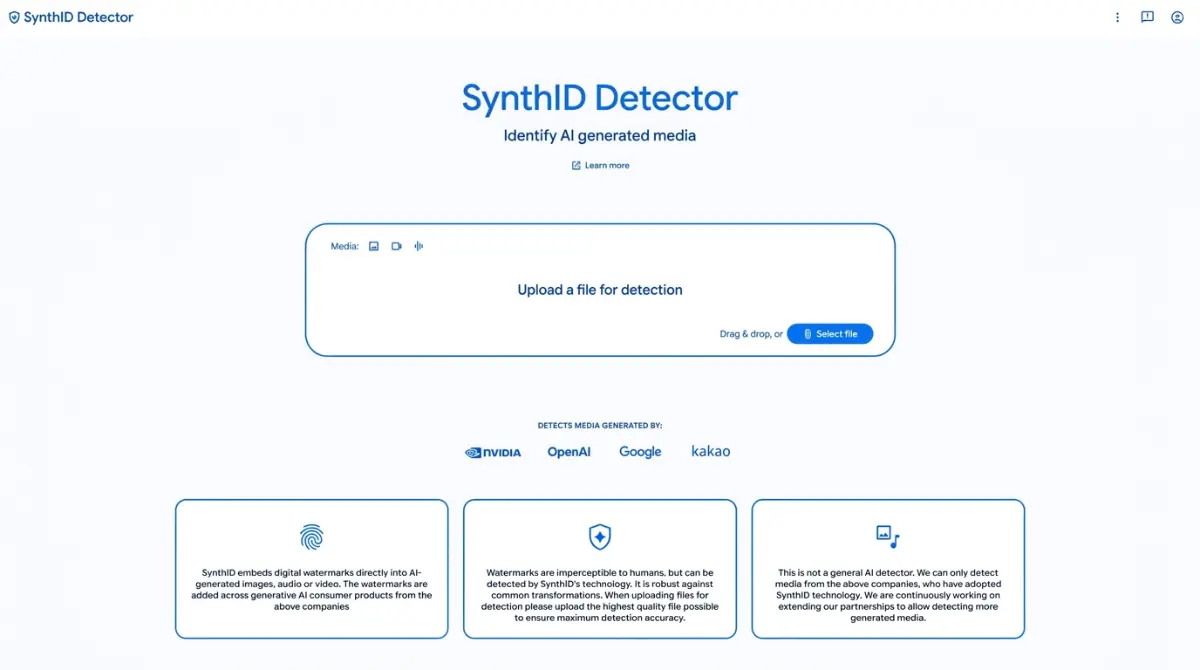
Google expanded its SynthID detection system worldwide in English to identify machine-made media across web formats, revealing that Apple will integrate its generative tools into the verification network later this year.
Oladipupo Ajayi | 7 Oct. 2026, 4:53 AM · 7 min read

Tracking synthetic media across the web has long felt like an uphill battle where regular internet users have zero reliable weapons. Anyone scrolling social feeds or opening messaging apps encounters realistic portraits, synthetic voice notes, and machine-rendered video sequences. Telling genuine human documentation from machine generation using human eyes or ears alone has become virtually impossible. While software developers previously confined watermark verification tools to private engineering consoles, Google changed that dynamic this week. On Wednesday, October 7, 2026, the company expanded its SynthID verification web portal globally in English, allowing anyone with an account to test whether uploaded media carries imperceptible watermarks. Crucially, the company revealed that the verification system will soon identify media generated by Apple models alongside existing partners.
The global rollout marks a major step forward for cross-company verification. The system does not merely scan for content produced by Google DeepMind tools like Imagen, Lyria, or Veo. It currently identifies synthetic markers embedded by systems from OpenAI, Nvidia, and South Korean web operator Kakao. Adding Apple to that lineup later this year brings millions of consumer devices into the same verification circle. Bringing high-volume consumer smartphone builders into a shared watermarking arrangement changes the stakes for digital verification. We followed how regulatory scrutiny and safety policies pressure software developers in our report on how an international panel demanded urgent safety rules without delay.
How SynthID Bypasses Metadata Vulnerabilities
To grasp why the global expansion of SynthID matters, one must examine why previous verification efforts consistently failed. Most online platforms attempted to track provenance by attaching digital certificates or file metadata to exported images. These solutions mimic paper luggage tags. The second a user takes a quick screenshot, applies a color filter, or re-uploads a picture to an encrypted messaging group, the tag gets stripped away instantly. Once that metadata vanishes, standard software treats the file as an untracked original.
SynthID takes a radically different route by modifying the raw mathematical fabric of the file itself. When a participating model generates a photograph, the algorithm introduces tiny, imperceptible variations directly into pixel values across the entire canvas. These modifications form an invisible mathematical pattern that remains readable even after heavy compression, cropping, or resolution changes. The same approach protects audio clips by weaving undetectable signals straight into the audio waveform. A person listening to a cloned voice clip hears natural speech cadence, yet the detector identifies the hidden frequency signature in seconds. We examined similar technical protection layers when reporting on how engineers build safety testing sandboxes to isolate automated code.
Why Apple Joining the Coalition Matters
The announcement that Apple will soon join the SynthID verification network marks a rare moment of technical alignment between fierce mobile competitors. The Cupertino company spent years constructing a closed hardware and software fortress, rarely integrating third-party detection hooks into its consumer ecosystem. Yet with Apple Intelligence rolling out image creation and audio generation tools across hundreds of millions of iPhones, iPads, and Mac computers, leaving those outputs unverified would leave a massive blind spot in global media tracing.
By bringing Apple into the SynthID fold, the detection portal gains coverage over one of the largest consumer hardware fleets on earth. When an iPhone owner creates a synthetic picture or modifies a photograph with generative features, the underlying operating system will stamp the output with compatible watermarks. Anyone encountering that file online can upload it to the detector and confirm its origins. The cooperation highlights how hardware vendors must balance competitive rivalries against shared public trust obligations. We examined how corporate relationships between these platform giants evolve in our coverage of Qualcomm renewing its patent license agreement with Apple.
Broad Format Support and Daily Usage Footprint
The expanded web tool accommodates an extensive list of standard consumer media formats. On the visual side, users can upload images saved as JPG, JPEG, PNG, BMP, WEBP, AVIF, HEIC, HEIF, TIFF, TIF, and GIF files. For motion pictures, the system accepts MP4, MOV, and WEBM video containers. Audio scans process WAV, MP3, OGG, FLAC, AAC, and M4A sound tracks. Providing broad format support ensures that everyday consumers do not need to convert file extensions before running an authenticity check.
Google noted that verification checks are already deeply integrated into existing web tools. Around one million verification checks run daily across Google Chrome browser menus, Google Search lookups, and Gemini chat prompts. Making the tool accessible via an open browser address broadens access beyond existing Google software power users. Journalists, independent researchers, and casual web users now possess a dedicated destination to evaluate questionable media without installing specialized browser extensions. The growing reliance on automated software checks mirrors patterns we analyzed when automated web requests began outnumbering human browsing traffic.
The Blind Spot: Unmarked and Open Models
Despite the technical sophistication of the platform, the service comes with an enormous caveat that users must understand: a negative result does not guarantee that a piece of media is authentic. SynthID functions as a matched detection system. It specifically seeks out the proprietary mathematical patterns inserted by compliant corporate models. If an image or voice note was built using an independent open model or created by a developer who disabled watermarking scripts, the detector finds nothing and reports no watermark.
This reality creates a serious information risk. An uneducated web user might upload a hyper-realistic fake image created by a malicious actor, receive a clean scan result, and wrongly conclude the image depicts a real historical event. The vast majority of deliberate misinformation campaigns rely on open models hosted on private servers precisely because those systems omit corporate guardrails and watermarks. Consequently, the detection site operates as a verification registry for compliant industry participants rather than a universal truth engine. The public anxiety surrounding synthetic media verification echoes themes we documented when surveys revealed rising user anxiety over machine generated content.
Privacy Safeguards and Data Retention Policies
Uploading personal files to an inspection server naturally introduces privacy concerns. Investigative reporters handling sensitive leaks or ordinary citizens verifying private family pictures want guarantees that their data will not be indexed or used to train commercial models. Google addressed these concerns by publishing explicit data retention policies for the tool.
According to the service terms, uploaded media files are deleted from active servers as soon as the analysis finishes. The company retains a digital fingerprint of the file for twenty-four hours to block denial-of-service attempts and monitor repetitive automated query spikes. Automated web scraping, bulk querying tools, and unauthorized scripts remain strictly prohibited on the public consumer interface. Enterprise organizations that require bulk scanning pipelines must purchase commercial cloud API access instead. Maintaining data boundaries remains a heated topic across the industry, similar to concerns we covered when critics raised privacy alarms over automated assistants scanning user messages.
The Looming Standard Battles
Google push to turn SynthID into the global default faces competition from rival corporate coalitions. Industry groups backed by Microsoft, Adobe, and Intel continue promoting cryptographic metadata frameworks like C2PA. While metadata and pixel watermarking can theoretically complement each other, technology companies routinely clash over which standard receives native integration inside web browsers and operating systems.
If Google cements SynthID as the standard for consumer verification, the company strengthens its position as the primary arbiter of web authenticity. Competing technology firms remain hesitant to depend on Google servers to validate their own outputs. How regulatory frameworks in Europe and North America treat these competing standards will dictate whether the industry converges on an open hybrid model or remains fragmented across corporate camps. We explored how international policymakers approach corporate technology oversight when European leaders rejected tech self-regulation proposals.
The Realities of Digital Authenticity
Expanding the SynthID verification tool globally and securing future participation from Apple represents meaningful progress in the fight against synthetic deception. Providing an accessible web portal gives everyday users a practical way to check media generated by the biggest commercial artificial intelligence models in the world.
Yet digital watermarking will always remain a partial defense. As long as independent coders can download unconstrained models to private workstations, bad actors will produce realistic synthetic media that bypasses corporate detectors completely. Verifying digital reality requires combining mathematical watermarks with critical human judgment, source corroboration, and healthy skepticism. The launch of Google global portal provides a valuable checkpoint, but the ultimate responsibility for spotting deception still rests with the human mind viewing the screen.
Read More on TechRobust:
Oladipupo Ajayi
 LinkedIn
Oladipupo Ajayi
Expertise:Artificial Intelligence, Machine Learning Trends, Data Infrastructure, Enterprise AI Strategy, Frontier Tech Commentary
Award:TechRobust AI & Data Voice of the Year 2025
Ola is an Editor-at-Large at TechRobust, delivering authoritative commentary, high-level analysis, and investigative features across the frontiers of machine intelligence and big data. He tracks frontier model developments, enterprise AI adoption, data governance, and the societal shifts driven by computational breakthroughs.