
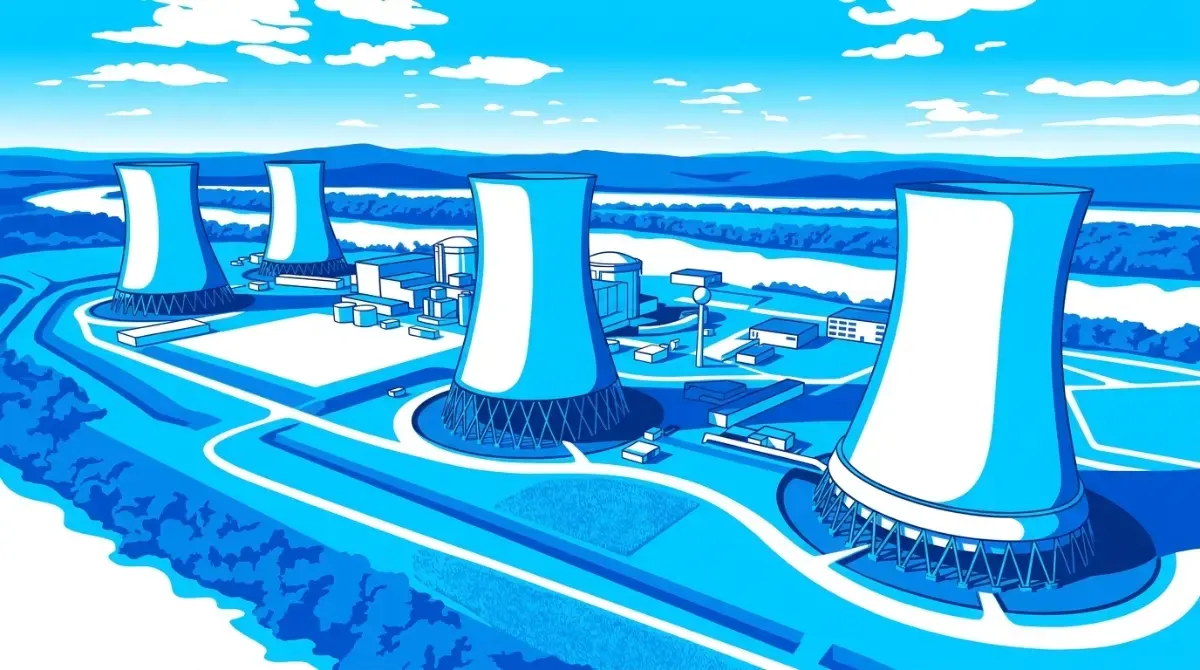


Google Signs 3.6 GW Deal With Constellation for Nuclear Power
Google finalized a 3.6 GW electricity agreement with Constellation Energy to secure 890 MW of upgraded nuclear capacity and 2,700 MW of regional generation across the PJM grid.
Umar Abubakar | 6 Oct. 2026, 10:07 AM · 8 min read

Big technology corporations are buying entire utility portfolios to keep their data centers running. For years, cloud operators bought renewable energy certificates from wind farms and solar installations, claiming green credits while drawing coal and gas electricity from local utility grids during night hours. As machine learning clusters multiply across North America, intermittent solar arrays cannot satisfy the nonstop electrical appetite of modern graphics processors. Computer chips need continuous voltage every second of every day. On Tuesday, October 6, 2026, Google answered that constraint by signing a commercial transaction with Constellation Energy covering 3,590 megawatts across the PJM Interconnection grid. The pact pairs a twenty-year nuclear power purchase agreement with a fifteen-year energy supply contract, guaranteeing massive power reserves for data center campuses across the Mid-Atlantic and Midwest.
The transaction provides financial backing for over $4.3B in direct capital investments by Constellation Energy. Rather than waiting a decade to build brand new atomic plants from scratch, the power company will upgrade 11 existing nuclear reactor units located across Illinois, Pennsylvania, and New Jersey. These physical reactor uprates will add 890 megawatts of fresh, zero-carbon electricity to the shared transmission system. The first upgraded megawatts are scheduled to reach the grid by 2028, with all 11 reactor enhancements finishing before 2032. Alongside the nuclear allocation, Google secured a separate contract covering 2,700 megawatts from Constellation broader generation fleet. The combined 3.6 gigawatts represents one of the largest corporate electricity purchases in modern industrial history. We followed how data facilities strain civic resources in our report on growing public scrutiny over server facility electrical consumption.
The Mechanics of Nuclear Reactor Uprates
To grasp why tech executives chose reactor uprates over new nuclear facilities, one must understand the regulatory roadblocks facing nuclear power. Building a new nuclear generating station in the United States takes over a decade, requires billions in upfront permits, and faces endless court challenges from local zoning boards. Power lines also face years-long interconnection queues managed by regional grid coordinators, meaning a finished power plant can sit idle waiting for permission to connect to public high-voltage lines.
Reactor uprates completely bypass these administrative roadblocks. An operating nuclear facility already possesses valid federal licenses, active water intake rights, established safety perimeters, and direct connections to regional transmission lines. By swapping out older steam generators, replacing turbines with aerodynamic blades, installing modern digital control instrumentation, and re-licensing core thermal thresholds, technicians can extract ten to fifteen percent more electrical output from the exact same reactor vessel. Gaining 890 megawatts through hardware uprates adds electricity equal to a brand-new commercial atomic reactor without digging a single new foundation. Engineering teams complete the upgrades during scheduled refueling outages, bringing clean capacity online years faster than greenfield construction. Similar infrastructure bottlenecks were evaluated in our report on how water constraints threaten multi-billion dollar server campuses.
Defending the PJM Grid Against Blackouts
The geography of the agreement is critical to American digital commerce. The PJM Interconnection operates the largest electrical grid in North America, coordinating wholesale electricity across thirteen states and the District of Columbia. That footprint covers Northern Virginia, known across the global telecommunications industry as Data Center Alley. More than seventy percent of worldwide internet traffic routes through server warehouses located in Loudoun and Fairfax counties. The sudden concentration of artificial intelligence clusters in this single regional corridor has pushed transmission lines to maximum thermal ratings.
PJM officials recently cautioned that incoming corporate power demand could outpace regional generation by 2029, raising the possibility of rolling summer brownouts for residential neighborhoods. Local public utility commissions faced furious complaints from homeowners whose monthly electrical bills jumped to finance grid upgrades for commercial tech parks. By funding 890 megawatts of new generation and contracting 2,700 megawatts of steady fleet capacity, Google is adhering to the Bring Your Own Power framework promoted by regional transmission operators. The technology company is underwriting the expansion of the shared pool rather than simply buying up existing power and leaving suburban households to absorb price spikes. How electrical grids respond to rising technical loads was explored when human error proved more hazardous to energy systems than automated software.
The Race for 24-7 Carbon-Free Energy
The Constellation partnership marks a shift away from standard carbon-offset accounting toward true around-the-clock clean power. Under legacy corporate sustainability targets, a corporation would purchase solar power in California at noon, match that total volume against server consumption in Virginia at midnight, and claim net-zero emissions on annual marketing brochures. That paper accounting hid the fact that server halls consumed natural gas and coal power whenever the sun set or wind speeds dropped.
Google has committed to running all data centers on hourly matching by 2030, meaning every single kilowatt consumed by a server hall must be matched by clean generation on the exact same regional grid during that specific sixty-minute window. Nuclear energy provides the only scalable baseload power source capable of operating continuously at ninety-five percent capacity factors without burning fossil fuels. The commercial push to secure atomic baseload matches steps taken by rival cloud operators, including Microsoft contract with Constellation to restart the shuttered Three Mile Island Unit 1 reactor in Pennsylvania, and Amazon procurement of nuclear power from Talen Energy Susquehanna facility. We examined how massive investments shape server infrastructure when covering nuclear power facing the ultimate test in data center expansion.
Commercial Details and Revenue Certainty
While the press announcements highlighted the 890 megawatts of fresh nuclear output, the larger 2,700-megawatt portion of the agreement provides critical revenue stability for Constellation Energy. That fifteen-year block of power is not tied to one single generating station. It allows the utility to supply power from its wider Mid-Atlantic fleet, which includes nuclear facilities as well as natural gas peaking stations. This broad structure gives Constellation guaranteed cash flows for over a decade, shielding its operating balance sheet from wholesale electricity price drops.
In exchange, Google receives fixed energy pricing, hedging its data operations against volatile fuel costs during extreme weather freezes. Financial terms, including the exact price per megawatt-hour, remain undisclosed under commercial non-disclosure agreements. However, Wall Street analysts project the total contract value easily reaches into the billions over its multi-decade duration. The agreement also includes a five-year corporate software pact, where Constellation will deploy Google Cloud tools and Gemini models to improve site selection, monitor sensor readings on operating turbines, and protect operational technology networks against external cyber attacks. The heavy financial commitments behind digital compute clusters mirror developments we detailed when Oracle delayed massive data center payments over power supply fights.
Economic Windfalls Across Midwestern Industrial Towns
The $4.3B capital injection will flow directly into industrial communities that experienced decades of manufacturing decline. Constellation operates six commercial nuclear stations across Illinois, Pennsylvania, and New Jersey that will host the upgrade work. The company confirmed the agreement will sustain approximately 4,400 permanent high-skilled union engineering and maintenance positions across those host towns.
The construction phase will generate roughly 7,200 temporary construction jobs as pipefitters, welders, electricians, and instrumentation specialists install heavier equipment inside turbine buildings. Local school districts and county governments depend heavily on commercial property tax payments from operating nuclear stations. Extending the operational life of these facilities through long-term corporate power purchase agreements ensures steady tax revenues for civic services, fire departments, and public roads. The physical scaling of hardware facilities across rural regions was detailed in our report on Crusoe securing a $3B funding round for data centers.
Operational Load Shaping and Demand Flexibility
A notable technical provision inside the Google agreement involves demand-response coordination. Modern artificial intelligence training runs require enormous power, but they do not always require millisecond execution. If an extreme winter freeze or summer heatwave strikes the Mid-Atlantic, pushing regional residential electricity demand to critical peaks, Google software systems can throttle back non-critical computing tasks.
By temporarily reducing the electrical draw of model training clusters, the company frees up generation capacity for public hospitals and residential homes on the PJM system. In return, the utility grants preferential pricing during low-demand night hours. This operational flexibility turns data centers from passive electrical drains into active grid-balancing assets. The engineering required to build adaptable electrical networks mirrors broader industrial software trends we tracked when analyzing how Metris Energy automated commercial solar portfolios.
The New Realities of Industrial Computing
The 3.6-gigawatt agreement between Google and Constellation demonstrates that the artificial intelligence race has left the digital sphere and entered the heavy industrial sector. A technology enterprise cannot dominate machine learning by writing clever algorithms alone; it must secure gigawatts of physical electrical power, negotiate multi-decade contracts with public utilities, and finance turbine upgrades inside atomic power stations.
As cloud providers spend hundreds of billions on compute infrastructure, the companies controlling operating nuclear reactors hold enormous commercial leverage. The digital economy cannot function without physical electricity, and solar panels alone cannot power the machines driving tomorrow models. By locking up 11 nuclear reactors across three states, Google ensured that while its competitors hunt for scarce power lines, its own server racks will hum with continuous atomic energy for decades to come.
Read More on TechRobust:

Umar Abubakar
 LinkedIn
Umar Abubakar
Expertise:Editorial Leadership, Product Design (UI/UX), Digital Media Strategy, Technology Systems, Product Architecture
Award:TechRobust Visionary Leader of the Year 2025
Umar serves as Editor-In-Chief and CEO of TechRobust, combining editorial vision with senior product design expertise to shape how modern technology stories are built, packaged, and told. Overseeing all editorial verticals, he directs coverage across global and regional tech landscapes while applying deep design thinking to publication strategy and reader experience.