
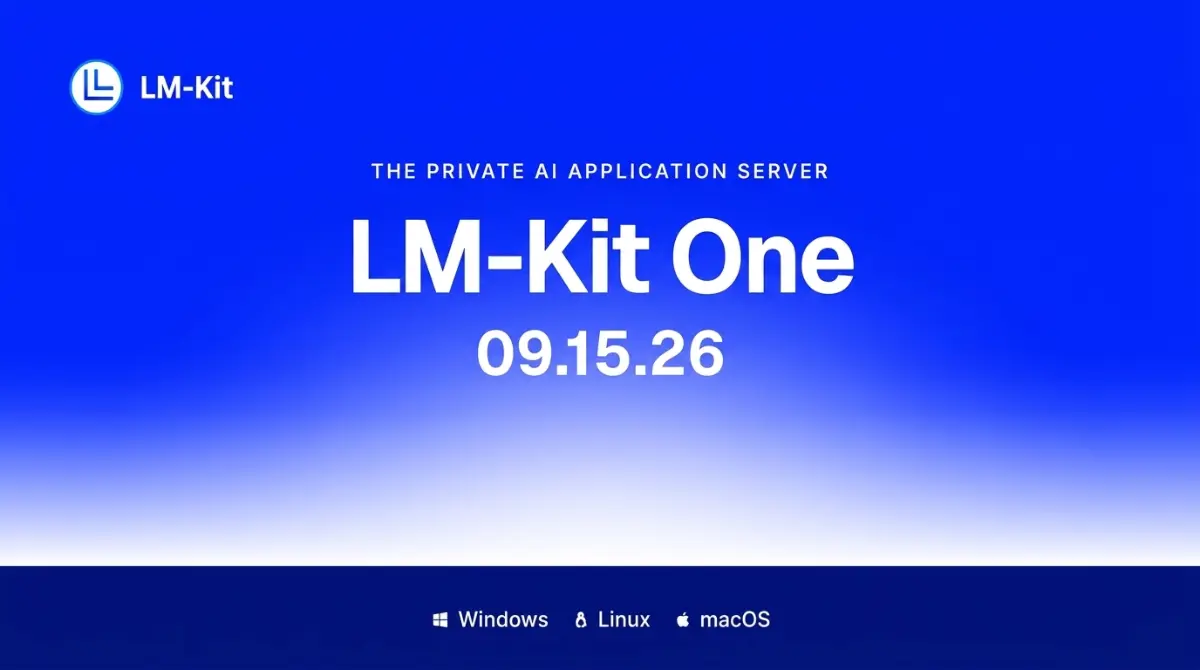


LM-Kit Debuts LM-Kit One Private AI Application Server
French software developer LM-Kit introduced LM-Kit One on Tuesday, offering a self-contained server package that runs local models and retrieval pipelines without third-party cloud leaks.
Umar Abubakar | 15 Sept. 2026

Walk through the server rooms of regional hospitals, commercial banks, or European municipal offices, and you will spot a persistent technological standoff. Corporate software vendors keep insisting that genuine automation requires streaming every document, email thread, and client record into multi-tenant public server clusters across North America. IT directors nod politely during product demonstrations, watch slides depicting miraculous cloud agents, and immediately slam their checkbooks shut. They know that handing unredacted customer files or proprietary medical scans to third-party endpoints violates domestic privacy statutes, central bank security mandates, and basic corporate governance. On Tuesday, September 15, 2026, French software developer LM-Kit stepped directly into that privacy standoff, launching LM-Kit One, an on-premise application server engineered to run local reasoning models, retrieval pipelines, and autonomous agents entirely behind corporate firewalls.
The product release, introduced by parent group Calico IIM, offers an all-in-one alternative to the sprawling software architectures teams traditionally stitch together to achieve private computing. Rather than forcing corporate engineers to configure separate vector databases, independent document parsers, isolated model runners, and custom API gateways, the platform combines model execution, optical character extraction, document chunking, hybrid retrieval, and agent permission rules into a single binary. The software runs across Windows, Linux, and macOS environments, operating either as a background operating system service or inside containerized clusters. You can examine how enterprises protect local computing nodes against autonomous software breaches by reviewing our report on how CrowdStrike and OpenAI expanded their partnership to secure autonomous agents.
Dismantling the Fragile Open-Source Glue Stack
To grasp why enterprise engineers dread building private computing systems today, you have to look at the maintenance nightmare known as the open-source glue stack. When an engineering division decides to run an open-weight model on private hardware, the project quickly spirals out of control. Developers must pull one framework to host model weights, install another tool to parse scanned PDF forms, configure a separate database to index text embeddings, and write thousands of lines of glue code to connect everything together. Every component carries its own software dependencies, update cycles, and security holes. When one library introduces an incompatible update, the entire operational pipeline crashes.
LM-Kit One eliminates that fragile patchwork by packaging twelve distinct infrastructure tasks into a unified server engine. Developed over four years with more than 150 software releases, the platform handles optical character recognition for paper records, converts layout hierarchies into structured text, runs BM25 lexical and vector searches side by side, and extracts schema-constrained data with confidence indicators. Founder Loïc Carrère noted that modern organizations should never have to surrender control of their sensitive records simply to access computational reasoning. By unifying document processing and inference into a tested binary, the platform cuts implementation schedules from six months down to an afternoon. We tracked how software vendors adapt internal workflows to reduce administrative friction in our analysis of Wipro freeing capacity equivalent to 20,000 workers via automated tools.
Native Dialects and Model Context Protocol Support
Where the platform separates itself from isolated research tools is its approach to enterprise integration. Many private tools force engineering teams to abandon existing client software and learn proprietary programming hooks. LM-Kit One circumvents that friction by speaking the common communication languages of modern software engineering. The server ships with native translation endpoints compatible with OpenAI, Anthropic, and Ollama client libraries, allowing existing software tools, coding assistants, and browser extensions to point at local IP addresses without rewriting code.
Crucially, the server provides full support for the Model Context Protocol, the open communication standard gaining traction across autonomous software tools. When an external desktop assistant requests a document search, financial calculation, or redaction task, it sends the request through a local protocol pipeline. The local server processes the file inside corporate memory, applies strict access controls, and returns only the finalized answer to the assistant. The underlying source document never leaves the protected network perimeter. This architectural wall satisfies strict data residency requirements, a regulatory shift we detailed when reporting on how Africa data protection rules reshape regional tech regulation.
A Commercial Model Designed for Distribution
The company paired its technical rollout with a disruptive distribution policy aimed squarely at independent software developers and growing businesses. The software is available for download without registration gates, product license keys, or activation handshakes. Teams can evaluate the software indefinitely without artificial feature caps. Furthermore, production deployment remains completely free for organizations generating under $1M in annual gross receipts, employing ten or fewer workers, and holding under $3M in outside venture capital.
For larger commercial entities, government departments, and independent software vendors packaging local reasoning capabilities into commercial products, the company offers paid commercial licenses backed by long-term maintenance agreements and technical support commitments. By making local software evaluation frictionless, the company is betting that grassroots developer adoption will outpace the top-down enterprise sales cycles favored by cloud monopolies. Private ventures are increasingly navigating competitive enterprise markets by offering transparent software packaging, a founder dynamic we examined when Norwest partners evaluated founder commercial execution before backing.
The Geopolitical Push for Computational Sovereignty
The arrival of dedicated private server platforms aligns with an intensifying push across Europe and allied nations to establish sovereign digital control. Over the past three years, European institutions have watched with growing discomfort as American hyperscale cloud giants tightened their grip on corporate data processing. Passing protective data statutes does little good if domestic businesses have no viable alternative to foreign server centers.
Platforms like LM-Kit One prove that modern reasoning tools do not require round-the-clock internet connections to deliver enterprise value. As open-weight foundational models shrink in physical size and gain mathematical reasoning power, running high-performance models on standard workplace workstations and private server racks becomes an achievable reality for regional businesses. The technology sector spent a decade convincing corporate leaders that the public cloud was the only path forward. Now, a growing wave of pragmatic software designers is proving that true enterprise autonomy starts when you unplug the cable, close the firewall, and run the machine on your own terms.
To inspect the technical documentation, API coverage references, and deployment packages for this private application server, you can visit VentureBeat.
Read More on TechRobust:
Umar Abubakar
 LinkedIn
Umar Abubakar
Expertise:Editorial Leadership, Product Design (UI/UX), Digital Media Strategy, Technology Systems, Product Architecture
Award:TechRobust Visionary Leader of the Year 2025
Umar serves as Editor-In-Chief and CEO of TechRobust, combining editorial vision with senior product design expertise to shape how modern technology stories are built, packaged, and told. Overseeing all editorial verticals, he directs coverage across global and regional tech landscapes while applying deep design thinking to publication strategy and reader experience.