


Big Federal Tax Breaks Target Rural AI Data Centers
The federal government is offering massive corporate tax discounts to incentivize the construction of heavy computing infrastructure in low income agricultural regions, sparking intense political resistance from local communities.
Umar Abubakar | 4 Oct. 2026 · 6 min read

The push to build massive computing facilities is moving away from traditional urban technology hubs and spilling directly into agricultural regions. Hardware developers desperately need open land and cheap electricity to run thousands of advanced processors. To encourage this rural expansion, the federal government recently passed the One Big Beautiful Bill Act. This legislation completely rewrites the existing Opportunity Zones program, unlocking massive tax benefits for technology corporations willing to construct server farms in low income rural census tracts starting January 1.
The original Opportunity Zone program passed during the first Donald Trump administration to stimulate struggling local economies. The updated legislation specifically targets rural infrastructure. By granting heavy corporate tax discounts, lawmakers hope to bring modern construction and high paying jobs to forgotten agricultural towns. A recent study published by the Searchlight Institute evaluated these newly designated rural zones against active construction permits. The researchers identified over one hundred computing facilities currently being built that could immediately qualify for these federal financial incentives. Some industry estimates suggest the total number of planned rural projects sits closer to one thousand.
This massive migration toward agricultural land marks a structural shift in how internet infrastructure operates. A separate study conducted by Pew Research noted that only thirteen percent of currently active server farms sit in rural locations. In stark contrast, rural zones account for nearly sixty seven percent of all planned future sites. The technology sector simply ran out of physical space and electrical capacity near major cities. We saw this exact physical limitation halt corporate expansion recently when water constraints threatened multi billion AI server campuses located in traditional urban zones.
Public Backlash and the Ghost Town Effect
While federal politicians celebrate the promised economic boom, local residents view the incoming technology giants with heavy suspicion. A server farm is not a traditional factory. A single facility might consume enough electricity and fresh water to power a small city, yet it only requires a few dozen technicians to maintain operations once construction finishes. Local advocacy groups argue these developments deliver a ghost town effect, where the community surrenders its agricultural land and utility grid stability in exchange for a massive, silent warehouse that generates almost zero local employment.
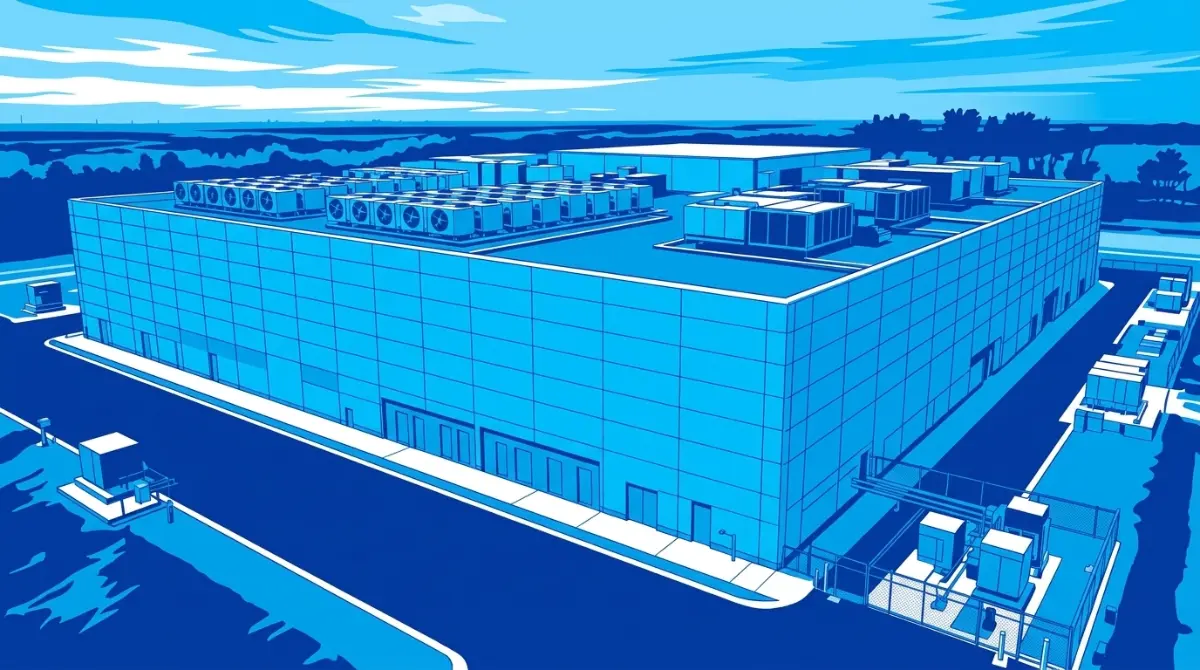
The environmental and physical costs are immediate. Neighboring residents frequently complain about the relentless, high pitched noise generated by massive industrial cooling fans running twenty four hours a day. The extreme electricity demands also trigger rate hikes for local homeowners. Expanding high voltage transmission lines to reach a remote server farm requires utility companies to spend millions, costs that are eventually passed down to the average consumer. This friction between private computing demands and public utility stability mirrors the conflict we documented when Oracle delayed $1.65B data center payments over a power fight.
Conservative lawmakers are starting to notice the rural backlash. Senator Josh Hawley recently introduced legislation attempting to block computing facilities from receiving any Opportunity Zone funding. He argued that offering federal tax discounts to the wealthiest technology monopolies to pave over productive farmland hurts domestic agriculture. The political resistance proves that building digital infrastructure is no longer an invisible process. Local voters are organizing to block permits, sue zoning boards, and enact construction moratoriums.
Hyperscalers Reject the Financial Assistance
Despite the available federal cash, the largest corporations claim they are ignoring the tax program completely. When questioned by journalists, representatives from Microsoft, Meta, and Amazon explicitly denied using the revised Opportunity Zone benefits to dictate their real estate purchases. Microsoft legal counsel Rima Alaily confirmed the company does not utilize the program to buy land. Amazon representatives echoed this stance, stating they select locations based strictly on electrical grid capacity, land availability, and access to skilled labor, completely independent of specific tax incentives.
This public rejection of federal money highlights a fascinating corporate strategy. The largest technology firms already face intense scrutiny regarding their market dominance and aggressive tax accounting. Taking federal subsidies meant for struggling rural communities creates a terrible public relations narrative. Additionally, these companies possess enough cash reserves to build their facilities without government assistance. They are actively trying to avoid the political spotlight. The industry already faced extreme public anger earlier this year when the White House cleared data centers to pollute local air during emergency peak hours. Avoiding another controversial federal handout is a smart defensive move.
Despite these claims, academic researchers suspect the tax benefits play a larger role than the corporations admit. Nathan Jensen, a public policy professor at the University of Texas, expressed extreme skepticism regarding the corporate denials. While a company might not pick a site solely for the tax discount, ignoring a massive financial incentive during the final planning stages makes zero business sense. Establishing the necessary investment structure to claim the benefits requires complex legal maneuvering, and because internal tax filings remain confidential, proving whether a company actually claimed the discount remains difficult for outside observers.
The Economics of Silicon Real Estate
Building the hardware required for modern reasoning algorithms is incredibly expensive. Securing land, laying optical cables, and installing specialized liquid cooling systems pushes the cost of a single facility into the billions. Smaller infrastructure companies and independent cloud providers will absolutely utilize the new federal tax breaks to remain competitive against the massive hyperscalers. If a mid tier hosting company can shave twenty percent off their construction costs by building in a designated rural zone, they will take the money without hesitation. We observed this intense scramble for private infrastructure capital when Crusoe secured a $3B funding round at a $30B valuation for data centers.
The global race to build physical computing networks is redefining international real estate. Countries and states are actively competing to attract these massive construction projects, offering cheap land and relaxed environmental regulations. We tracked this global competition recently when Finland became a Europe data center hub with $30.2B in foreign bets. The rural American tax break is simply the domestic version of this exact same strategy. The government wants to ensure the hardware powering the next generation of software is physically located within the United States.
The updated Opportunity Zone program will face severe testing over the next twelve months. As heavy construction equipment arrives in quiet agricultural towns, the conflict between rural preservation and technological progress will escalate. The technology sector desperately needs the electricity and the acreage. The federal government is perfectly willing to subsidize the expansion. The only remaining question is how loudly the local residents will fight back when the silent warehouses replace their open fields.
Read More on TechRobust:

Umar Abubakar
 LinkedIn
Umar Abubakar
Expertise:Editorial Leadership, Product Design (UI/UX), Digital Media Strategy, Technology Systems, Product Architecture
Award:TechRobust Visionary Leader of the Year 2025
Umar serves as Editor-In-Chief and CEO of TechRobust, combining editorial vision with senior product design expertise to shape how modern technology stories are built, packaged, and told. Overseeing all editorial verticals, he directs coverage across global and regional tech landscapes while applying deep design thinking to publication strategy and reader experience.