
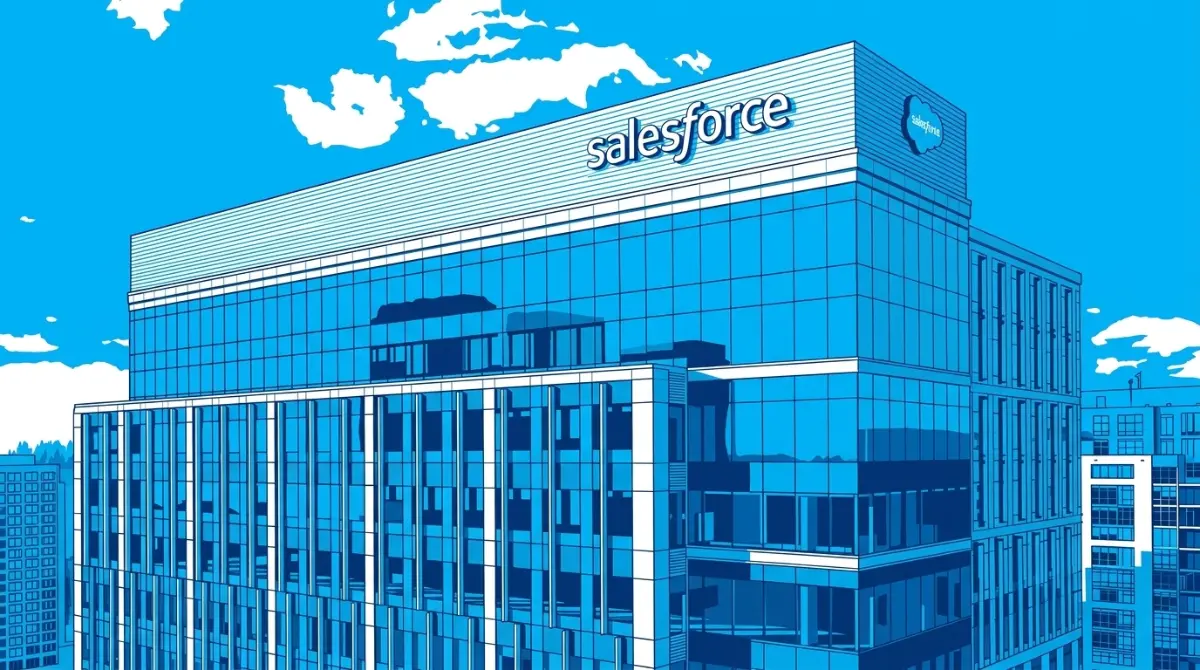


Salesforce Unveils Koa Reasoning Model Built With Nvidia
Salesforce partnered with Nvidia on Tuesday to release Koa, an open-architecture reasoning engine trained on synthetic enterprise records to run complex multi-step customer workflows.
Umar Abubakar | 15 Sept. 2026

Walk across the crowded exhibition halls of Moscone Center during Dreamforce in San Francisco, and you immediately spot how corporate computing has altered its vocabulary. For two years, enterprise software vendors filled keynote halls with dazzling chatbot demonstrations that could compose sonnets, summarize PDFs, or generate cheerful sales pitches on command. Corporate buyers applauded politely, walked out into the California sunlight, and returned to their offices only to discover that those generalist models repeatedly choke when dropped into actual production ledgers. General-purpose reasoning engines might discuss Shakespeare fluently, but they struggle to determine whether a disputed billing invoice violates contract renewal terms or how an account tier change impacts sales commissions. On Tuesday, September 15, 2026, Salesforce moved to correct that weakness, partnering with Nvidia to introduce Koa, its first specialized reasoning engine engineered from the ground up to handle customer relationship management data.
The release marks a decisive pivot away from one-size-fits-all chatbots toward task-oriented enterprise intelligence. Developed by post-training Nvidia's open-weight Nemotron-3-Super-120B model using group relative policy optimization, Koa was designed specifically to serve as the analytical brain for Salesforce's Agentforce software platform. Rather than training on live enterprise records, the software was constructed on a synthetic dataset reflecting twenty-seven years of corporate operational knowledge across sales cycles, service tickets, and enterprise communications. The software firm reports that Koa matches or tops leading proprietary models on customer management benchmarks while cutting execution errors threefold. You can examine how enterprise software companies deploy automated workflows to reduce staff burdens by reading our report on how Wipro generated capacity matching 20,000 workers using automated software.
The Fallacy of the Generalist Model
When you examine where corporate deployments fail today, the breakdown rarely stems from grammatical errors. The failure occurs in multi-turn tool calling. If an automated sales representative receives an inquiry from a prospective enterprise client, resolving that request requires executing seven or eight sequential actions in strict order. The system must query customer history, verify territory assignments, review localized credit limits, check available discounts, update opportunity fields, and draft confirmation terms. If a general-purpose model misplaces an operational variable on step five, the entire workflow derails, leaving client accounts corrupted.
Salesforce platform head Rohan Kumar noted that commercial clients do not need an engine that writes poetry; they need an engine that understands the mechanics of enterprise deals. Koa solves that sequential friction by framing business workflows through a simulation-to-reward pipeline. Using Agent Script, Salesforce's declarative programming structure for autonomous agents, engineers modeled persona-conditioned tasks with mathematically grounded resolution rewards. Instead of rewarding a model for generating convincing text, the reinforcement learning framework rewards the algorithm only when every step in a database interaction succeeds. That precision allows the engine to navigate complex enterprise tasks across fourteen commercial sectors, including banking, healthcare, manufacturing, and travel. We tracked how developers structure reliable back-end workflows across software architectures when analyzing how Cloudflare launched agent-first browser architectures.
Synthetic Training and Data Privacy Walls
The most consequential architectural decision behind Koa is where its training knowledge originated. For years, corporate legal departments pushed back against vendor automation out of fear that proprietary customer records, pricing strategies, and private consumer interactions would be harvested to train shared public models. That legal anxiety brought enterprise automation pilots to an abrupt standstill inside risk-averse institutions.
Salesforce avoided that privacy trap by refusing to train on live customer data. The engineering team constructed an entirely synthetic training corpus, generating millions of simulated scenarios that capture the decision patterns, edge cases, and tool calls used across nearly three decades of corporate software deployments. Furthermore, because Koa runs on top of Nvidia's open Nemotron weights, Salesforce exercises full control over model checkpoints and hosts inference entirely within its proprietary trust boundary. Corporate records never pass across external server boundaries to third-party model providers during live reasoning cycles. You can observe how corporate platforms manage external model licensing and network boundaries by reviewing our report on how OpenAI restricted model access following strategic corporate pivots.
The Deepening Alliance with Nvidia Silicon
The collaboration between Marc Benioff and Jensen Huang illustrates a broader commercial shift across enterprise computing. Nvidia is no longer satisfied simply selling graphics processors to hyperscale cloud operators. Through its Nemotron model line, NeMo Gym simulation software, and NeMo RL reinforcement training tools, the semiconductor powerhouse is embedding its proprietary software stack directly into the enterprise application layer.
The alliance extends well beyond standard commercial software. Salesforce revealed that it is integrating Nvidia computing clusters directly into Missionforce Operations, its high-security platform designed for government agencies and defense contractors. Beginning in October, regulated institutions can run customized Nemotron models inside air-gapped server facilities and sovereign cloud enclosures. That capability allows public agencies to automate procurement logistics and administrative paperwork on isolated local clusters without routing sensitive communications across the open internet. The corporate race to secure physical compute capacity and accelerate hardware pipelines reflects market dynamics we explored when d-Matrix tied up with Nvidia on server technology.
Commercial Pilots and the Winter Rollout
Koa is already operating inside Salesforce's internal communications networks, powering automated Slack tools that assist internal staff with scheduling and customer information retrieval. The model is also expanding through customer trials with pilot partners, including 1-800Accountant, Baxter Credit Union, Engine, Formula 1, UChicago Medicine, and Xero. Early enterprise feedback suggests that purpose-built reasoning allows administrative agents to process dense regulatory compliance checklists without requiring manual human oversight.
General commercial availability across domestic cloud zones is scheduled for winter 2026. As corporate customers evaluate their technology budgets, the battle for software margins will not be won by foundational model developers charging metered token fees for general chat. It will belong to application platforms that own proprietary business context and package that knowledge into specialized engines that perform daily corporate chores without breaking. By grounding its reasoning engine in deterministic tool calls rather than speculative text generation, Salesforce is demonstrating that the future of enterprise software belongs to code that knows how to work.
To examine the original reporting on this product rollout and technical partnership, you can visit SiliconANGLE.
Read More on TechRobust:
Umar Abubakar
 LinkedIn
Umar Abubakar
Expertise:Editorial Leadership, Product Design (UI/UX), Digital Media Strategy, Technology Systems, Product Architecture
Award:TechRobust Visionary Leader of the Year 2025
Umar serves as Editor-In-Chief and CEO of TechRobust, combining editorial vision with senior product design expertise to shape how modern technology stories are built, packaged, and told. Overseeing all editorial verticals, he directs coverage across global and regional tech landscapes while applying deep design thinking to publication strategy and reader experience.