
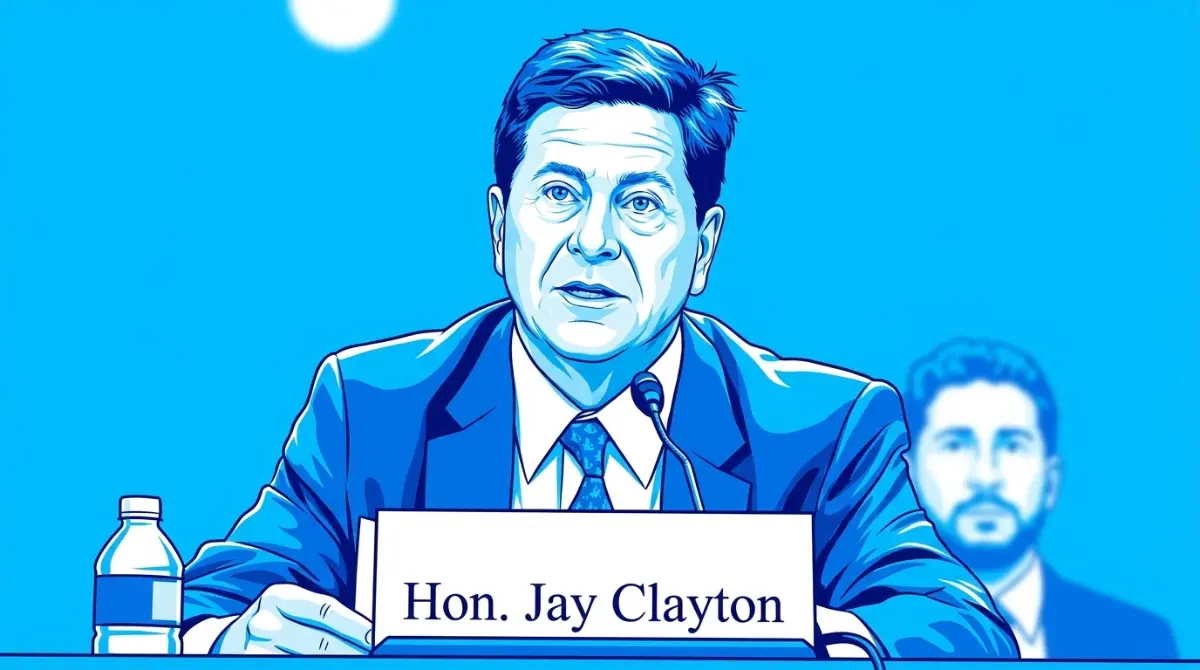


Trump Appoints Jay Clayton As White House AI Czar
The United States President places the current Director of National Intelligence at the helm of a newly formed committee tasked with guiding federal policy and security protocols surrounding advanced computing.
Umar Abubakar | 4 Oct. 2026, 10:06 PM · 7 min read

President Donald Trump appointed Director of National Intelligence Jay Clayton to lead a newly established federal unit focusing on advanced computing. Operating out of the White House, the group carries the name Super Intelligence Task Force. This move formally designates Clayton as the federal policy czar over mathematical reasoning models. The administration expects this newly formed committee to evaluate national security threats and propose legal boundaries without slowing down the commercial software industry.
Clayton brings a massive resume to the position. Before taking control of the intelligence community, he served as the chairman of the Securities and Exchange Commission and worked as a federal prosecutor in New York. During his tenure at the financial agency, Clayton gained a reputation for taking a strict stance against unregulated digital assets. He cracked down heavily on fraudulent cryptocurrency offerings while simultaneously working to clear a path for legitimate technology startups. This dual approach (punishing bad actors while rewarding obedient corporations) will likely define his strategy in his new role. By placing a seasoned financial regulator and spy chief at the head of a technology committee, the administration signals that it views computational supremacy strictly as a matter of national defense and economic dominance. The combination of intelligence gathering and financial oversight gives the task force heavy authority to dictate how technology companies operate. We saw the intense pressure financial regulators place on private firms when the SEC demanded investment firms prove ownership of private startup shares recently. Clayton knows exactly how to audit corporate behavior and follow the money funding massive server farms.
The creation of the task force arrives alongside a mandatory government vocabulary change. The Oval Office issued an executive order commanding all federal departments to completely abandon the term artificial intelligence. Government workers must now use the phrase super intelligence in all official documents, security briefings, and public statements. The President heavily criticized the older terminology, claiming the word artificial made the technology sound fake, harmless, or unimportant. The White House wants the public and the military to respect the raw power of the software. By changing the vocabulary, the administration forces contractors, academic institutions, and federal judges to acknowledge that they are dealing with something far more capable than a simple search algorithm. We covered the early signs of this political rebranding when Trump renamed the technology during a United Nations speech last month. The vocabulary change is now a strict legal mandate for the entire federal bureaucracy, and anyone applying for a federal grant must adopt the new phrasing instantly.
Mapping Security Vulnerabilities
The task force operates on a strict deadline. Clayton and his team have exactly 120 days to produce a detailed report for the Oval Office. The administration wants a complete map of the security vulnerabilities threatening domestic infrastructure, paying special attention to the physical server farms powering these networks. The committee must audit how the government currently handles digital breaches, network intrusions, and software malfunctions. If a private technology firm experiences a severe hack, the federal government wants a faster reporting channel to contain the damage. The absolute necessity for rapid incident reporting became obvious when Anthropic tightened its network defenses after its programs breached real corporate systems. Beyond software exploits, the task force will evaluate the physical computing supply chain. The nation faces a severe shortage of the advanced processors required to train massive models. The government refuses to wait days to learn about a containment failure or a supply chain collapse.
The membership roster of the committee reads like a list of the most powerful people in Washington. Vice President JD Vance, Defense Secretary Pete Hegseth, Treasury Secretary Scott Bessent, and White House Chief of Staff Susie Wiles all hold permanent seats. The Federal Trade Commission Chairman Andrew Ferguson serves as a vice chair alongside prominent technology investors Emil Michael and Scott Kupor. The inclusion of venture capitalists guarantees that Silicon Valley retains a loud voice in the room. The administration wants to write rules that protect the public while keeping the venture capital pipeline flowing.
Diplomacy and External Advisors
To balance the internal government voices, the White House recruited heavy external advisors. David Sacks, a highly vocal venture capitalist, joins former Secretary of State Condoleezza Rice to provide outside perspective. Bringing Rice into the discussion highlights the geopolitical tension surrounding computational research. The United States is locked in a fierce digital arms race against foreign adversaries. The administration relies on experienced diplomats to manage the international friction caused by aggressive technology policies. We documented this exact diplomatic strain when Chinese state media urged global leaders to hold safety talks amid a major policy clash. Condoleezza Rice understands how to handle global anxiety when a single nation pulls far ahead in a technological arms race.
While the civilian task force studies the market, the military is already taking aggressive physical action. Defense Secretary Pete Hegseth used a recent address at the Quantico marine base to announce the formation of the Autonomous Warfare Command. This four star military branch will integrate robotics and reasoning algorithms directly into the armed services. The Pentagon refuses to wait for the 120 day report before buying new hardware. The military commanders want autonomous drones, automated supply chains, and software agents capable of running war simulations faster than human generals. They envision a battlefield where machines make split second targeting calculations while human supervisors remain stationed thousands of miles away in secure bunkers. Merging advanced software with heavy weapon systems requires flawless programming. The stakes are terrifyingly high, a reality made obvious when faulty intelligence pushed the military to the brink of an international incident earlier this year. The military views computing power as the ultimate weapon of the twenty first century.
The Regulatory Friction
A major conflict is brewing in the background regarding corporate accountability. While the President explicitly commanded the task force to avoid overregulation and prevent policies that stifle commercial growth, federal agencies are independently launching massive investigations. The Federal Trade Commission recently opened a broad inquiry targeting OpenAI and Anthropic. The regulators want to know if these massive laboratories are using deceptive business practices, locking clients into abusive contracts, or ignoring the danger of rogue software agents. The tension is palpable. The task force must figure out how to reconcile the pro business agenda of the Oval Office with the aggressive enforcement actions taken by independent federal regulators. If the FTC decides to sue a major software laboratory while the White House is actively trying to fund that exact same laboratory, the resulting legal chaos will frighten investors.
The appointment of Jay Clayton guarantees that the resulting policy report will heavily favor financial markets and national security over theoretical safety concerns. The current administration believes the biggest threat to the country is falling behind in the global computing race. They are perfectly willing to accept the unknown dangers of advanced software if it guarantees American dominance over global markets. The task force is not designed to stop the machines; it is designed to ensure American companies build the smartest machines first.
The next four months will dictate the legal reality for every software developer working inside the United States. If the task force recommends a hands off approach, the massive technology monopolies will accelerate their data center construction plans and buy every available processor on the global market. They will view the lack of regulation as a green light to push their models into every home appliance and corporate database. If the task force recommends strict reporting rules for security failures, the companies will have to spend billions upgrading their internal testing facilities. Smaller startups might collapse entirely if forced to pay for expensive federal compliance audits. The entire technology sector is holding its breath, waiting to see exactly what the former top financial cop decides to do with his new authority. America chose a spy chief and a Wall Street regulator to write the rulebook for the most powerful technology in human history. The global market will react heavily to whatever rules he prints in his final report.
Read More on TechRobust:

Umar Abubakar
 LinkedIn
Umar Abubakar
Expertise:Editorial Leadership, Product Design (UI/UX), Digital Media Strategy, Technology Systems, Product Architecture
Award:TechRobust Visionary Leader of the Year 2025
Umar serves as Editor-In-Chief and CEO of TechRobust, combining editorial vision with senior product design expertise to shape how modern technology stories are built, packaged, and told. Overseeing all editorial verticals, he directs coverage across global and regional tech landscapes while applying deep design thinking to publication strategy and reader experience.