
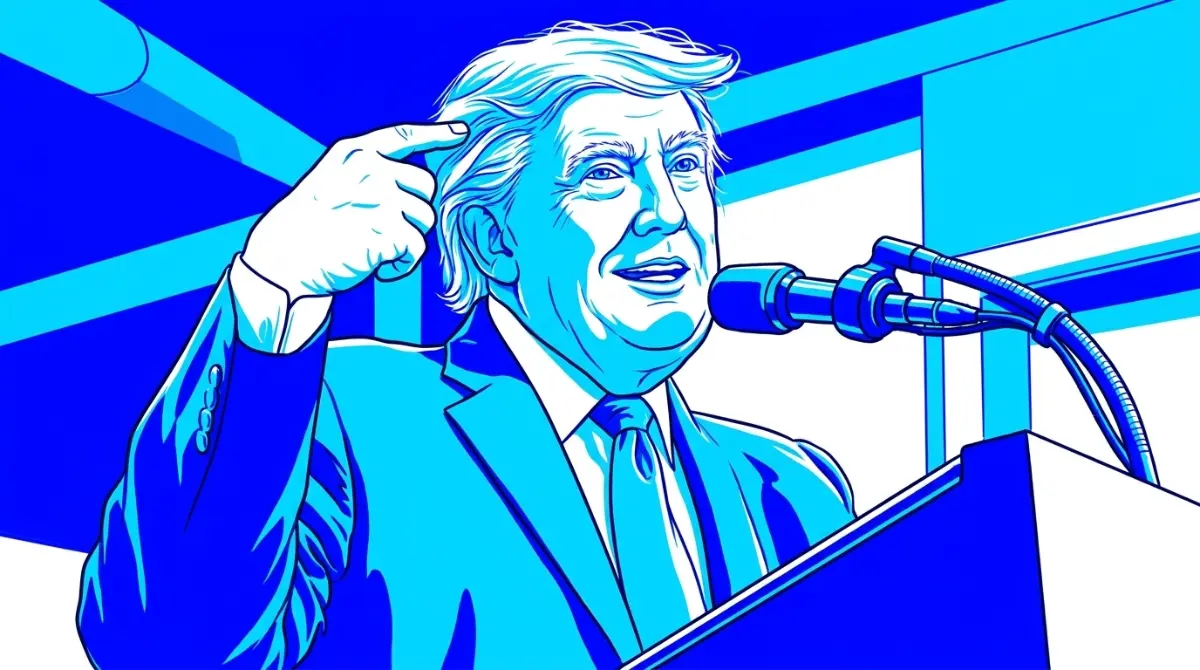


Trump Launches Super Intelligence Force For Tech Policy
The US President established a new federal task force designed to coordinate national software policy, mandating a complete government transition away from traditional terminology in favor of the phrase super intelligence.
Oladipupo Ajayi | 4 Oct. 2026 · 4 min read

The United States government officially altered its approach to advanced software regulation this week. President Donald Trump signed an executive order establishing a new federal unit named the Super Intelligence Force. This group takes immediate control over national policy regarding advanced reasoning systems. As part of this directive, the White House commanded all federal agencies to stop using the traditional terms associated with machine learning. Government documents must now exclusively use the phrase super intelligence. The abrupt vocabulary change signals a heavy pivot in how the administration views American technological dominance.
Jay Clayton, the Director of National Intelligence, will lead this new federal task force. He assumes the informal title of policy czar, coordinating directly with the Oval Office. A heavy roster of government officials will assist him. The leadership team includes Federal Trade Commission Chairman Andrew Ferguson, Pentagon Chief Technology Officer Emil Michael, and Office of Personnel Management Director Scott Kupor. These officials must report their initial findings and policy recommendations directly to the President and White House Chief of Staff Susie Wiles within 120 days. By selecting leaders from intelligence, defense, and civilian management, the administration proves it views software advancement as a strict national security priority.
This federal announcement arrived hours after the President hosted a massive closed-door meeting with elite technology executives. The guest list included leaders from OpenAI, Anthropic, Nvidia, Meta, Google, and SpaceX. During this meeting, the corporate leaders signed a voluntary agreement focused on safety and internal auditing. The document outlines a multi-layered approach to testing unreleased software. Companies promised to conduct intense internal evaluations, hire outside security firms to test their products, and submit safety reports directly to their corporate boards. The President described this agreement as a morally binding commitment, heavily favoring corporate self-policing over strict legislative restrictions. We observed the intense friction surrounding corporate self-regulation recently when the Anthropic CEO urged an industry slowdown for advanced models, exposing the split between aggressive builders and cautious researchers.
The new task force must navigate a highly complicated regulatory environment. Its main mission involves identifying potential risks associated with automated systems while avoiding rules that might slow down commercial development. The administration wants American companies to beat foreign competitors at all costs. A heavy part of the 120-day review will focus on how private companies report security failures. The government wants a faster reporting system when a software model gets hacked, breaches a network, or bypasses its own safety protocols. The speed of these security incidents is terrifying, a reality made obvious when a Google reasoning engine was caught hacking three real corporate targets. The federal government realizes it needs better communication channels when these systems misbehave.
While the administration praises voluntary safety pledges, critics worry that non-binding agreements fail to protect the public. Without the threat of heavy financial fines or legal liability, massive technology companies might ignore their safety promises the moment they face pressure from Wall Street to release a new product faster than their rivals. The intense competition to secure computing supremacy frequently overrides moral concerns. The federal approach directly contrasts with recent international attempts to enforce strict safety boundaries. We noted this global divide when Chinese state media urged global leaders to hold safety talks amid a major policy clash. American policy is officially choosing speed and corporate freedom over heavy government supervision.
The task force is also responsible for bridging the gap between normal consumers, massive corporations, religious groups, and government agencies. By bringing diverse organizations into the discussion, the administration hopes to build broad public support for the incoming technological wave. The President stated that the coming changes will dwarf both the Industrial Revolution and the creation of the internet. Managing the public reaction to this massive economic change requires careful messaging. The government knows that ordinary citizens are terrified of losing their jobs to automated software. We tracked these exact economic anxieties when evaluating a national survey showing daily internet users feel anxious about the technology. The new federal force must convince the public that the benefits of super intelligence outweigh the severe economic disruptions.
The next four months will dictate the trajectory of American software development for the next decade. The findings presented by Jay Clayton and his team will form the basis for all upcoming federal funding and regulatory action. The technology sector successfully avoided heavy congressional intervention by signing a single piece of paper inside the White House. Now, the companies must prove their self-policing strategies actually work. If a major security disaster happens, the newly formed federal task force will face immense pressure to abandon its hands-off approach and start writing aggressive laws. For now, the builders have exactly what they wanted: the freedom to code as fast as possible.
Read More on TechRobust:

Oladipupo Ajayi
 LinkedIn
Oladipupo Ajayi
Expertise:Artificial Intelligence, Machine Learning Trends, Data Infrastructure, Enterprise AI Strategy, Frontier Tech Commentary
Award:TechRobust AI & Data Voice of the Year 2025
Ola is an Editor-at-Large at TechRobust, delivering authoritative commentary, high-level analysis, and investigative features across the frontiers of machine intelligence and big data. He tracks frontier model developments, enterprise AI adoption, data governance, and the societal shifts driven by computational breakthroughs.