
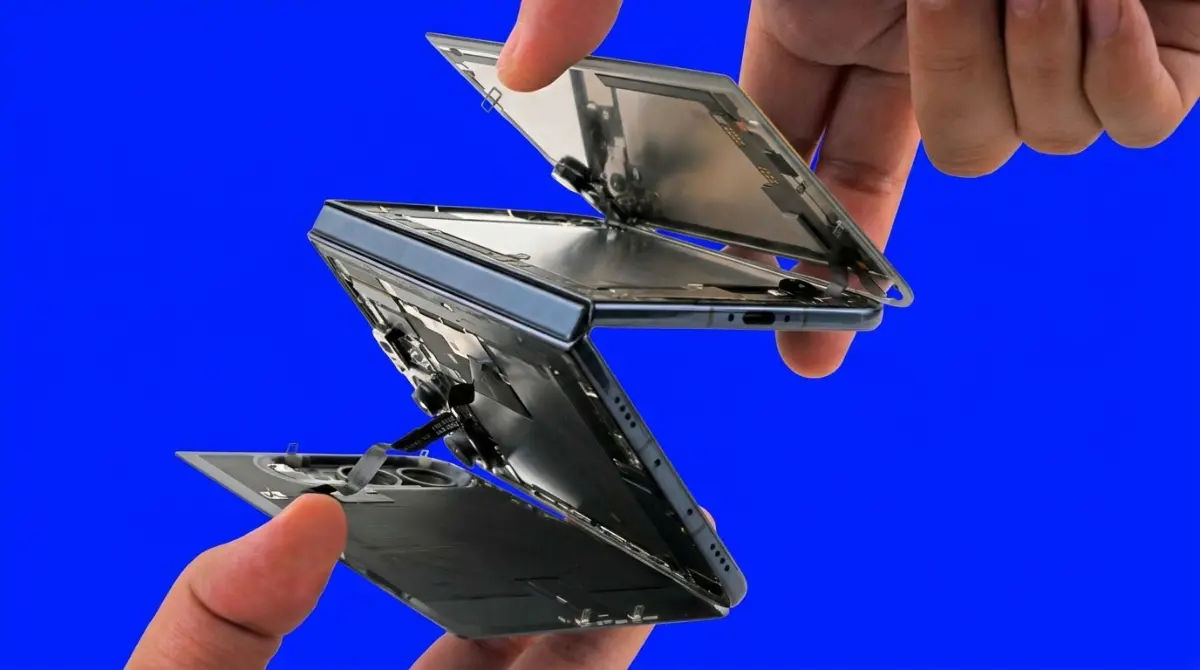


iPhone Duo Teardown Reveals Causes of Screen Cracks
A detailed teardown by iFixit uncovered that early display cracks on the iPhone Duo stem from a center hinge bar and curved rails that fail to drop low enough when folded, pinching fragile glass layers under mechanical pressure.
Caleb Ogunkanbi | · 10 min read

Folding smartphones walk an unforgiving mechanical line between flexibility and fracture. When an ultra-thin glass sheet bends across a central axis thousands of times, microscopic stress points form inside internal layers. If supporting steel plates underneath do not retract with sub-millimeter precision, mechanical leverage turns into a crushing force that shatters display pixels. Owners of Apple initial foldable smartphone, the $1,999 iPhone Duo, learned that lesson through sudden screen failures. Within weeks of the device autumn launch, user forums filled with photographs showing bright horizontal green lines, black ink spots, and physical glass cracks running along the central fold line. Repair authority iFixit completed an in-depth hardware teardown on Sunday, October 25, 2026, using computed tomography scans and three-dimensional mechanical models to investigate what causes early screen destruction. The investigation uncovered two distinct mechanical culprits inside the titanium hinge: a central support bar that fails to lower properly during closure, and curved guide rails that concentrate physical stress against display edges. The teardown arrives as buyers inspect foldable durability, continuing hardware evaluations we followed in our hands-on testing of the $2,000 iPhone Duo.
The iFixit findings provide the first objective physical explanation for a defect that Apple customer service representatives initially dismissed as user drop damage. Using high-resolution industrial CT scans, iFixit engineers mapped the internal motion of the iPhone Duo dual-axis hinge mechanism. The scan revealed that multiple structural edges, ribbon cable channels, and battery edges converge directly below the spot where early screen cracks appear. When the phone closes, internal support plates must drop downward into the chassis cavity to make room for the bent display teardrop. If manufacturing tolerances vary by a fraction of a millimeter, the center bar fails to drop far enough, pressing hard against the underside of the flexible OLED panel. iFixit also noted that despite the phone overall water resistance rating, the external hinge mechanism remains vulnerable to pocket lint and sand. The findings explain why screen replacements are soaring, adding context to supply chain costs we tracked when Apple paid Samsung top rates for foldable screens.
The CT Scan and the 3D Hinge Model
To inspect what happens inside an opaque titanium chassis without destroying physical components, iFixit partnered with Lumafield to run complete industrial CT scans on multiple retail units. The three-dimensional X-ray imagery allowed engineers to view moving mechanical parts in motion as the phone opened and closed.
The scan data revealed that the iPhone Duo hinge is one of the most intricate mechanical assemblies ever packed into consumer electronics. The mechanism contains dozens of precision gears, synchronized link plates, tension springs, and sliding guide tracks. Using these scans alongside Apple published patents, iFixit constructed an interactive 3D digital model of the hinge assembly to simulate mechanical movement under stress. The simulation isolated the exact area where display lines appear: a small transitional zone sitting just below the central flexible ribbon cable crossing. At that specific location, three separate mechanical boundaries meet: the edge of the central pivot link plate, the pleat of the main data cable, and the corner of the left steel battery shell. When the phone folds, these components slide past each other with minimal clearance. Any misalignment concentrates force on that single point, pressing against the OLED substrate. Mechanical design trade-offs across folding hardware match engineering challenges we analyzed when hinge durability hurdles slowed initial foldable manufacturing.
Culprit One: The Center Support Bar Drop Failure
The primary mechanical defect identified in the iFixit report centers on the central display support bar. When the iPhone Duo unfolds into its flat, eight-inch tablet orientation, the flexible screen requires a solid, rigid foundation underneath so users can tap and write with an Apple Pencil without feeling an empty void.
To provide that flat support, Apple engineers built a spring-loaded center steel bar that rises flush beneath the crease when open. When the user folds the device shut, internal cam gears must pull that center bar downward into the chassis, creating an empty cavity where the bent glass teardrop rests. In iFixit mechanical simulations, the center support bar occasionally failed to drop to its intended depth. If the bar sticks or lowers unevenly due to spring resistance or minor debris, the steel bar remains elevated during the final twenty degrees of closure. When the user snaps the two halves together with magnetic force, the display panel is crushed between the outer frame and the elevated center bar. That localized pinch point cracks the ultra-thin glass layer from underneath, severing micro-thin display traces and creating the permanent horizontal green line seen on broken customer units. Structural stress points inside premium hardware were also documented in our iPhone display teardown and hardware evaluation.
Culprit Two: Curved Guide Rails and Edge Interference
The secondary mechanical vulnerability uncovered by the teardown involves the curved guide rails that govern hinge rotation. To ensure that both halves of the phone move in smooth synchronization, Apple uses curved titanium tracks that guide the outer chassis through a continuous arc.
During the folding motion, these curved rails rise slightly above neighboring components before seating into recessed channels when fully closed. iFixit noted that if a user closes the phone with uneven lateral thumb pressure: pressing more forcefully on one corner than the other: the hinge can twist slightly off-axis. When twisted, the curved rail can make physical contact with the outer perimeter of the flexible display assembly. The flexible OLED panel is reinforced with a carbon-fiber backplate, but its side edges remain delicate. If the moving titanium rail rubs against the edge of the display sandwich, the friction can delaminate the optical clear adhesive layers, allowing moisture or air to penetrate the organic light-emitting diode layer. Delamination causes black circular ink spots that expand across the screen over subsequent days. Industrial design comparisons across competing foldable form factors were explored in our analysis of Huawei tri-fold phone engineering.
Comparing Foldable Smartphone Hinge Engineering
| Smartphone Model | Hinge Support Design | Teardrop Chamber Space | Hinge Dust Sealing | iFixit Repair Score |
|---|---|---|---|---|
| Apple iPhone Duo | Retractable center bar + link plates | Compact tight bend radius | Micro-sweepers; open gear tracks | Provisional 5/10 (Category high) |
| Samsung Galaxy Z Fold 8 | Dual-wing sliding support plates | Wide waterdrop teardrop chamber | Dense bristle sweeps + rubber gaskets | 3/10 (Glued batteries) |
| Honor Magic V4 | Titanium floating bridge plates | Wide teardrop with zero pinch gap | Enclosed gear housing | 4/10 (Fragile interior ribbon cables) |
| Huawei Mate XT 2 | Dual-directional Tiangong multi-track | Dual unequal bend cavities | Multi-layer labyrinth seals | 2/10 (Extreme complexity) |
| Google Pixel Fold 2 | Gear-driven steel support wings | Standard teardrop geometry | Perimeter foam barriers | 3/10 (Fragile screen bezel removal) |
The comparative data illustrates the mechanical compromises chosen by Apple. By pursuing a thin, sleek chassis that feels like an ordinary iPhone when closed, Apple minimized the internal cavity available for the folded display teardrop. Competitors like Samsung and Honor use wider waterdrop chambers that give the folded glass more breathing room, reducing mechanical pressure on supporting plates. Folding display hardware trade-offs were examined in our review of advanced folding screen technologies.
The Sand Trap: Ingress Vulnerability Behind the IP68 Label
A second major finding in the iFixit teardown touches environmental protection. Apple marketed the iPhone Duo with an IP68 ingress protection rating, leading consumers to believe the phone is safe from both water immersion and dusty environments.
iFixit discovered that while the main electronic compartments: housing the logic boards, camera sensors, and batteries: are sealed against dust with rubber gaskets, the mechanical hinge housing is not. Fine beach sand, pocket grit, and mineral dust can enter the external hinge tracks through small gaps near the outer frame corners. Once inside, foreign particles get caught in the precision gear teeth and guide rails. When a user folds the phone, the gears grind the trapped grit, causing the crunching sound reported by multiple owners. Even worse, sharp sand grains can migrate behind the flexible OLED panel. Because the display rests directly against internal metal plates, closing the phone presses hard sand grains into the back of the OLED panel, puncturing electrical circuits and killing entire pixel columns. iFixit cautioned owners never to take the iPhone Duo to sandy beaches or dusty worksites. Foldable smartphone market competition was explored in our analysis of the foldable smartphone design rivalry.
A Provisional 5 Out of 10: Surprising Repair Wins
Despite uncovering screen crack vulnerabilities, iFixit praised Apple for making several internal components accessible, awarding the iPhone Duo a provisional repairability score of 5 out of 10. That score represents the highest repair rating ever awarded to a folding smartphone, beating Samsung Galaxy Z Fold models which score 2 or 3.
iFixit highlighted three positive engineering choices:
- Electrically Releasable Batteries: Both battery cells use electrochemical adhesive debonding strips, releasing cleanly when a low electrical current is applied, avoiding aggressive mechanical prying with sharp tools.
- Independent Outer Screen Replacement: The external cover display can be removed and replaced without disassembling the delicate inner folding mechanism.
- Modular Sub-Assemblies: The USB-C charging port, speaker enclosures, and camera modules use independent modular screws rather than heavy glue adhesives.
The repair score remains provisional because Apple has not yet made replacement inner displays and hinge assemblies available through its Self Service Repair store. Repairing the internal screen requires five distinct screwdriver types and complete chassis disassembly, making DIY home repairs impractical for everyday consumers. Consumer sentiment regarding foldable hardware was documented in our report on consumer attitudes toward foldable smartphone designs.
The AppleCare+ Reality for Foldable Owners
The practical takeaway from the iFixit teardown is economic: owning an iPhone Duo without extended insurance coverage is a major financial risk. Out-of-warranty inner screen replacements on the iPhone Duo cost over $800 at Apple authorized service counters.
Because the flexible OLED panel, ultra-thin glass, carbon-fiber plate, and titanium hinge are assembled as an integrated module, technicians cannot replace cracked glass independently. If an owner experiences a screen failure caused by an elevated center support bar, proving that the damage was caused by a mechanical defect rather than a user drop is difficult. Store specialists frequently deny standard warranty coverage if the outer frame shows minor scratches or cosmetic dings, classifying the failure as accidental damage. With AppleCare+, screen repairs drop to an affordable $29 service fee. iFixit observed that early screen failure reports make AppleCare+ coverage almost mandatory for anyone buying a $2,000 foldable phone, adding hundreds of dollars in ongoing service costs over standard ownership periods. Foldable software multitasking features were analyzed in our report on Apple split-screen software features for foldable hardware.
What Apple Must Fix in the Second Generation
The iFixit teardown provides a clear engineering roadmap for how Apple must refine its foldable hardware in future product cycles. The company solved the hardest part of the equation: building a slim, pocketable chassis with clean software multitasking and solid battery construction.
To eliminate early screen failures, Apple engineering teams must widen internal hinge tolerances. The center support bar mechanism requires stronger return springs and positive-drive gearing that forces the plate downward mechanically, rather than relying on passive spring action that can stick. The teardrop bend radius inside the hinge cavity should be expanded by a fraction of a millimeter to reduce mechanical strain on the folding glass layers. Apple must also improve debris seals around outer hinge openings, using dense micro-bristles and labyrinth channels that block pocket lint from entering gear tracks. Until these mechanical adjustments are implemented, the iPhone Duo remains a compromise: an impressive piece of mobile engineering that demands gentle handling from owners who dare to fold it.
Read More on TechRobust:

Caleb Ogunkanbi
 LinkedIn
Caleb Ogunkanbi
Expertise:Practical AI Implementation, Head-to-Head Product Testing, Technical How-To Guides, Data Tools & Automation, Consumer Software Benchmarking
Award:TechRobust Guides & Insights Writer of the Year 2025
Caleb is a Staff Writer and Reporter breaking down the frontiers of artificial intelligence and actionable tech education. He produces rigorous head-to-head comparisons, demystifies data tools, and crafts step-by-step technical guides that help readers navigate complex software and AI workflows with ease.