
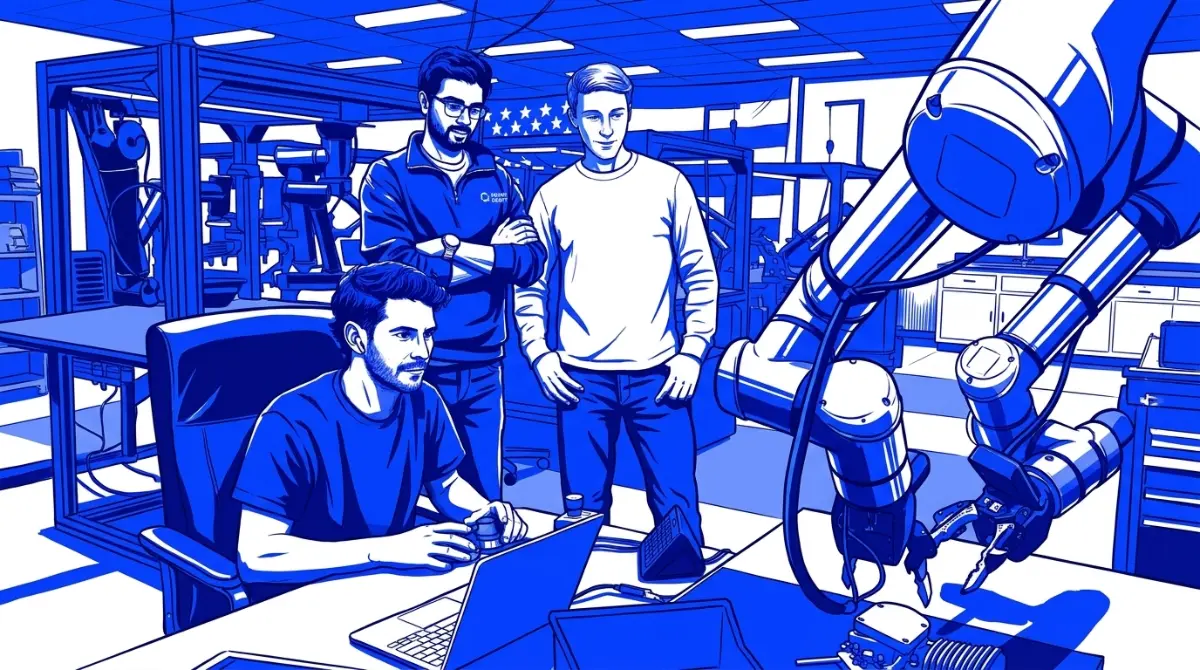


Foundry Raises $100M Series A for Autonomous Factories
Foundry Robotics completed a $100M Series A financing round led by Marlinspike Partners, constructing a 130,000-square-foot California facility to operate autonomous manufacturing cells that produce complex defense hardware, aerospace satellites, and commercial drones without manual production line setups for clients.
Inioluwa Ademidun | · 7 min read

Building specialized hardware in the United States has spent three decades trapped in a painful manufacturing cycle. When an aerospace venture designs a reconnaissance drone or a defense supplier needs specialized wiring harnesses, constructing a dedicated factory production line takes eighteen months and tens of millions of dollars in mechanical tooling. If market demand shifts or the engineering team alters a metal bracket design, the physical production line becomes obsolete, requiring complete teardowns and expensive machinery retooling. American hardware startups were forced to outsource physical assembly to overseas plants, creating supply chain vulnerabilities and intellectual property risks. Bay Area robotics startup Foundry Robotics moved to solve that industrial bottleneck on Wednesday, October 28, 2026. The company announced a $100M Series A financing round led by defense-focused investment firm Marlinspike Partners, joined by prominent venture syndicates including Khosla Ventures, Red Glass Ventures, and SE Ventures. The financing sits in the top three percent of all American deeptech Series A rounds on record, providing capital to build out a 130,000-square-foot autonomous production center in Emeryville, California. The capital raise arrives as venture funds back physical automation platforms, continuing hardware trends we tracked when Sequoia backed Mecka AI for robot training data.
The strategic differentiation that convinced investors to write a nine-figure Series A check sits in Foundry business model: manufacturing-as-a-service. Instead of licensing software code or selling robotic arms to existing manufacturers, Foundry owns and operates the physical factory floor directly. Founded by Chief Executive Officer Adarsh Kulkarni, the enterprise designed flexible robotic cells powered by its proprietary FoundryOS software platform. The system connects multi-axis industrial robots, computer vision cameras, and cloud computation into a unified assembly network. When a customer submits computer-aided design blueprints for an uncrewed aerial vehicle or satellite electronics subassembly, Foundry robotic cells reconfigure their physical toolheads and assemble the product within weeks, eliminating the multi-month tooling delays that plague traditional contract manufacturers. Duane Fotheringham, president of HII Unmanned Systems, stated that physical production capacity has become the primary national constraint on deploying autonomous systems. Kulkarni argued that reviving domestic manufacturing requires rebuilding factories from the ground up rather than retrofitting outdated machinery. Autonomous factory software integrations match principles we examined when CloudNC automated precision factory operations.
The Tooling Trap of Traditional Assembly Lines
To grasp why Foundry raised $100M, one must inspect how physical products are assembled in traditional factories. Conventional manufacturing relies on fixed automation: stamping presses, injection molds, and pick-and-place arms bolted to concrete floors, engineered to perform one repetitive movement millions of times.
Fixed automation works well for mass-market consumer gadgets like plastic toothbrushes or television remotes, where production runs exceed five million identical units. Modern aerospace, defense, and industrial hardware operate on different commercial rules: high complexity, rapid design changes, and low production volumes. An uncrewed defense drone or orbital satellite subassembly might require only five hundred units per year. Building dedicated metal stamping dies and specialized assembly fixtures for small production runs drives per-unit expenses into the tens of thousands of dollars. When military engineers update a sensor package, the assembly line stops while technicians spend weeks machining new fixtures. Foundry replaces specialized mechanical fixtures with adaptive robotic arms guided by real-time neural vision. The robots adjust their grip angles, torque limits, and movement trajectories based on live optical camera feedback, assembling complex electro-mechanical devices without custom physical tooling. Robotic coordination across distributed facilities was detailed in our review of Destro AI coordinating automation systems.
FoundryOS: The Brain Behind Adaptive Robotic Cells
The technical core of the Foundry platform is FoundryOS, an integrated operating system that bridges digital engineering blueprints with physical robotic actuators. In traditional factory automation, programming a single robotic arm to assemble a wire harness requires weeks of manual programming in specialized languages.
FoundryOS automates this programming pipeline through synthetic simulation and spatial reasoning models. The workflow executes through three distinct operational phases:
- Digital Blueprint Ingestion: The software parses customer 3D CAD models, mapping assembly hierarchies, fastener torque specifications, and tolerance boundaries automatically.
- Simulation Path Planning: Inside virtual simulation environments, physics models test thousands of robotic movement paths, calculating optimal toolhead selections and avoiding mechanical collisions before physical motors turn.
- Closed-Loop Execution: On the physical factory floor, multi-spectrum camera sensors track robotic movements, measuring parts down to five micrometers and feeding telemetry back into the model to refine subsequent assembly cycles.
Because the software learns from every production run, knowledge transfers across product categories. A robotic cell that spent Monday assembling a drone power distribution box can spend Wednesday assembling an aerospace satellite transceiver with zero physical downtime. The software simply loads a new motion policy, swaps magnetic end-effector tools, and begins production immediately. Precision engineering automation was explored in our analysis of Flow Engineering securing growth capital for industrial workflows.
Comparing Contract Manufacturing Business Models
| Manufacturing Model | Setup Lead Time | Minimum Order Quantity | Tooling Capital Expense | Design Change Adaptability |
|---|---|---|---|---|
| Foundry Autonomous Factories | 2 to 4 weeks (Software setup) | 10 to 5,000 units (High-mix) | Near-zero (Reconfigurable cells) | Immediate via software updates |
| Traditional Domestic Job Shops | 8 to 16 weeks (Manual fixtures) | 50 to 500 units | Moderate ($25k to $100k tooling) | Slow: requires manual rework |
| Overseas Contract Plants (Foxconn) | 6 to 12 months (Full line build) | 100,000+ units minimum | Millions in dedicated tooling | Rigid: costly line shutdowns |
| In-House OEM Production | 12 to 24 months factory setup | Dedicated internal volume | Heavy real estate & capital equipment | High balance sheet risk |
| Commercial 3D Printing Hubs | Days for simple parts | 1 to 100 units prototype | Zero tooling cost | Limited to structural plastics/metals |
The comparative data illustrates why defense suppliers and hardware startups are partnering with Foundry. While commercial 3D printing handles simple plastic brackets, it cannot assemble complex systems containing electric motors, printed circuit boards, and optical sensors. Traditional contract manufacturing requires six months and millions of dollars to set up dedicated lines. Foundry provides the missing middle: rapid, flexible assembly for complex electro-mechanical systems. Construction monitoring and factory tracking platforms were analyzed in our review of Buildots securing capital for automated construction tracking.
The National Defense Mandate: Rebuilding the Industrial Base
The decision by Marlinspike Partners to lead the $100M financing highlights the geopolitical importance of physical production capacity. Marlinspike specializes in dual-use national security investments, backing ventures that support American defense supply chains.
Recent international conflicts exposed acute vulnerabilities in Western defense manufacturing. The United States defense industrial base struggles to produce sufficient volumes of uncrewed reconnaissance drones, counter-drone interceptors, and precision guidance electronics. When defense agencies attempt to surge production, contractor facilities report multi-year backlogs because they cannot hire enough skilled assembly technicians. Foundry autonomous factories provide surge capacity for defense contractors. By deploying software-controlled robotic cells, Foundry can operate manufacturing shifts twenty-four hours a day, assembling critical defense subassemblies without human fatigue. Producing defense hardware domestically on automated lines protects military supply chains from foreign shipping blockades and hostile foreign component tampering. National security investments and defense technology venture capital were examined in our review of Mach Industries expanding defense production facilities.
The 130,000-Square-Foot Emeryville Megafacility
The immediate operational deployment for the $100M Series A capital is the construction of Foundry flagship production center in Emeryville, California. The 130,000-square-foot facility represents a twentyfold expansion of the company existing manufacturing footprint.
The megafacility will house dozens of synchronized robotic cells, cleanroom assembly bays for sensitive optical payloads, and automated testing chambers. Foundry plans to expand its engineering roster, recruiting specialized researchers in computer vision, mechanical design, and distributed systems software. The company will also hire experienced production technicians to supervise automated operations, ensuring that finished hardware meets strict aerospace quality certifications like AS9100. Management confirmed that multiple commercial satellite operators and autonomous mobility developers have signed advance production commitments, guaranteeing immediate capacity utilization when the Emeryville facility powers up in early 2027. Orbital manufacturing and space technology ventures were detailed in our report on Varda Space raising capital for orbital manufacturing.
The Long-Term Outlook for Autonomous American Manufacturing
Foundry Robotics $100M Series A proves that the future of physical manufacturing will not be decided by cheap labor overseas. For thirty years, Western nations exported assembly lines under the belief that physical production was a low-margin commodity.
As geopolitical tensions mount and software tools master physical coordination, owning the means of physical production has re-emerged as the ultimate strategic asset. By replacing rigid mechanical tooling with flexible software-guided robotics, Adarsh Kulkarni and his team are establishing a blueprint for domestic re-industrialization. As Foundry scales its Emeryville facility, the company is proving that the factories of the next century will not be smoky, noisy sweatshops, but clean, flexible software centers where code meets metal to build the physical future.
Read More on TechRobust:

Inioluwa Ademidun
 LinkedIn
Inioluwa Ademidun
Expertise:African Tech Ecosystem, Early-Stage Startups, Emerging Market Dynamics, Venture Capital & Tech Reporting, Product Management
Award:TechRobust Contributor of the Year 2025
Inioluwa is a Senior Product Manager by day and an investigative technology reporter by night, bridging the gap between scalable software architecture and high-impact journalism. She delivers deep-dive analysis on venture-backed founders, regulatory shifts, and grassroots tech ecosystems across Africa and global emerging markets.