
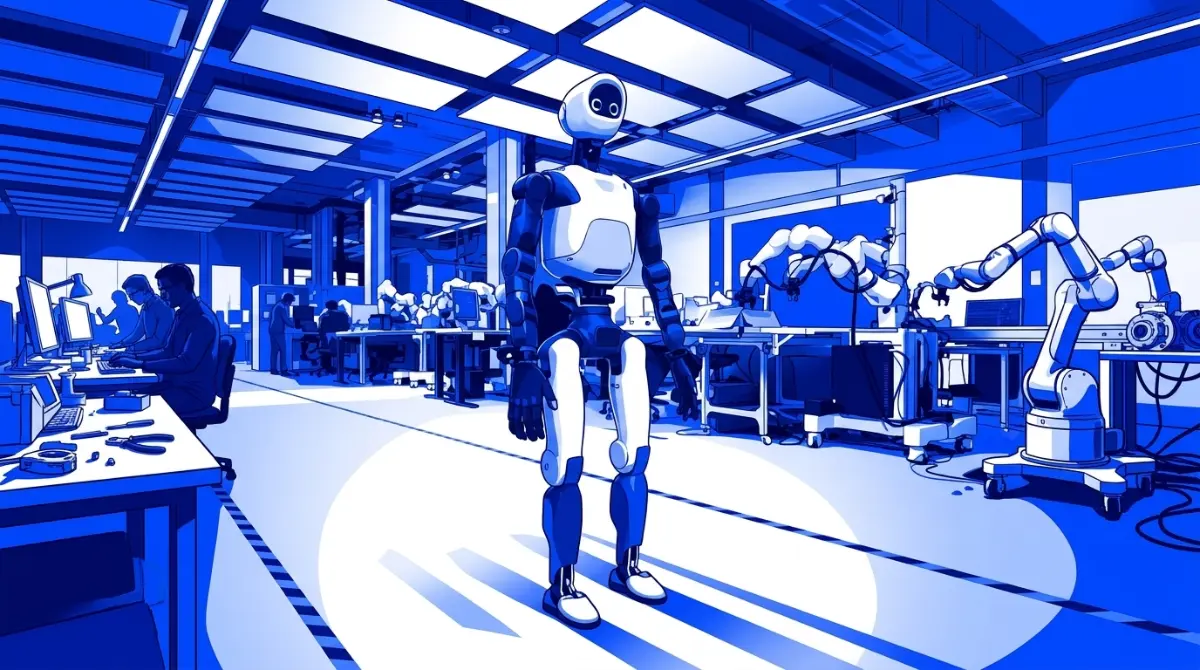


Machenta Raises $40M to Train Robots in Virtual Worlds
London robotics venture Machenta raised $40M in seed financing co-led by Creandum and Union Square Ventures, operating with an eleven-person engineering team to train autonomous physical machines entirely inside simulated environments without expensive real-world data collection.
Inioluwa Ademidun | · 7 min read

Building physical robots has historically required breaking expensive hardware. When a roboticist tests an automated arm or bipedal walking legs, machines crash into walls, burn out electric motors, and drop fragile components onto concrete floors. Collecting enough training data to teach a machine how to clear a dining table or navigate a cluttered warehouse requires thousands of hours of manual human teleoperation. Silicon Valley hardware giants spend fortunes building physical testing rooms and contracting armies of human teleoperators to capture physical motion. A small London engineering team is proving that physical data collection can be replaced by virtual physics. Robotics startup Machenta announced on Tuesday, October 27, 2026, that it raised $40M in seed financing. The outsized funding round was co-led by European venture firm Creandum and American investor Union Square Ventures, marking an extraordinary seed valuation for an enterprise employing just eleven people. Machenta trains physical robots completely inside virtual simulations, using synthetic physics worlds to teach machines motor skills before deploying software onto physical metal. The funding round arrives as venture investors back physical automation data, continuing investment trends we followed when Sequoia backed Mecka AI for robotics data.
The investment represents an aggressive bet that simulated data can solve the physical robotics bottleneck. Large language models succeeded because billions of pages of human text existed on the open internet. Physical robots possess no equivalent digital library of motor coordination. Humanoid robot makers like Figure, Tesla, and Sanctuary spend hundreds of dollars per hour paying humans to wear virtual reality headsets to steer physical prototypes. Machenta, founded by engineering alumni from Imperial College London, rejects that manual collection process entirely. The eleven-person team built high-speed simulation engines that generate synthetic physics environments on cloud server clusters. In these digital worlds, virtual robots complete millions of practice cycles: dropping cups, balancing on uneven gravel, and manipulating tools: in fractions of a second. The startup plans to use its $40M seed capital to expand its engineering roster, purchase server computing power, and scale synthetic dataset generation. The rapid growth of robotics software ventures matches developments we documented when TwelveLabs used human video to train robots.
The Sim-to-Real Chasm: Why Virtual Training Stalled
To grasp why Machenta seed round caught the attention of venture investors, one must examine why simulated robot training historically failed. In robotics engineering, the gap between virtual simulation and real-world execution is known as the sim-to-real transfer problem.
Traditional physics simulators, such as MuJoCo or standard video game engines, rely on mathematical approximations of physical laws. They calculate friction as a uniform number, treat objects as rigid geometric blocks, and ignore sensor noise. When an algorithm trained in a clean simulator is uploaded to a physical robot on an actual factory floor, the machine fails instantly. The real world contains micro-vibrations, uneven floor tiles, air currents, and unpredictable friction variations that computer simulations omit. A robot arm trained in a standard simulator might grasp a coffee mug with correct geometry, yet drop the cup because the real ceramic was slick with soapy water. Overcoming this sim-to-real gap required physical testing fleets, creating a massive barrier to entry that favored well-funded conglomerates. Simulation challenges across automated machines were analyzed in our report detailing how Skild AI and Nvidia trained physical automation tools.
Machenta Neural Physics and Domain Randomization
The technical insight that allowed Machenta to bridge the sim-to-real chasm lies in neural physics modeling and extreme domain randomization. Rather than building a single, perfect simulation of a room, Machenta software generates thousands of parallel virtual variations simultaneously.
The system randomizes physical properties across every simulated instance. In one virtual room, gravity is set slightly higher, friction is reduced to mimic wet ice, and virtual camera sensors are degraded with digital noise. In another room, lighting conditions fluctuate, object masses shift unexpectedly, and actuator joint delays vary by twenty milliseconds. By exposing the machine learning model to millions of extreme physical variations, the robot learns motor control policies that are resilient to real-world chaos. When the software is deployed to a physical robot in the real world, the robot treats actual physical unpredictability as just another variation it has already solved inside the simulator. The eleven-person team proved this resilience by training a robotic arm entirely in simulation to assemble complex mechanical parts, with the software executing the task on physical hardware on the very first physical attempt. Hardware durability testing across robotics systems was explored in our review of nursing room hardware automation.
Comparing Robotics Training Methodologies
| Training Approach | Capital Cost per Training Hour | Physical Hardware Wear | Environmental Diversity | Scaling Speed |
|---|---|---|---|---|
| Machenta Virtual Simulation | Pennies per hour (Cloud compute) | Zero hardware wear during training | Infinite procedural environments | Exponential: runs on parallel GPUs |
| Human Teleoperation (VR) | $250 to $500 per hour | High: motor burnout & joint fatigue | Limited to physical staging rooms | Linear: requires 1:1 human labor |
| Physical Fleet Deployment | Millions in physical hardware capex | Severe: continuous physical damage | Real-world client sites only | Slow: bound by physical logistics |
| Passive Video Web Scraping | Low web collection expense | Zero physical wear | High visual diversity | Fast: limited by lack of force metrics |
The comparative data reveals why venture investors wrote a $40M seed check for an eleven-person startup. Physical data collection methods do not scale efficiently: hiring hundreds of human teleoperators to teach robots how to open doors creates heavy payroll bills that compress startup margins. Machenta software replaces human labor with server compute, allowing an eleven-person engineering team to generate more training hours in a weekend than a large hardware company can capture in six months of manual testing. Warehouse robotics automation was detailed in our report on Destro AI coordinating automation systems.
The Imperial College Deeptech Ecosystem in London
The rise of Machenta highlights the growing concentration of deeptech engineering talent in London. Machenta originated from research conducted within Imperial College London, an institution recognized internationally for mechanical engineering and spatial computing.
European venture capital firms historically hesitated to back early-stage robotics ventures, viewing physical hardware as capital-intensive and slow to commercialize. The decision by Creandum and Union Square Ventures to co-lead a $40M seed round signals that institutional investors view robotics software as a premier venture asset class. Operating in London allows Machenta to recruit specialized researchers in physics simulation, neural rendering, and reinforcement learning from British and European universities. The founding team lean structure demonstrates that in the modern software economy, small teams of specialized engineers can build infrastructure that rivals large corporate laboratories. Capital efficiency and engineering productivity were explored in our analysis of Flow Engineering securing growth capital for industrial workflows.
Challenging the Humanoid Hardware Establishment
Machenta strategy positions the startup as a neutral software provider for the emerging humanoid robotics industry. Major hardware companies are spending billions designing physical chassis: engineering carbon-fiber limbs, harmonic drive gearboxes, and high-torque electric actuators.
Many of these hardware manufacturers lack the software expertise required to train general-purpose motor skills. Building complex simulation environments requires deep understanding of distributed computing, numerical mathematics, and graphics programming. Machenta aims to license its simulation-trained models to third-party robot makers, acting as an outsourced intelligence layer. A commercial robotics firm in Germany or Japan can manufacture physical hardware, download Machenta motor policies, and deploy functional robots to customer warehouses without spending years collecting physical teleoperation data. Auditing safety standards across automated robotics was examined in our report on Safeworld auditing generative robotics systems.
The Road to General Purpose Physical Manipulation
The capital secured in the $40M seed round gives Machenta the resources needed to expand its simulation capacity. The startup plans to scale its cloud server clusters, building synthetic environments that simulate complex interactions: handling deformable objects like cloth and rubber, using power tools, and operating in hazardous weather.
The ultimate goal pursued by Machenta is achieving general-purpose physical manipulation. Just as large language models learned to answer diverse questions by training on vast volumes of text, physical robots must learn to manipulate arbitrary objects by training across vast virtual worlds. If Machenta proves that simulation-trained policies can handle the messy unpredictability of real human environments, the company will have eliminated the largest obstacle standing between humanity and functional domestic robots. As eleven engineers in London build digital worlds to teach physical machines, they are proving that the future of robotics will not be built on factory floors alone, but inside the virtual reality of the machine. Early venture capital in robotics research was detailed in our review of DeepSeek backing robotics startup Winverse.
Read More on TechRobust:

Inioluwa Ademidun
 LinkedIn
Inioluwa Ademidun
Expertise:African Tech Ecosystem, Early-Stage Startups, Emerging Market Dynamics, Venture Capital & Tech Reporting, Product Management
Award:TechRobust Contributor of the Year 2025
Inioluwa is a Senior Product Manager by day and an investigative technology reporter by night, bridging the gap between scalable software architecture and high-impact journalism. She delivers deep-dive analysis on venture-backed founders, regulatory shifts, and grassroots tech ecosystems across Africa and global emerging markets.