


Maxinsights Raises $30M to Turn Chores Into Robot Data
Robotics training startup Maxinsights secured $30M in Series A funding to record and annotate human domestic chores, paying workers to wear sensor-packed camera rigs while washing dishes, folding laundry, and organizing pantries to train humanoid robot foundational models.
Inioluwa Ademidun | · 9 min read

Teaching a computer model to write an essay requires scraping text from millions of public web pages. Teaching a bipedal robot to fold a cotton bath towel or unload ceramic bowls from a dishwasher requires physical data that does not exist on the internet. For three years, robotics laboratories made slow progress because machines lacked physical common sense. If a robot arm grasps a delicate glass tumbler with too much force, the glass shatters; if it grips the glass too loosely, the vessel slips and crashes onto the kitchen tile. Internet text models understand the dictionary definition of fragility, but they have never felt the weight of ceramic plates or the sliding friction of wet dish soap. Silicon Valley robotics data venture Maxinsights stepped forward on Friday, October 23, 2026, to commercialize the collection of that physical knowledge. The Next Web reported that Maxinsights closed a $30M Series A financing round led by prominent deeptech venture syndicates. The startup deploys human workers wearing sensor-packed camera helmets and haptic gloves to record thousands of hours of routine household chores, turning everyday human motion into training datasets for physical humanoid robots. The capital infusion arrives as venture investors shift attention toward physical automation, an investment pattern visible when Sequoia backed Mecka AI for robotics data.
The investment reflects an urgent bottleneck across the commercial robotics sector. Well-funded robotics manufacturers like Tesla, Figure AI, Boston Dynamics, and Sanctuary AI have built impressive humanoid hardware: designing bipedal legs that walk across gravel, electric actuator joints that move with high speed, and dexterous hands with multi-axis fingers. What these multi-million-dollar robots lack is motor intelligence: the software brains that instruct actuators how to navigate messy human homes. Maxinsights was founded by computer vision researchers who recognized that the robotics race is fundamentally a data collection contest. Rather than confining robot testing to sterile academic laboratories, Maxinsights contracts with hundreds of human workers across North America, paying them hourly wages to perform domestic chores while wearing spatial tracking gear. The company processes raw video feeds, inertial sensor logs, and finger pressure readings, converting human muscle memory into structured multimodal datasets that robot developers purchase to train motor control models. The focus on foundational industrial data matches development patterns we explored when TwelveLabs used human video to train robots.
The Data Desert in Physical Robotic Manipulation
To grasp why venture capitalists committed $30M to Maxinsights, one must examine why physical robotics lags behind conversational language models. Language models succeeded because forty years of human internet activity provided trillions of words of training text: Wikipedia articles, digitized library books, news archives, and public discussion forums.
Physical robotics operates in a data desert. There is no historical digital archive recording the micro-movements of human fingers peeling an onion or wiping marinara sauce from a quartz kitchen counter. When a human buttering bread feels the toast begin to crack, their wrist automatically adjusts knife angle and downward pressure in fractions of a millisecond. That tactile adjustment is instinctive for a five-year-old child, but programming that reflex into a robot requires millions of verified data points linking visual pixels to motor force vectors. If robot makers rely solely on teleoperation: having an engineer wear an expensive virtual reality headset to steer a physical prototype robot remotely: collecting data is slow, costing hundreds of dollars per recorded hour. Maxinsights turns ordinary human homes into distributed data collection factories, scaling physical data volume at a fraction of laboratory costs. The challenge of training physical automation systems was examined in our report detailing Skild AI and Nvidia training physical automation tools.
The Teleoperation Rig: Cameras, IMUs, and Tactile Glove Arrays
The technical core of Maxinsights collection engine is its proprietary wearable sensor suit. The company designed a lightweight, non-restrictive hardware package that human workers can wear comfortably for four-hour recording shifts without experiencing physical fatigue.
The wearable package incorporates three synchronized sensor modalities:
- Stereoscopic Spatial Cameras: High-speed binocular cameras mounted on a lightweight forehead rig, capturing 4K resolution at 120 frames per second with depth sensing to map three-dimensional distance to kitchen objects.
- Inertial Measurement Units: Miniature IMU sensors strapped to human shoulders, elbows, and wrists, measuring joint angles, rotational acceleration, and arm trajectory curves.
- Tactile Pressure Gloves: Thin, flexible sensor gloves embedded with hundreds of piezoresistive micro-sensors across fingertips and palms, recording exact grip force in newtons.
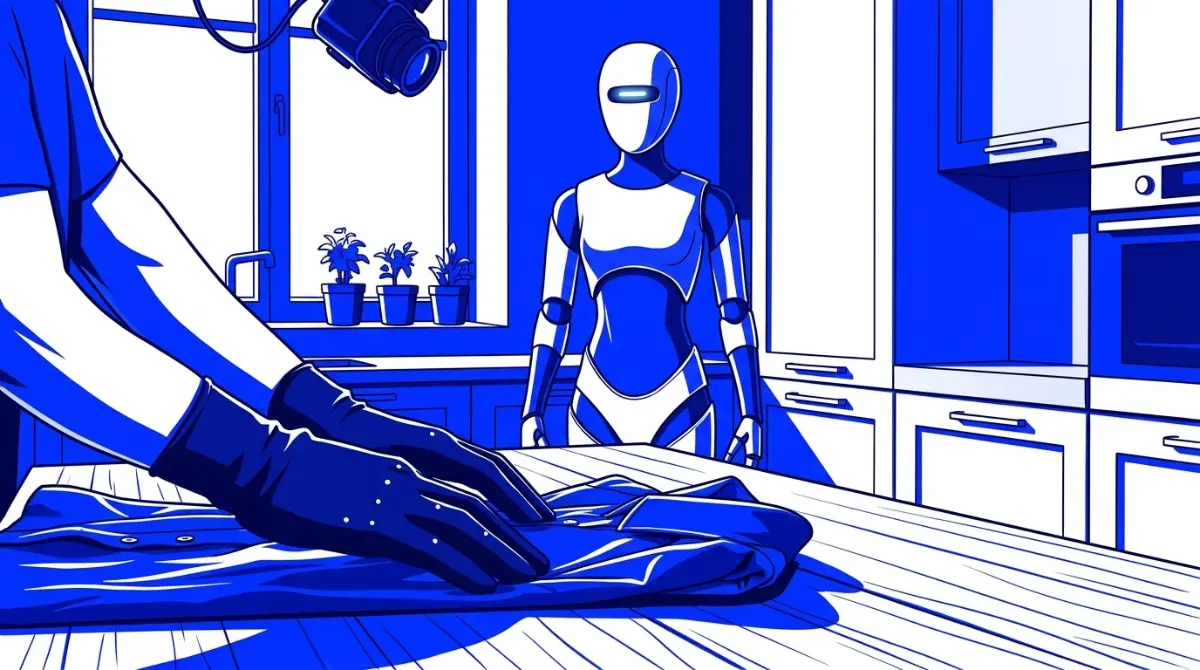
The system records what the human worker sees alongside the force their muscles exert. When a worker folds a laundry towel, the software records the visual fabric texture, the corner alignment points, and the grip tension required to lift the cotton weave without pulling the cloth out of shape. The system matches time-stamped visual pixels to mechanical force commands, creating an action-perception dataset that robot builders can feed directly into neural networks. Testing hardware durability and component life matches principles we examined when Norbert Health secured capital for nursing room automation.
Comparing Robotics Data Collection Methodologies
| Collection Methodology | Hourly Data Cost | Tactile Force Accuracy | Environmental Diversity | Scaling Velocity |
|---|---|---|---|---|
| Maxinsights Chore Wearables | Low ($25 to $40 per hour) | High: real piezoresistive glove metrics | Extreme: hundreds of real consumer homes | High: scales with distributed human workers |
| VR Robot Teleoperation | High ($200 to $450 per hour) | Moderate: limited by robot actuator feedback | Low: confined to company testing rooms | Slow: requires 1:1 human-to-robot pairing |
| Physics Simulation (Sim-to-Real) | Near-zero marginal cost | Artificial: mathematical approximations | High: procedural synthetic generation | Infinite: runs on cloud compute server clusters |
| Passive YouTube Video Scraping | Negligible web scraping cost | Zero: no tactile force or depth channels | High: vast catalog of internet video | Fast: automated batch ingestion |
The comparison matrix makes clear why robotics manufacturers are purchasing Maxinsights data. Passive internet video scraping provides visual context, but a robot cannot learn how tightly to hold an egg from a YouTube cooking video because the video contains zero force measurements. Conversely, virtual reality teleoperation is too expensive to scale across thousands of chore variations. Maxinsights combines authentic human dexterity with low collection costs, providing the missing training data needed to teach machines physical skills. Automated warehouse robotics workflows were explored in our analysis of Destro AI coordinating automation systems.
The Gig Economy of Household Chore Telemetry
The operational engine behind Maxinsights is an expanding gig workforce. Rather than hiring full-time engineering technicians in Silicon Valley, the company operates a distributed contractor network across regional cities in the United States and Canada.
Workers apply online, receive a verified sensor kit by mail, and complete calibration tutorials inside a mobile smartphone app. Contractors are assigned specific chore assignments: such as loading ten different dishwasher models, cleaning greasy frying pans, organizing refrigerator produce drawers, or sorting messy laundry baskets. Workers earn between $20 and $35 per hour, uploading encrypted data packets to Maxinsights cloud servers at the conclusion of each shift. Quality control software audits incoming files automatically: checking for sensor calibration drift, verifying camera lens focus, and flagging unnatural, jerky movements that could teach robots erratic behaviors. By drawing data from hundreds of authentic homes, Maxinsights captures natural environmental diversity: different countertop heights, varying kitchen lighting conditions, worn utensils, and diverse appliance layouts that laboratory test environments can never duplicate. Gig workforce management and corporate labor models were examined in our review of labor classification legal settlements.
Customer Privacy and Strict Home Masking Protocols
Recording video inside private homes introduces severe privacy and security liabilities. If a contractor wearable camera captures personal family photographs, unredacted bank statements sitting on a kitchen table, or children playing in a living room, distributing those recordings to third-party robotics labs would violate privacy laws.
Maxinsights engineered an automated privacy scrubbing pipeline that processes video feeds before data lands in commercial datasets. The company machine vision models detect and permanently blur human faces, computer displays, television screens, prescription pill bottles, and paper documents. The software replaces background family members with generic wireframe figures or removes them from video frames completely. Audio streams are stripped entirely, preventing private household conversations from being recorded. Furthermore, contractors sign strict privacy agreements agreeing to conduct recording sessions only within designated kitchen, laundry, and dining areas. Maintaining these privacy perimeters is necessary for winning enterprise data licensing contracts with major corporate clients like Tesla and Boston Dynamics. Auditing safety and compliance perimeters across emerging tech platforms was detailed in our report on Safeworld auditing generative robotics systems.
The Battle for General Purpose Embodied Intelligence
The ultimate commercial prize pursued by Maxinsights is becoming the foundational data layer for what researchers call General Purpose Embodied Intelligence. For two decades, industrial robots were single-task machines: bolted to concrete factory floors, welding car doors or stacking shipping boxes along fixed coordinate paths.
Humanoid robots represent a different mechanical paradigm. To be commercially viable in residential homes and hospital wards, a humanoid robot must be general-purpose: capable of cooking an omelet in the morning, scrubbing a bathtub in the afternoon, and carrying laundry upstairs in the evening without requiring custom code for every individual task. Achieving that versatility requires foundation models trained on hundreds of thousands of hours of diverse physical manipulation data. Maxinsights plans to use its $30M Series A capital to expand its contractor network to five thousand active collectors, targeting over one million recorded hours of domestic chore data by late 2027. The company is also opening specialized data studios in Detroit and Pittsburgh to capture heavier tasks: like operating power tools, assembling flat-pack furniture, and carrying heavy grocery bags up narrow stairwells. Early venture capital investments in robotics research were explored in our analysis of DeepSeek backing robotics startup Winverse.
The Road to Commercial Domestic Humanoids
Maxinsights $30M fundraise proves that the robotics industry has entered an era of practical execution. The romantic phase of releasing promotional videos showing bipedal robots doing backflips or dancing to pop songs has run its course. Corporate buyers and everyday consumers want to know when robots will actually do their chores.
Building machines that can navigate the messy physical reality of human homes requires more than clever mechanical engineering; it demands massive volumes of high-quality physical data. By transforming everyday household chores into structured digital telemetry, Maxinsights is supplying the critical missing ingredient needed to bring humanoid robots out of research labs and into human kitchens. The road ahead will require disciplined execution: managing a distributed workforce, protecting homeowner privacy, and proving that models trained on human movements transfer reliably to physical robot actuators. If Maxinsights succeeds, it will not only deliver handsome returns to its venture backers; it will help unlock the dream of domestic robotic assistance, freeing human beings from household drudgery once and for all.
Read More on TechRobust:

Inioluwa Ademidun
 LinkedIn
Inioluwa Ademidun
Expertise:African Tech Ecosystem, Early-Stage Startups, Emerging Market Dynamics, Venture Capital & Tech Reporting, Product Management
Award:TechRobust Contributor of the Year 2025
Inioluwa is a Senior Product Manager by day and an investigative technology reporter by night, bridging the gap between scalable software architecture and high-impact journalism. She delivers deep-dive analysis on venture-backed founders, regulatory shifts, and grassroots tech ecosystems across Africa and global emerging markets.