
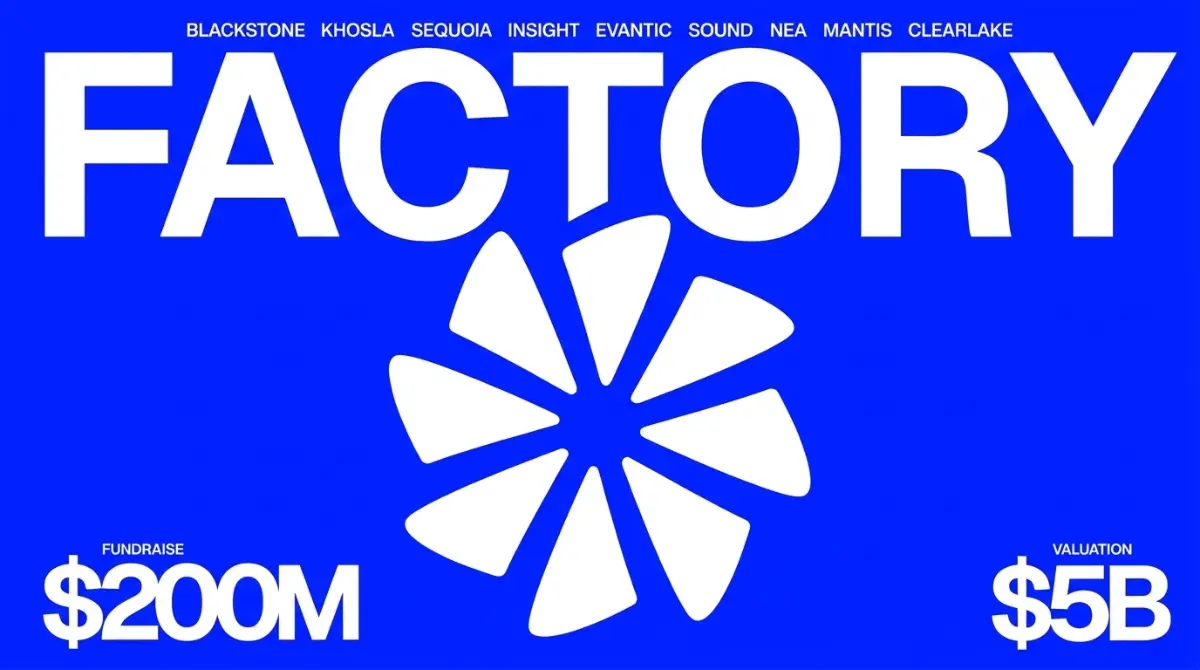


Factory Triples Valuation to $5B in $200M Funding Round
San Francisco startup Factory raised $200M backed by Blackstone and Sequoia, lifting its valuation to $5B as businesses automate complete programming pipelines.
Umar Thariwat | 15 Sept. 2026

For three years, corporate leaders celebrated programming assistants that lived inside code editors, functioning essentially like glorified autocomplete engines. Developers typed a function name, watched a few lines of syntax appear, and pressed tab to accept the recommendation. That phase of passive software assistance was merely an opening rehearsal. True industrial automation does not happen when you hand a human programmer a typing aid; it happens when you hand entire engineering assignments over to autonomous digital workers. On Tuesday, September 15, 2026, San Francisco software agent builder Factory proved that corporate investors are willing to pour fortunes into that exact transition, securing $200M in fresh funding that tripled its valuation to $5B.
The financing marks an extraordinary repricing for a firm launched just three years ago. Back in April, the startup secured a valuation of $1.5B. Multiplying that baseline by more than three times in five months demonstrates how fast venture capital has pivoted away from simple developer chatbots toward full-lifecycle development pipelines. The syndicate backing the $200M injection features heavy institutional check writers, led by Blackstone, Khosla Ventures, and Sequoia Capital, alongside Insight Partners, Evantic Capital, and Sound Ventures. Total funding raised by the enterprise now clears $400M. Co-founders Matan Grinberg and Eno Reyes are deploying these funds to scale their automated workforce across Fortune 500 engineering departments. You can review how massive technology corporations adjust their headcounts when automated software takes over internal tasks by reading our report on how Wipro freed capacity equivalent to 20,000 workers via automated tools.
Moving Beyond the Coding Assistant Illusion
To understand why institutional funds wrote massive checks, you have to look at how real software engineering teams spend their working hours. Writing new lines of code represents a small fraction of a programmer's actual week. The overwhelming majority of engineering hours are consumed by unglamorous maintenance chores: tracking down obscure bugs, writing unit tests, reviewing pull requests, updating documentation, and fixing broken deployment scripts. A typing assistant that suggests five lines of code does almost nothing to relieve that administrative burden.
Factory attacks those tedious maintenance bottlenecks through autonomous software agents known as Droids. Rather than waiting for a developer to type out code, Droids operate independently across the development cycle. When an automated error monitor detects a broken checkout button or a slow database query, a Droid pulls the relevant code repository, reproduces the failure in a private testing sandbox, drafts a software patch, runs the test suite, and submits the pull request for human sign-off. Chief executive officer Matan Grinberg points out that businesses are moving past individual coding assistants toward complete software factories that anchor corporate engineering operations. This shift mirrors changes we detailed when examining how Cloudflare launched agent-first browser architectures.
The Battle for the Enterprise Codebase
The commercial race to control enterprise software pipelines has turned into an intense financial arms race. Just days before Factory confirmed its latest financing, competitor Cognition closed a $2B funding round that pushed its valuation to $48B, backed by Andreessen Horowitz and Accel. At the same time, tools like Cursor, GitHub Copilot, and open-weight models are battling to capture developer mindshare. Yet while consumer tools fight for individual subscriptions, Factory targeted corporate balance sheets directly.
The company already counts corporate heavyweights including Nvidia, Royal Bank of Canada, EY, Adobe, Palo Alto Networks, Adyen, and Blackstone among its active corporate accounts. In these institutions, the primary selling proposition is not just speed, but consistency. Human developers change jobs, misplace project notes, or write undocumented code that puzzles their successors. An autonomous software pipeline preserves organizational memory, ensuring that complex codebases remain maintainable over decades. We analyzed how institutional investors evaluate long-term enterprise moats in our feature on Norwest partners evaluating founder commercial execution before backing.
The Growing Divide Between Usage and Trust
Despite the $5B valuation, scaling autonomous programming tools introduces profound governance and security questions. Industry surveys show that while roughly 90% of professional developers use coding tools regularly, trust in full machine autonomy remains low. Enterprise security officers worry about the hallucination of non-existent software libraries, accidental introduction of security vulnerabilities, and copyright exposure from training datasets. If an automated agent introduces a subtle security flaw into a banking ledger, the financial fallout can be devastating.
Furthermore, running multiple reasoning agents in parallel consumes staggering amounts of computing power, raising real questions about corporate return on investment. An agent that loops through ten revisions to fix an obscure software bug can burn through computational tokens rapidly, turning what seemed like an inexpensive automation shortcut into a hefty server bill. Factory must prove that its Droids can resolve software problems reliably without generating exorbitant computing overhead or requiring human engineers to spend their entire day auditing machine output. Corporate boards are watching these infrastructure expenses closely, an investment tension we documented when economists warned of volatility in computing capital expenditures.
The Future of Human Engineering
The tripling of Factory's valuation reflects an undeniable restructuring of white-collar work. For twenty years, university students were told that learning to write computer code was the ultimate ticket to financial security. Today, that conventional wisdom is being rewritten in real time. As software agents become capable of designing, testing, and shipping complex applications, the role of human engineers is shifting from manual coding to higher-level architectural design and systems oversight.
The companies that emerge as enduring software giants will not be those that simply generate syntax snippets in a browser tab. The winners will be the platforms that integrate seamlessly into existing corporate development repositories, enforce strict security permissions, and allow small engineering teams to build software at a scale previously reserved for multi-thousand developer organizations. By building autonomous workers that handle the full software lifecycle, Factory is showing that the software industry is finally applying its powerful automation tools to itself.
Read More on TechRobust:
Umar Thariwat
 LinkedIn
Umar Thariwat
Expertise:Tech News Reporting, Tech Business Analysis, Economic Foundations, Market Trends, Digital Economy
Award:Rising Voice of the Year 2025
Thariwat is a Staff Writer and Reporter covering tech news and enterprise trends at TechRobust. Blending daily reporting with her ongoing academic background in economics, she analyzes earnings, digital market, and the commercial strategies powering the global tech sector.