
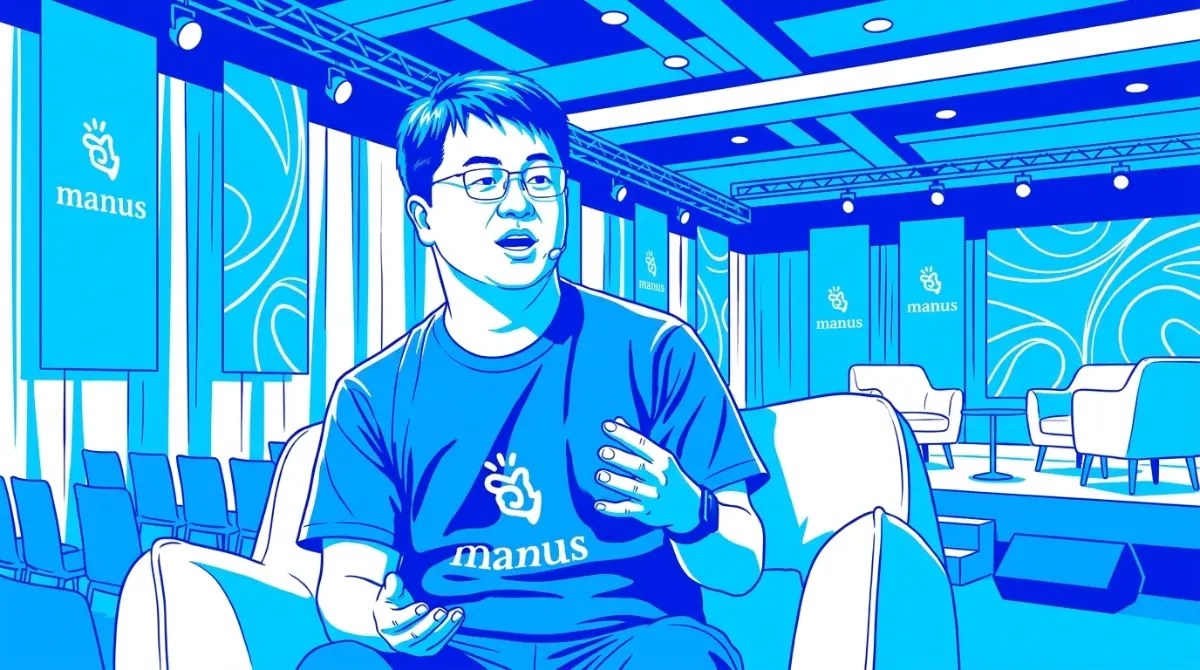


Manus Seeks $4B Valuation in $500M Post-Meta Round
Singapore based agent developer Manus opened talks to raise $500M at a $4B valuation, doubling its prior valuation after regulators blocked its sale to Meta.
Umar Thariwat | 18 Sept. 2026 · 5 min read

National borders have caught up with autonomous computer code. For years, software founders operated under the assumption that moving corporate paperwork to Singapore or the Cayman Islands protected their balance sheets from political tension. You incorporated overseas, hired globally, and sold software to American conglomerates without asking local ministries for permission. That borderless illusion is gone. When algorithms begin executing end-to-end commercial tasks like writing software, organizing research files, and navigating web browsers without human help, sovereign states treat that code as a protected strategic weapon. On Friday, September 18, 2026, software agent builder Manus demonstrated the intense financial rebound following that geopolitical collision, opening discussions to secure $500M in fresh financing at a $4B valuation just months after regulators in Beijing dismantled its planned acquisition by Meta.
The financing talks represent an extraordinary doubling of the company's valuation baseline. In December 2025, American social media giant Meta signed an agreement to acquire the autonomous agent developer for approximately $2B, aiming to integrate its virtual computer execution system directly into consumer software suites. But Chinese regulatory watchdogs intervened, citing national export controls and prohibitions against domestic engineering talent flowing to foreign geopolitical competitors. The transaction was formally unwound, forcing early investors to buy back Meta's equity position at the original $2B valuation. Now operating as an autonomous entity under founders Xiao Hong, Zhang Tao, and chief scientist Ji Yichao, the firm is preparing to add $500M to its treasury. You can review our original reporting on how the corporate buyout unravelled by inspecting our analysis of how Manus resumed solo operations after the Meta deal collapsed.
The Physics of the Virtual Computer
To understand why institutional check writers are willing to assign a $4B price tag to a team that just weathered a regulatory breakup, one must look past standard text prediction. Most chat programs sit passively inside a browser tab, outputting paragraphs of text and waiting for human operators to copy those words into external software. If you ask a standard chatbot to analyze competitor pricing, it provides a summary, leaving you to manually gather raw web pages, organize spreadsheets, and assemble presentation slides.
Manus built its reputation on an entirely different software concept: autonomous digital execution. When a client assigns an objective, the platform spins up an isolated virtual operating system in the cloud. The software agent uses a digital browser, navigates live web pages, writes functional programming scripts, resolves errors independently, and outputs finished deliverables like deployed web applications, financial models, or presentation decks. By December 2025, the company had provisioned more than 80 million of these virtual computer environments for users worldwide. Removing the human from intermediate digital steps allowed the company to cross $100M in annualized recurring revenue before the buyout attempt. That commercial velocity accelerated throughout 2026, reportedly reaching $400M in run-rate revenue as enterprises subscribed to its full-pipeline software builders. How automated developer tools reshape enterprise productivity was analyzed when we covered how Wipro generated capacity matching 20,000 workers via automated tools.
Domestic Capital Rallies Behind National Champions
The syndicate assembling behind this $500M round reveals how Asian capital markets are consolidating around sovereign champions. The roster of potential investors includes IDG Capital, Boyu Capital, and battery manufacturing giant Contemporary Amperex Technology, known globally as CATL. Existing shareholders Tencent Holdings, HongShan, and ZhenFund are also participating, with Tencent actively positioning itself to become the single largest corporate shareholder on the cap table.
This aggressive institutional backing serves a clear purpose. When regulators in Beijing blocked the sale to Meta, they sent an unmistakable message to local entrepreneurs: domestic capital will compensate founders who remain within the regional sphere. Rather than suffering a valuation discount after losing an American acquirer, the firm is securing double the purchase price from domestic funds. Tencent gaining influence over the company's autonomous agent architecture provides the Shenzhen conglomerate with an immediate technical answer to Western development tools like Cursor, Replit, and OpenAI's autonomous browser agents. We tracked how institutional investors navigate platform ownership and enterprise moats in our feature on Norwest partners evaluating founder commercial execution before backing.
The Road to a Hong Kong Listing
Alongside the equity fundraising, executive leadership is weighing a corporate restructuring designed to prepare for an initial public offering on the Hong Kong Stock Exchange. Floating shares in Hong Kong provides liquid exit options for early backers while avoiding the regulatory hostility facing Chinese software developers on Wall Street. Over the past three years, American securities watchdogs and federal investment committees tightened scrutiny around Chinese technology firms, making New York listings complex and legally risky.
A successful Hong Kong listing would establish the firm as the benchmark public stock for autonomous software agents in Asia. Competitors like Evoken, which develops the Lovart design agent, are raising capital at valuations near $3B to keep pace. If public markets validate this $4B private price, it will ignite a flurry of public listings among regional artificial intelligence startups seeking public currency to finance server clusters and research talent. The corporate drive to secure public capital during platform transitions matches trends we monitored when Sam Altman called a 2026 OpenAI IPO plan ill-advised.
Sovereign Firewalls Divide the Software World
The geopolitical forces shaping this transaction illustrate the broader fracturing of the global technology ecosystem. For twenty years, developers shared open code libraries across international lines, creating an interconnected internet where products moved without border friction. That open environment is being replaced by digital sovereignty rules, national security bans, and territorial capital syndicates.
Western technology firms are increasingly restricted from acquiring Asian software leaders, while Asian regulators prevent indigenous algorithms from transferring to Western parent corporations. The result is a parallel technology landscape. Western developers will build automated workflows around tools developed in San Francisco and Seattle, while Asian enterprises construct their digital workflows on platforms anchored in Singapore and Shenzhen. By walking away from Meta and securing $500M from domestic giants, Manus is proving that cutting-edge software ventures no longer require Silicon Valley approval to build multi-billion balance sheets. In the emerging era of computational statecraft, national backing is becoming the most lucrative balance-sheet asset of all.
Read More on TechRobust:
Umar Thariwat
 LinkedIn
Umar Thariwat
Expertise:Tech News Reporting, Tech Business Analysis, Economic Foundations, Market Trends, Digital Economy
Award:Rising Voice of the Year 2025
Thariwat is a Staff Writer and Reporter covering tech news and enterprise trends at TechRobust. Blending daily reporting with her ongoing academic background in economics, she analyzes earnings, digital market, and the commercial strategies powering the global tech sector.