
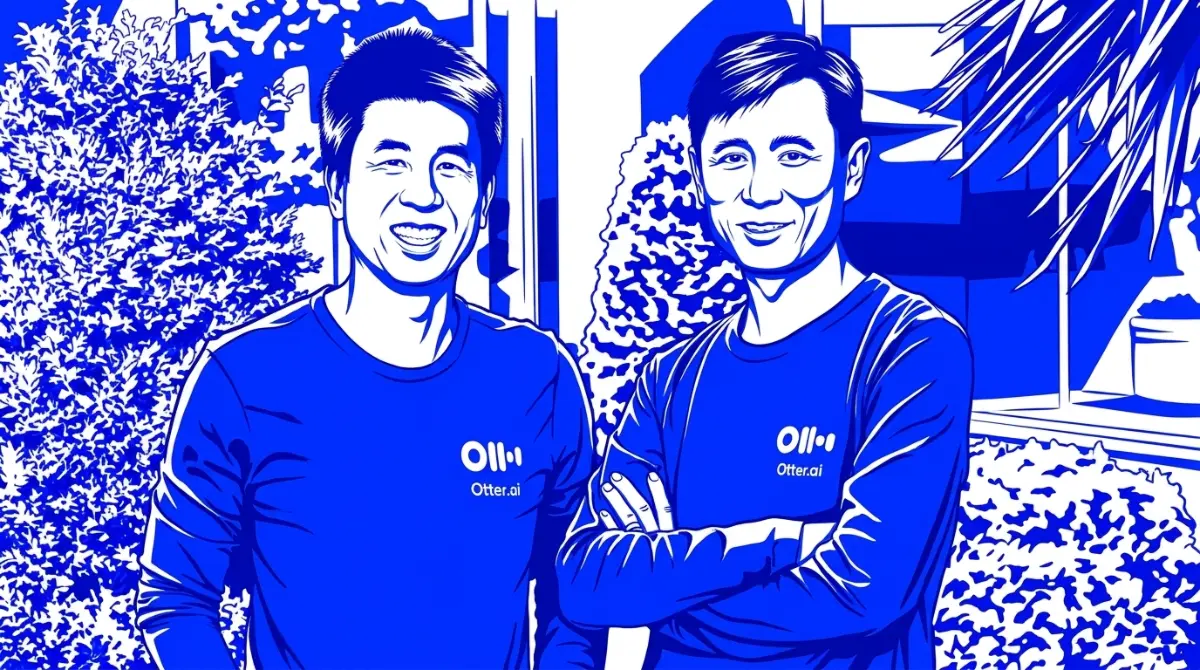


Otter.ai Raises $320M to Build Enterprise AI Agents
Meeting transcription pioneer Otter.ai raised $320M from General Catalyst Customer Value Fund to expand beyond basic speech-to-text, deploying autonomous workplace agents that extract decisions, assign project deadlines, and sync corporate tasks across Fortune 500 networks.
Umar Thariwat | · 9 min read

Corporate boardrooms are filled with conversations that produce zero documented action. In typical enterprise offices, teams spend hours in virtual conference rooms debating product designs, marketing budgets, and sales targets. Once participants close their video screens, agreements dissolve into conflicting memories. Important action items slip through administrative cracks, project deadlines go unrecorded, and managers schedule follow-up sessions to discuss what was supposed to happen in the previous meeting. Speech transcription pioneer Otter.ai is working to transform that conversational waste into reliable corporate records. On Tuesday, October 20, 2026, the Mountain View software venture announced a $320M growth investment from General Catalyst Customer Value Fund. The capital injection funds a strategic expansion beyond passive speech-to-text transcription toward autonomous software agents that execute corporate tasks based on spoken words. The funding arrives as enterprise software providers race to automate routine office chores, a corporate transition visible when Superhuman acquired meeting automation tools.
The investment represents an important validation for co-founders Sam Liang and Yun Fu, who launched Otter in 2016 to solve audio transcription. The platform now supports over 40 million registered users, with corporate teams across more than 86% of the Fortune 500 using the software to capture spoken dialogue. Having transcribed more than one billion meetings, Otter holds one of the largest private collections of conversational business audio in the world. The company plans to use the $320M to fund international sales offices, expand its enterprise engineering teams, and deploy agentic workflows that turn raw audio transcripts into completed business deliverables. The round highlights how corporate investors are backing software that saves verifiable human working hours, matching productivity patterns we analyzed when corporate technology deployments replaced thousands of administrative hours.
The Customer Value Fund Structure and Growth Capital
To grasp why General Catalyst committed $320M to Otter, one must look at the financial structure of the transaction. Rather than investing through a traditional venture capital partnership that demands massive equity dilution and board seats, the capital comes from General Catalyst Customer Value Fund.
The Customer Value Fund was designed specifically to fund customer acquisition and international expansion for established software companies with proven unit economics. Instead of diluting existing stockholders at volatile private valuations, this fund provides growth capital linked to predictable customer contract renewals and lifetime revenue metrics. For Otter, which previously raised capital from Spectrum Equity, Horizon Ventures, and Draper Associates, the structure provides substantial financial reserves without forcing the founders to surrender corporate control. General Catalyst calculated that Otter high customer retention and strong gross margins make it a low-risk borrower of growth capital. The funding will support enterprise sales teams targeting multinational accounts, helping Otter compete against bundled software offerings from tech giants. The corporate discipline required to finance mature software ventures mirrors strategies we tracked when Ramp expanded autonomous financial systems.
Moving From Passive Transcription to Autonomous Agents
The strategic justification behind the $320M round centers on a fundamental product shift: transitioning from passive transcription to active software execution. For eight years, Otter built its brand on being an accurate digital scribe. The software joined Zoom, Microsoft Teams, and Google Meet calls, transcribing spoken dialogue in real time and generating summary bullet points.
While summaries are convenient, they still require human workers to read the notes, copy information into project management systems, and write follow-up messages. Otter is deploying what chief executive Sam Liang terms enterprise agentic workflows. Under this architecture, the software listens to a client meeting, extracts agreed decisions, and takes action in connected business systems automatically. If a sales executive tells a client, "I will send you a revised contract with a ten percent discount by Thursday," the agent updates the client deal record in Salesforce, generates a draft proposal inside Google Docs, and schedules an approval alert on the sales director calendar. By executing tasks without human data entry, Otter removes the administrative drag that slows corporate sales cycles. Autonomous workplace coordination matches software developments we examined in our review of Catch securing seed capital for automated assistants.
Comparing Enterprise Meeting and Transcription Platforms
| Platform Solution | Primary Product Focus | Registered User Base | Ecosystem Integration | Autonomous Agent Execution | Enterprise Security Controls |
|---|---|---|---|---|---|
| Otter.ai | Cross-platform conversational intelligence | Over 40 million registered users | Agnostic (Zoom, Teams, Meet, in-person) | Native automated CRM and task syncing | SOC 2 Type II, HIPAA, private vaults |
| Microsoft Teams Copilot | Bundled Office 365 assistance | Hundreds of millions of commercial seats | Strictly locked inside Microsoft ecosystem | Power Automate script connections | Enterprise Microsoft Entra governance |
| Fireflies.ai | Voice recording and team search | Estimated 5 million business users | Broad video conferencing support | Basic API triggers and Zapier webhooks | Standard business data encryption |
| Granola | Screen-aware personal notepad | Early-stage individual professional user base | Local macOS audio capture | Manual export to Notion and Slack | Local client-side encryption |
The comparison matrix makes Otter competitive advantage clear. While Microsoft Copilot works well within pure Microsoft environments, modern enterprises use a mix of video software: hosting partner calls on Zoom, internal syncs on Google Meet, and customer webinars on Microsoft Teams. Otter platform-agnostic design allows an enterprise to maintain a single conversational record across all video tools. That independence prevents information silos from forming between departments that use different communication software. The push toward cross-platform tools reflects software trends we documented when Thally deployed automated knowledge layers across enterprise software suites.
Sales Teams as the Commercial Adoption Engine
A primary reason Otter achieved strong enterprise penetration is its focus on corporate sales organizations. In B2B sales, account executives spend hours every day on discovery calls with prospective clients. After each call, sales representatives are expected to update customer relationship management systems like Salesforce or HubSpot, recording client budgets, procurement timelines, and technical requirements.
Sales professionals dislike manual data entry. Studies show that account executives spend less than thirty percent of their working hours actually selling, with the remainder consumed by administrative paperwork. Otter Sales feature set automates this documentation. The software listens to client sales calls, extracts customer objections, identifies competitor mentions, and populates CRM deal fields automatically. If a prospective client mentions that their legal department requires specific data residency terms, the agent flags the requirement for the solutions engineering team immediately. By removing administrative chores from sales staff, Otter helps sales organizations close deals faster, giving enterprise buyers a clear financial justification for company-wide licensing contracts. The commercial value of automated sales tools matches software models we explored when Spott raised capital for automated sales software.
Overcoming Privacy Fears in Regulated Boardrooms
Despite strong user growth, Otter faces persistent security challenges in conservative corporate environments. Financial institutions, medical providers, and defense contractors maintain strict policies regarding meeting recordings. Corporate risk managers worry that an uninvited transcription bot joining a sensitive board meeting or personnel review could capture confidential information that violates privacy mandates.
Otter has spent years hardening its security infrastructure to satisfy enterprise risk audits. The company achieved SOC 2 Type II certification, maintains compliance with European GDPR standards, and offers dedicated HIPAA business associate agreements for healthcare clients. The software includes administrative controls that let company administrators block bots from joining specific internal calls, mandate single sign-on authentication, and enforce automatic deletion policies that purge audio files after thirty or sixty days. Furthermore, Otter provides contractual guarantees that customer audio recordings are never used to train public machine learning models. Demonstrating strict data security boundaries is mandatory for software companies handling sensitive records, a requirement we analyzed when Warp automated human resource administrative operations.
The Looming Threat of Hyperscaler Bundling
The greatest long-term commercial challenge confronting Otter is the pricing power of cloud monopolies. Microsoft, Google, and Zoom are actively embedding their own conversational intelligence tools directly into their video conferencing platforms. Microsoft includes basic transcription and summarization in its enterprise Office 365 tiers, while Zoom offers Zoom AI Companion at no additional cost to paid business subscribers.
When an enterprise chief information officer looks to reduce corporate software budgets, canceling third-party subscriptions in favor of free bundled features is tempting. To defend its market position, Otter must maintain a significant capability advantage over generic bundled tools. Free bundled tools provide simple summaries; Otter is betting that enterprise buyers will pay for multi-platform integration, custom CRM automations, and agentic workflows that generic tools cannot match. The corporate struggle between specialized software innovators and bundled platform monopolies matches dynamics we evaluated in our report on cloud hyperscalers overhauling enterprise messaging.
Expanding Global Footprints and International Languages
Otter plans to use the $320M investment to accelerate international expansion outside North America. While the software built a commanding presence in English-speaking corporate markets, multinational corporations operate in dozens of languages across Europe, Latin America, and Asia.
The company is expanding its automatic speech recognition models to support Spanish, French, German, Japanese, and Mandarin, allowing global enterprises to standardize on Otter across international offices. Expanding language coverage requires training specialized acoustic models that understand regional accents, localized business terminology, and multilingual code-switching during team calls. Otter is establishing regional sales and support hubs in London, Tokyo, and Singapore to court multinational clients directly. The discipline required to scale specialized technical software across international borders reflects patterns we tracked when Lovable hit revenue records through Fortune 500 adoption, alongside global banking expansions analyzed when Revolut expanded international operations against banking incumbents.
The Future of Spoken Enterprise Knowledge
Otter.ai $320M growth round demonstrates that spoken conversation is becoming the most valuable raw material in enterprise computing. For decades, business knowledge was locked inside written documents, spreadsheets, and slide presentations. The vast majority of real decisions: the debates, the compromises, and the strategic choices: occurred verbally in meetings and were immediately forgotten.
By capturing spoken dialogue, transcribing words with high accuracy, and deploying autonomous agents to execute follow-up tasks, Otter is building the institutional memory for modern corporations. As Sam Liang and his team deploy their growth capital, they are proving that the future of workplace productivity is not about attending more meetings or typing faster notes; it is about building software that listens, remembers, and acts so that human workers can focus on high-stakes strategy and creative thinking. In the modern enterprise, the companies that succeed will be those that turn spoken words into verified business action.
Read More on TechRobust:
Umar Thariwat
 LinkedIn
Umar Thariwat
Expertise:Tech News Reporting, Tech Business Analysis, Economic Foundations, Market Trends, Digital Economy
Award:Rising Voice of the Year 2025
Thariwat is a Staff Writer and Reporter covering tech news and enterprise trends at TechRobust. Blending daily reporting with her ongoing academic background in economics, she analyzes earnings, digital market, and the commercial strategies powering the global tech sector.