
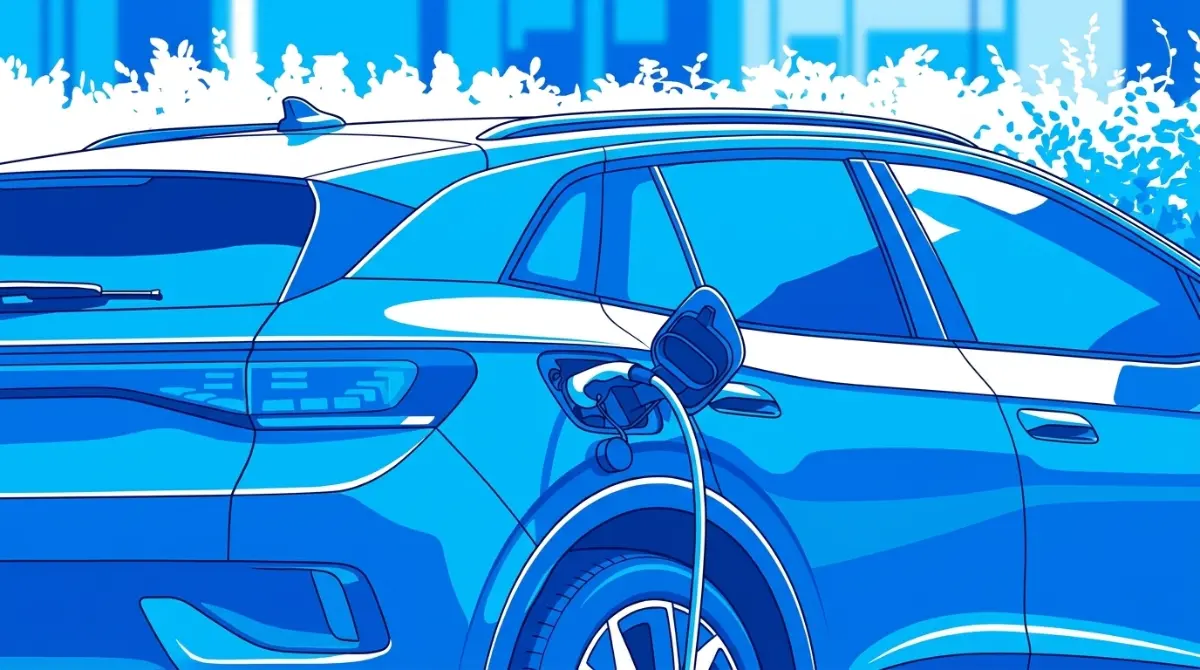


Why America Cannot Escape the Electric Vehicle Future
American drivers remain hesitant about pure battery power, but falling manufacturing costs and global regulatory demands mean the electric transition will happen regardless of political debate.
Umar Thariwat | 18 Sept. 2026 · 6 min read

American car dealerships are caught in an intense cultural and commercial standoff. On showroom floors from Dallas to Detroit, rows of battery-powered pickup trucks and crossovers sit parked under sales banners, their windshield stickers slashed with unadvertised rebates. Dealership managers report that mainstream car buyers walk past high-voltage models, asking instead for conventional gasoline engines or traditional hybrid powertrains. Media commentators point to cooling sales figures as evidence that the electric mobility experiment has ended in failure. That conclusion misunderstands modern manufacturing economics. While consumer adoption has hit an expected plateau, international automotive competition and industrial supply investments have locked the global transport sector onto an electric track that domestic politics cannot derail.
The numbers behind this transition reveal steady market penetration rather than sudden collapse. Independent automotive market data shows that electric cars and plug-in hybrids accounted for approximately 10% of light-duty vehicle sales across the United States in 2025. That total tracks behind California, where zero-emission registrations clear 25%, but it represents a substantial base of over 1.5 million vehicles hitting domestic highways each year. Global totals put the American debate into perspective. In China, clean vehicles capture more than 50% of monthly consumer deliveries, while European markets consistently top 20%. American automakers understand that developing purely combustion platforms cuts them off from overseas buyers. We documented how autonomous electric platforms attract heavy corporate capital when reporting on how Crusoe secured a $3B funding round at a $30B valuation for data centers.
The Cultural Resistance to Battery Power
Understanding why American buyers hesitate requires examining practical daily habits rather than ideological arguments. Early adopters who purchased luxury electric sedans five years ago owned suburban homes with dedicated garages. They plugged their vehicles into domestic 240-volt circuits every night, waking up to full batteries without ever visiting a public filling station. Mainstream motorists face an entirely different set of physical hurdles.
Tens of millions of American households rent apartments, live in multi-family units, or rely on street parking where installing a home charger is impossible. When those drivers evaluate an electric car, they calculate how many hours they will spend sitting at highway fast-charging plazas each week. News reports highlighting broken payment screens, frozen charging cables during winter storms, and long lines at charging plazas validate their skepticism. For families living on strict budgets, paying a premium sticker price for a vehicle that makes daily logistics harder is an irrational decision. Automakers spent years marketing high-end performance gadgets instead of building dependable, low-cost transportation for working families.
Hybrids Emerge as the Pragmatic Middle Ground
While purists argue that plug-in transitions must happen overnight, consumers have voted with their wallets for hybrid powertrains. Dealership lots cannot keep hybrid versions of popular trucks and sport utility vehicles in stock. By pairing small internal combustion engines with compact electric battery packs, hybrids eliminate charging anxiety while delivering immediate reductions in weekly fuel bills.
Automotive giants like Toyota, Ford, and Hyundai are responding by reallocating factory lines to expand hybrid availability across their catalogs. A hybrid vehicle requires no change in driver behavior, charges its battery using regenerative braking, and costs thousands less to produce than an electric car carrying an eighty-kilowatt battery pack. This commercial shift provides automotive manufacturers with vital operating cash flow while battery production lines mature. Pragmatic bridge technologies allow automakers to meet tightening regional emission baselines without alienating their core customer base, an operational compromise we tracked when analyzing Framework adjusting component pricing to protect customer trust.
The Relentless Physics of Falling Battery Costs
Consumer skepticism and political speeches cannot change the laws of industrial scaling. The primary barrier to electric vehicle parity has always been the purchase price of the chemical battery pack. In 2010, lithium-ion battery cells cost over $1,200 per kilowatt-hour. Today, commercial battery costs have dropped below $115 per kilowatt-hour, with advanced lithium-iron-phosphate chemistries approaching $70 per kilowatt-hour at the factory gate.
When battery packs fall below $100 per kilowatt-hour, electric vehicles become cheaper to manufacture than equivalent internal combustion vehicles. An electric drivetrain contains roughly twenty moving components, compared to over two thousand moving parts inside a modern gasoline engine and transmission system. Electric drivetrains eliminate exhaust pipes, spark plugs, catalytic converters, fuel injectors, and mechanical gearboxes. Once battery costs cross the parity threshold, producing combustion engines becomes an expensive, uncompetitive liability for factory operators. Legacy automakers that postpone electric architecture development will eventually find themselves undercut by international rivals producing simpler, cheaper electric platforms.
Infrastructure Reliability Replaces Range Anxiety
The conversation among vehicle owners is shifting from battery range to charger reliability. Modern battery designs easily deliver 250 to 300 miles of driving range on a single charge, which exceeds the daily driving requirements of 95% of American motorists. The real problem is knowing whether a roadside charger will work when a driver arrives with a low battery.
The industry took an important step toward solving this issue when major domestic brands adopted Tesla's North American Charging Standard connector. Giving competing electric brands access to thousands of reliable Supercharger stations removes a major headache for highway travel. Simultaneously, regional utility programs and private operators are installing thousands of curbside plugs in urban centers, bringing overnight power to street parkers. Fixing the charging network is not a scientific mystery; it is an unglamorous civil engineering task that requires reliable software, regular physical maintenance, and simple payment interfaces.
The Inevitability of the Electric Platform
The debate over whether America will adopt electric transportation often confuses short-term political swings with long-term industrial momentum. Politicians may adjust federal purchase tax credits or roll back fuel economy standards during election seasons. However, global automotive corporations plan vehicle platforms on seven-year development cycles and invest billions in manufacturing facilities designed to operate for decades.
Automakers cannot afford to build two separate vehicle lineups: one dirty fleet for North America and one clean fleet for the rest of the world. International trade rules, corporate carbon disclosures, and overseas regulatory bans will force global brands to maintain their electric development schedules. The transition will not happen in a clean, uninterrupted line. It will move forward through hybrid compromises, price adjustments, and steady charging network expansion. American drivers may resist the initial shift, but as battery costs fall, charging stations become ubiquitous, and used electric cars flood secondary markets, the economic reality will settle the debate. Electric mobility is coming to American roads not because of political speeches, but because modern engineering inevitably replaces outdated machinery.
Read More on TechRobust:

Umar Thariwat
 LinkedIn
Umar Thariwat
Expertise:Tech News Reporting, Tech Business Analysis, Economic Foundations, Market Trends, Digital Economy
Award:Rising Voice of the Year 2025
Thariwat is a Staff Writer and Reporter covering tech news and enterprise trends at TechRobust. Blending daily reporting with her ongoing academic background in economics, she analyzes earnings, digital market, and the commercial strategies powering the global tech sector.