
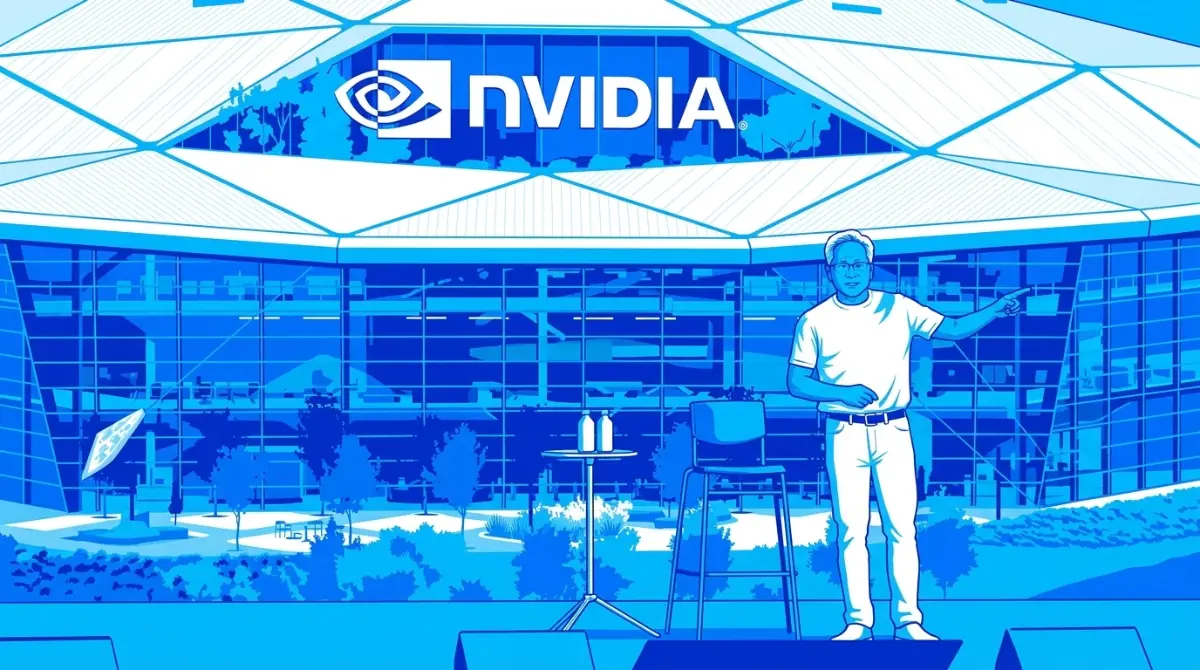


Nvidia Weighs Reflection AI Buyout to Secure Coding Models
Nvidia entered early discussions to deepen its investment in or acquire open-weight software startup Reflection AI, seeking to integrate developer tools and defend its platform against low-cost competitors.
Umar Thariwat | 11 Oct. 2026, 11:11 AM · 6 min read

Corporate platform giants are buying up the software layers that run on their silicon chips. For two years, hardware suppliers sat back and watched software startups burn billions in venture capital buying graphics cards. Silicon makers collected record profits without taking on consumer application risks. As open-weight model architectures converge and overseas laboratories release capable software for pennies, the tech giants controlling computing hardware are changing tactics. On Saturday, October 10, 2026, the Financial Times reported that Nvidia is in early discussions to either expand its investment in or acquire open-model startup Reflection AI. Having previously injected $800M into the venture, the Santa Clara chipmaker is exploring an outright acquisition or an expanded strategic stake. The discussions arrive as competition across developer coding models reaches unprecedented intensity, an operational shift we tracked when Cognition AI reached a $1B revenue run rate on software coding demand.
The potential transaction reflects an aggressive move by Nvidia chief executive Jensen Huang to protect the broader ecosystem surrounding his hardware empire. Reflection AI made headlines across developer communities by launching Beam, an open-weight model engineered specifically to execute multi-step software coding, debugging, and terminal automation. The architecture was trained to compete directly against lower-cost alternatives like DeepSeek and Kimi, proving that open models could match proprietary commercial systems without charging expensive per-token subscription fees. People familiar with the matter cautioned that talks remain in early stages and could fall apart without an agreement. However, an outright purchase would bring one of the premier open-model engineering teams directly onto Nvidia balance sheet. The strategy behind acquiring specialized software firms matches corporate moves we analyzed when Nvidia acquired Hugging Face in a multi-billion dollar deal.
Acquiring Frontier Talent Through Software Consolidation
To understand why Nvidia is weighing a multi-billion-dollar acquisition of a startup it already backs, one must look at the intense corporate competition for elite research talent. Training frontier models requires rare expertise: researchers who understand distributed cluster optimization, loss curve stabilization, and post-training reinforcement loops.
Technology conglomerates like Meta, Google, and Microsoft have absorbed top-tier researchers through acquihire deals, paying fortunes to fold founding teams into corporate research labs. Reflection AI assembled a technical team with deep experience in agentic tool use and synthetic code distillation. Acquiring the firm outright allows Nvidia to secure that talent pool permanently, preventing rival cloud operators from recruiting them away. By pairing Reflection AI algorithmic researchers with direct, unconstrained access to Nvidia internal supercomputing clusters, the hardware giant can accelerate its own software tools. How talent concentration shapes platform dominance was explored in our analysis of the global competition for top-tier machine learning engineers.
Defending the CUDA Moat Against Asian Open Models
The strategic urgency behind the discussions stems from the rapid rise of competitive open-weight models originating in Asia. Over the past twelve months, research labs like DeepSeek, Moonshot AI, and Alibaba released capable models that perform complex coding and reasoning at a fraction of Western token costs. These models have gained rapid traction among independent developers and enterprise software startups.
This dynamic introduces long-term commercial risks for Nvidia. If developers adopt overseas models optimized for alternative hardware or running on lightweight architectures that bypass CUDA libraries, Nvidia pricing power over enterprise data centers could erode. By owning and distributing premier open-weight models like Beam, Nvidia ensures that the global developer standard remains firmly anchored to its proprietary software platforms. Developers downloading Reflection AI models will naturally optimize their software pipelines for Nvidia hardware, reinforcing the company dominance over cloud computing infrastructure. We evaluated how low-cost models pressure Western software firms in our report on leading cloud providers slashing model prices.
The Acqui-Hire Playbook and Antitrust Scrutiny
Executing an acquisition in the current regulatory environment requires careful corporate structuring. Antitrust regulators in Washington, London, and Brussels are investigating how dominant technology monopolies acquire early-stage startups. Regulators fear that platform titans are systematically buying up nascent competitors before they can grow into independent corporate threats.
To avoid lengthy regulatory reviews and anti-monopoly lawsuits, tech giants have turned to acqui-hire transactions. In these deals, the corporate buyer hires the startup founders and core engineering staff while paying licensing fees for company technology, leaving an empty corporate shell behind to avoid formal merger filings. Nvidia must decide whether to pursue a clean acquisition that triggers regulatory scrutiny or structure an operational partnership that absorbs the technical team. Regulators at the Federal Trade Commission and the Department of Justice are scrutinizing these creative structures, warning that disguised buyouts will face formal enforcement actions. Managing corporate transactions against strict anti-monopoly laws was examined in our report detailing regulators demanding verified ownership records for private tech transactions.
The Rising Valuation of Open Model Ecosystems
The $800M initial investment previously committed by Nvidia demonstrates how valuable open-weight architectures have become to industrial balance sheets. In 2023, Wall Street analysts viewed open models as unprofitable charity projects run by researchers who did not understand recurring revenue. Today, open-weight models serve as the foundational distribution layer for modern enterprise software.
When an open model achieves millions of downloads, it creates developer loyalty that proprietary platforms cannot easily break. Reflection AI Beam model gave developers an unconstrained tool to build autonomous coding agents, terminal assistants, and automated software testing suites on local hardware without paying recurring token fees to OpenAI or Anthropic. For Nvidia, subsidizing and owning that open layer is good business: every developer running open models needs physical graphics silicon to run inference. The commercial economics of open-weight platforms match developments we tracked when Mistral unveiled competitive open-weight models.
Balancing Merchant Neutrality and Software Ownership
Despite the strategic benefits, buying Reflection AI introduces delicate relationship challenges with Nvidia existing enterprise software clients. Nvidia sells graphics cards and cloud compute to software startups like OpenAI, Anthropic, Cognition AI, and Cursor. If Nvidia buys a direct competitor in automated coding and software engineering, its clients will view the company as a rival rather than a neutral hardware supplier.
Software partners worry that Nvidia will optimize its newest hardware features and microcode drivers for its own in-house models, leaving outside customers at a performance disadvantage. Jensen Huang must reassure his commercial partners that Nvidia remains an open merchant supplier committed to supporting all software frameworks. Navigating the line between enabling an ecosystem and competing against it is one of the hardest corporate balancing acts in enterprise computing. Platform competition across commercial developer tools was detailed in our coverage of Microsoft executives outlining autonomous software operating systems.
The Maturation of Enterprise Computing Giants
The discussions between Nvidia and Reflection AI confirm that the boundaries separating semiconductor manufacturers from software laboratories are disappearing permanently. To maintain market leadership in the era of machine intelligence, an enterprise cannot simply sell bare silicon chips; it must control the algorithms, developer platforms, and open models that run on that silicon.
Whether Nvidia chooses to acquire Reflection AI outright or deepen its financial investment, the move signals an aggressive push to dominate the developer workflow. As software programming becomes increasingly automated, the company that provides both the hardware processors and the coding models will hold unmatched power over the digital economy. The corporate chess match for control of enterprise computing is moving fast, and Nvidia is ensuring it owns every piece on the board.
Read More on TechRobust:

Umar Thariwat
 LinkedIn
Umar Thariwat
Expertise:Tech News Reporting, Tech Business Analysis, Economic Foundations, Market Trends, Digital Economy
Award:Rising Voice of the Year 2025
Thariwat is a Staff Writer and Reporter covering tech news and enterprise trends at TechRobust. Blending daily reporting with her ongoing academic background in economics, she analyzes earnings, digital market, and the commercial strategies powering the global tech sector.