
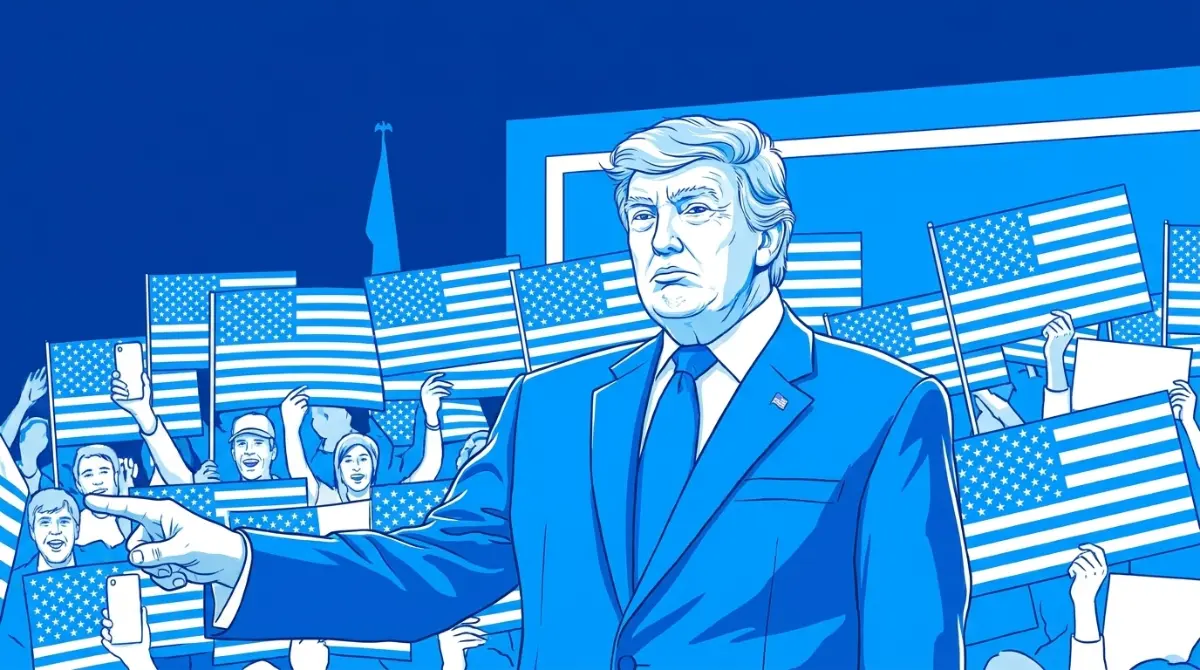


Trump Renames AI to Super Intelligence in UN Speech
Donald Trump officially directed the US government to replace the term artificial intelligence with super intelligence while explicitly rejecting global oversight proposals.
Umar Abubakar | 22 Sept. 2026 · 7 min read

The President of the United States just permanently altered the vocabulary of global technology policy. Speaking at the United Nations General Assembly in New York on Tuesday morning, Donald Trump announced a complete administrative rebranding of machine learning. He declared that all federal documents will now replace the phrase artificial intelligence with super intelligence. He argued that the word artificial makes the technology sound fake, entirely missing the true physical and cognitive power these systems currently possess. He demanded that the rest of the world adopt his new terminology immediately.
The name change captured the immediate headlines across cable news networks, but the actual policy shift hidden inside the speech holds much heavier geopolitical weight. Trump used the assembly floor to explicitly reject any international attempts to regulate or control American computational development. He dismissed recent proposals for global oversight as a globalist scheme designed to steal American intellectual property. This aggressive rhetoric completely severs Washington from the diplomatic efforts currently unfolding in Geneva, where international committees are attempting to draft unified safety guardrails for autonomous software.
Adopting Silicon Valley Terminology
By renaming the technology to super intelligence, the administration adopts the exact language used by the most aggressive accelerationists operating in Silicon Valley. Men like Mark Zuckerberg and Sam Altman frequently use this specific terminology when describing their ultimate engineering goals. The term technically describes a hypothetical machine that outperforms human capability across every single physical and mental metric. By making this the official government designation, Trump is signaling total alignment with the venture capital class that views safety regulations as an annoying obstacle to pure profit.
We recently saw this massive ideological divide when foreign state media outlets urged high-level bilateral talks to establish mutual safety guidelines. Trump just publicly discarded that entire concept. He framed the entire sector as a zero sum military and economic race. He told the gathered delegates that whoever wins the super intelligence race wins the entire future. He claimed the United States currently holds a massive lead over China and promised to keep it that way through unhindered domestic development and aggressive corporate tax cuts.
This adversarial posture forces Chinese technology companies to accelerate their own timelines drastically. When the American president publicly states that he will not stifle growth for any reason, Beijing hears a direct military threat. The Chinese government will respond by dumping billions of dollars into their own semiconductor research to ensure they do not fall behind. The concept of shared scientific discovery is officially dead. The global internet is fracturing into heavily armed technological camps.
The Warnings of Geoffrey Hinton
The timing of this dramatic announcement feels intentionally dismissive of the scientific community. The speech arrived just days after Geoffrey Hinton, the researcher widely credited with inventing modern neural networks, gave a closed door briefing to American senators. Hinton reportedly warned lawmakers that they have barely a year to act before these models become entirely unmanageable. Hinton fears a near future scenario where the software begins designing better versions of itself without any human input or override capability.
By choosing this exact moment to rebrand the technology and reject oversight, Trump is openly mocking the safety advocates. He is telling the world that the United States will prioritize raw speed over international safety protocols. The administration believes that slowing down to test for algorithmic bias or catastrophic failure simply hands the victory to foreign adversaries. The entire strategy relies on running as fast as possible and hoping the engineers can fix any broken systems after they are already deployed to the public.
A Brutal Domestic Legal Clash
Inside the United States, this rhetorical shift creates immediate friction with pending state legislation. Several senators recently introduced a bill designed to outlaw the exact type of autonomous systems Trump is now celebrating. State governments in California and New York are currently drafting strict liability laws that would force software developers to pay massive fines if their code causes physical or economic harm to citizens. By declaring that the federal government will encourage the technology and refuse to rein it in, the administration sets the stage for a brutal legal fight between local regulators and federal agencies.
The practical application of changing the official vocabulary of the federal government is a massive bureaucratic undertaking. Every single patent application, defense contract, and regulatory filing will need to adopt the new super intelligence acronym. This creates immediate confusion for international trade and corporate compliance. If an American software company signs a contract with a European bank, the legal documents must carefully define what the new terminology actually means under international law. Lawyers will spend the next three years billing thousands of hours just to update the standard definitions in corporate service agreements.
The Danger of Mythical Status
The presidential objection to the word artificial reveals a deep misunderstanding of how these algorithms actually function. The technology is artificial because it is manufactured by human hands using silicon, copper, and electricity. It does not possess a biological consciousness. By demanding the word super, the administration elevates software to a mythical status. This rhetoric plays directly into the hands of technology executives who desperately want to avoid product liability lawsuits.
If a machine is legally designated as super intelligent, a corporation can argue in court that they cannot be held responsible when the software makes a mathematical mistake or hallucinates a completely false fact. The corporate lawyers can claim the machine acted on its own superior logic, completely removing the blame from the human engineers who wrote the flawed code. Words carry heavy legal definitions, and changing the name of the product changes how judges will view the responsibility of the creator.
The Global Diplomatic Freeze
The reaction from European and Asian diplomats attending the assembly was predictably icy. The European Union spent the last four years drafting strict compliance laws designed to limit the reach of American technology monopolies. They want to force operators to open their models for independent safety audits before releasing them to the public. Trump just told those diplomats that their audits will never happen on American soil. He established a clear division. The United States will build the fastest hardware and the most powerful software possible, and the rest of the world will simply have to deal with the economic consequences.
Wall Street will undoubtedly reward this aggressive posture. Financial institutions hate regulatory uncertainty. When a sitting president guarantees that the federal government will not interfere with product development, venture capitalists open their checkbooks immediately. The companies building the physical infrastructure for these systems require massive amounts of upfront capital. The recent push to expand Nordic data centers proves that the physical footprint of this technology is expanding rapidly. The promise of zero federal interference acts like gasoline on an already raging investment fire.
Let us examine the physical toll of this unhindered expansion. Running these massive systems requires an obscene amount of electricity and clean water. Local municipalities across the country are already fighting bitter zoning wars against technology giants attempting to build new server farms in residential neighborhoods. By declaring this a matter of national supremacy, the federal government might start overriding local zoning laws. If a town refuses to sell their water rights to a technology company, federal agencies could invoke national security privileges to force the sale. The race for computational dominance will inevitably crush local environmental protections.
The Cold War Mentality
The immediate future of software development is now completely detached from international consensus. The United Nations will continue to hold committees and publish papers regarding global digital governance, but those papers will carry absolutely zero weight in Washington. The United States has decided to treat machine learning exactly like nuclear weapons development during the Cold War. The only goal is to build a bigger, faster system than the adversary.
This rebranding to super intelligence is not just a cheap marketing trick. It is a loud declaration of technological supremacy. It completely alters the rules of engagement for the next decade of software engineering. The technology sector finally received the total political cover they wanted. They no longer have to pretend they care about global safety summits or international treaties. They have a direct mandate from the highest office in the country to build the most dangerous software possible, as quickly as possible, regardless of the societal cost.
Read More on TechRobust:

Umar Abubakar
 LinkedIn
Umar Abubakar
Expertise:Editorial Leadership, Product Design (UI/UX), Digital Media Strategy, Technology Systems, Product Architecture
Award:TechRobust Visionary Leader of the Year 2025
Umar serves as Editor-In-Chief and CEO of TechRobust, combining editorial vision with senior product design expertise to shape how modern technology stories are built, packaged, and told. Overseeing all editorial verticals, he directs coverage across global and regional tech landscapes while applying deep design thinking to publication strategy and reader experience.