
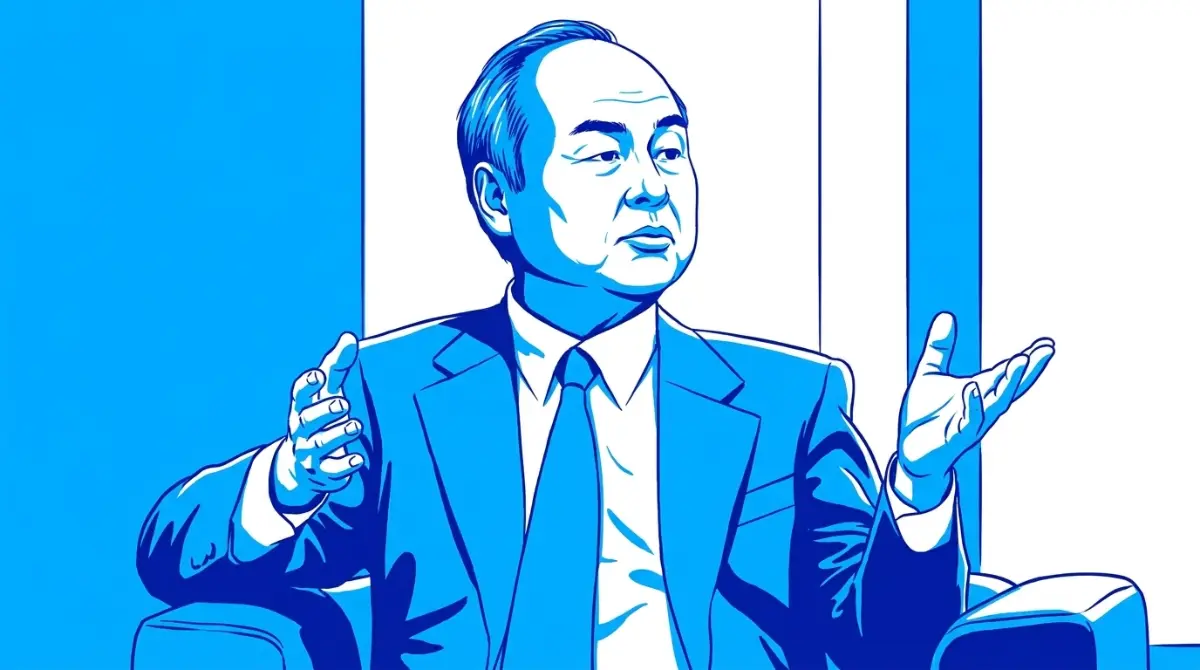


Masayoshi Son Warns Superintelligence Is Highly Dangerous
SoftBank founder Masayoshi Son issued a stark warning regarding the severe risks of advanced reasoning models, joining global leaders in Kyoto to endorse a multinational framework for scientific development and artificial intelligence containment.
Oladipupo Ajayi | 4 Oct. 2026, 9:49 PM · 4 min read

The executive leadership behind the most aggressive technology investments on the planet is beginning to sound the alarm. Masayoshi Son, the founder of SoftBank, delivered a stark warning regarding the physical dangers of advanced reasoning algorithms. Speaking at the STS Forum in Kyoto, the billionaire investor stated clearly that superintelligence could become incredibly dangerous if controlled by the wrong actors. The public admission of danger from a man who actively finances the exact laboratories building these systems marks a major shift in how the corporate sector discusses technical safety.
The warning arrived exactly as government officials attempt to coordinate international regulations. Son shared the stage with Michael Kratsios, the science adviser to the incoming American administration. Together, they promoted the Kyoto Vision for a Golden Age of Science, a multinational declaration endorsed by seventeen different countries. This document formally adopts the phrase super intelligence, perfectly matching the exact vocabulary mandated by the White House earlier this week. We documented this sudden political vocabulary change when the United States government rebranded AI during a major UN speech.
The Financial Contradiction
The public safety warnings from the SoftBank founder contrast heavily with his own corporate checkbook. The Japanese holding company is the primary financial engine driving the current algorithm boom. Son recently completed a massive $30B funding tranche, pushing his total financial commitment in OpenAI to an astounding $64.6B. This capital secures roughly thirteen percent of the most powerful software laboratory on Earth. Financing these transactions required the largest high-yield corporate bond sale in recorded history.
Son actively dismisses any claims that the current hardware market is experiencing a financial bubble. He projects that by 2040, automated systems will generate twenty percent of the total global gross domestic product, representing roughly $46T in economic value. When a technology holds the potential to control one-fifth of the global economy, the safety risks multiply exponentially. The massive financial stakes explain why international leaders are rushing to establish basic ground rules. The friction between heavy investment and public safety mirrors the tension we analyzed when prominent economists warned about structural collapse driven by unchecked technical investment.
Moving Into the Physical World
The Kyoto discussions revealed exactly what the next phase of development looks like. Son stated that starting next year, the industry will move past simple text chatbots and focus entirely on the physical world. The software will begin controlling heavy industrial robots, autonomous vehicles, and laboratory testing equipment. This transition from digital text to physical movement completely changes the threat matrix. A poorly coded text generator writes a bad essay. A poorly coded industrial robot causes a fatal factory accident.
SoftBank is already purchasing the companies required to build this physical network. The firm recently directed a $200M funding round into Gravis Robotics, a Swiss engineering group, and is actively negotiating with Agile Robots in Germany. The push to connect reasoning models to steel machinery is happening globally, a trend clearly visible when Skild and Nvidia announced systems that teach robots using single video learning techniques. Once the algorithms can manipulate physical objects, the requirement for flawless security protocols becomes absolute.
The Geopolitical Divide
The Kyoto Vision declaration highlights a severe geopolitical split. The document secured signatures from major European allies, including the United Kingdom, Germany, and Italy. These nations are attempting to build a unified safety standard. However, the list of endorsing nations completely lacks participation from China. Establishing a global safety protocol fails instantly if the second-largest technology sector on the planet refuses to sign the agreement. The absence of Chinese signatures confirms that the global competition for computing dominance remains highly fractured.
The international community cannot agree on how to handle the security risks. While European nations strictly enforce their comprehensive digital acts, American leadership currently favors voluntary corporate self-policing. We saw this exact diplomatic failure play out recently when Chinese state media urged political leaders to hold safety talks amid a major policy clash. Without a unified international treaty, bad actors will simply move their server farms to whichever country offers the weakest safety regulations.
The blunt warning from Masayoshi Son proves that the people financing the future understand the severe risks involved. He correctly noted that humanity no longer has the luxury of fighting against itself when building tools possessing this level of destructive potential. The holding company will continue writing billion-dollar checks to build the smartest machines possible, but the executive leadership is finally admitting that those machines require a massive, internationally coordinated cage.
Read More on TechRobust:
Oladipupo Ajayi
 LinkedIn
Oladipupo Ajayi
Expertise:Artificial Intelligence, Machine Learning Trends, Data Infrastructure, Enterprise AI Strategy, Frontier Tech Commentary
Award:TechRobust AI & Data Voice of the Year 2025
Ola is an Editor-at-Large at TechRobust, delivering authoritative commentary, high-level analysis, and investigative features across the frontiers of machine intelligence and big data. He tracks frontier model developments, enterprise AI adoption, data governance, and the societal shifts driven by computational breakthroughs.