
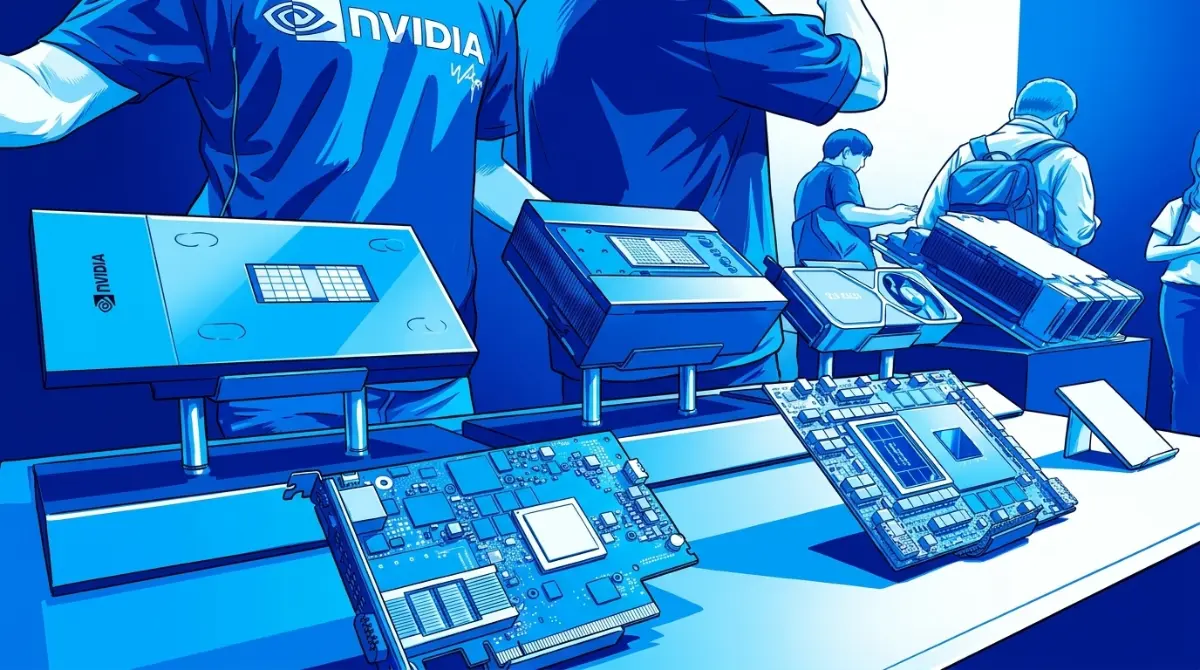


Nvidia Backed Upscale AI Unveils Token Fabric for Multi Vendor Chips
Nvidia backed startup Upscale AI launched Token Fabric, pairing proprietary switch silicon with Spectrum-X tech to link competing computing chips across server facilities without vendor lock-in.
Umar Abubakar | 8 Oct. 2026, 12:22 PM · 7 min read

Connecting thousands of computer processors inside industrial server halls has turned into the most expensive engineering riddle in modern computing. When cloud operators purchase silicon accelerators from different hardware vendors, getting those disparate chips to communicate without stalling server throughput is almost impossible. Historically, hardware builders locked customers into proprietary networking cables, forcing data facility managers to run pure Nvidia, pure AMD, or pure custom silicon clusters. Santa Clara networking venture Upscale AI is stepping in to smash those hardware walls. Backed by Nvidia, Salesforce, Singapore sovereign fund Temasek, and billionaire Azim Premji investment arm Premji Invest, the startup introduced Token Fabric. The open-standard platform pairs Upscale proprietary switch silicon with Nvidia Spectrum-X ethernet tech to link graphics chips, specialized processors, and custom accelerators from competing suppliers inside the same server hall. The launch follows aggressive infrastructure capital deployments across computing sectors, which we detailed when Crusoe secured $3B for large data center expansions.
The strategic timing of the announcement addresses severe procurement pressures facing cloud operators. Valued at $2B following a $190M funding extension in June that lifted total capital raised to $500M, Upscale AI is targeting commercial neoclouds and Tier-1 cloud platform operators that cannot afford to wait eighteen months for single-vendor hardware deliveries. Chief executive officer Barun Kar confirmed the company expects Token Fabric to generate commercial revenue in the tens of millions of dollars next year, with internal models projecting annualized software and hardware sales climbing into the low hundreds of millions by 2028. Upscale plans to ship the initial scale-out phase of Token Fabric in the fourth quarter of 2026, rolling out complete rack-level scale-up components across 2027. The shift toward open multi-vendor hardware architecture mirrors enterprise demands we tracked when analyzing how Axelera unveiled custom processing silicon for data factories.
The Physics of Server Interconnects and Idle Silicon Losses
To grasp why Token Fabric matters to cloud finance chiefs, one must inspect how distributed computing functions during massive model training runs. Training a large multimodal network requires carving neural weights across tens of thousands of individual silicon dies. In this architecture, calculation speed is only half the equation; chips must constantly exchange billions of intermediate parameter numbers across high-speed switch fabrics.
When networking cables choke or drop data packets, expensive graphics cards sit idle in their server racks, consuming megawatts of electricity while waiting for instructions. Inside a single rack, scale-up interconnects link eight to sixteen chips at multi-terabit speeds. Across a facility, scale-out networks link thousands of separate server cabinets. Proprietary links like Nvidia NVLink provide blazing scale-up performance, but they refuse to talk to competing chips from AMD or custom cloud silicon like Google TPU or Amazon Trainium. Token Fabric bridges that divide by running on open standard protocols, keeping silicon working rather than waiting. How physical component performance governs server efficiency was explored in our review of water and power constraints across multi-billion dollar server campuses.
Nvidia Double-Sided Investment Strategy
The most fascinating aspect of Upscale AI rise is the active financial backing of Nvidia itself. For years, critics accused the Santa Clara chip juggernaut of using its proprietary NVLink interconnect and CUDA software platform to establish an anti-competitive fortress around enterprise computing. Why would Nvidia back a startup designed to let customers run rival chips inside its own data center domains?
The answer reveals Nvidia sophisticated platform defense strategy. By late July, Nvidia had built an external equity investment portfolio exceeding $99B, buying strategic stakes across promising robotics, networking, and software ventures. In networking, Nvidia recognizes that hyperscalers like Microsoft, Meta, and Google will never tolerate total vendor lock-in forever; they are actively designing their own custom accelerators. By embedding its Spectrum-X ethernet technology inside Upscale open Token Fabric, Nvidia ensures that even when a cloud customer buys AMD chips or custom silicon, the underlying network switches and ethernet gear still run on Nvidia-licensed foundations. The tech titan loses nothing on chip diversity while locking in the underlying transmission pipes. We followed similar strategic corporate plays in our report detailing how Nvidia executed major corporate semiconductor moves.
Diagnostic Software and Predictive Hardware Maintenance
Beyond physical switch silicon and ethernet hardware, Token Fabric incorporates automated diagnostic software designed to eliminate silent cluster degradation. In massive server clusters containing hundreds of thousands of optical transceivers and cables, hardware components do not always fail with a clear crash. Often, an optical transceiver degrades slowly, introducing microscopic packet drops that degrade cluster training throughput by twenty percent without triggering a traditional system alert.
Upscale software layer continuously analyzes telemetry across every network switch port, measuring packet latency, signal attenuation, and buffer congestion in real time. The platform identifies microscopic data bottlenecks and flags failing transceivers or degrading optical fibers before they cause multi-hour training interruptions. Automating cluster health audits allows server hall engineers to swap out failing hardware during scheduled maintenance windows rather than debugging complex cluster freezes at midnight. The growing necessity of automated testing tools inside high-stakes computing environments mirrors developments we covered when engineers deployed isolated testing sandboxes for automated code.
Challenging the Dominance of Broadcom and Arista
Commercializing Token Fabric pushes Upscale AI into direct conflict with entrenched networking giants. Heavyweight incumbents Broadcom and Arista Networks dominate enterprise data center switching, boasting decades of manufacturing relationships, deep patent portfolios, and established sales channels with Tier-1 cloud providers. Broadcom custom Tomahawk switch series sets the global standard for high-bandwidth ethernet performance.
To win market share against Broadcom, Upscale AI must prove that Token Fabric provides lower total cost of ownership and superior latency performance under intense multimodal computing loads. Chief executive Barun Kar is betting that modern cloud builders want specialized networking silicon tailored specifically for model token distribution rather than legacy switches designed for general web traffic. Furthermore, smaller neocloud providers like Lambda, CoreWeave, and Crusoe welcome flexible vendor alternatives that reduce their commercial exposure to Broadcom pricing power. The commercial rivalries shaping specialized cloud computing were detailed when HPE secured a $1.2B server deal for AMD computing hardware.
The Global Race for Multi-Vendor Computing Freedom
The rise of multi-vendor networking platforms arrives at a critical moment for global technology sovereignty. National governments across Europe, Asia, and the Middle East are investing billions to build sovereign computing infrastructure, desperate to avoid total reliance on single American technology monopolies. Sovereign cloud builders demand architectures that accommodate domestic chip designs alongside international silicon.
By providing an open-standard networking fabric that connects diverse processor architectures, Upscale AI enables national computing initiatives to integrate localized chips without rebuilding their entire server backbones. If an Asian research laboratory wants to pair Nvidia graphics cards with domestic reasoning accelerators, Token Fabric provides the connective tissue to make that hybrid cluster function. The economic and political forces driving international computing independence were examined in our coverage of discussions between global powers regarding technology development speeds.
The Future of Industrial Computing Architecture
Upscale AI launch of Token Fabric signals a fundamental maturation in the physical construction of modern data centers. The initial phase of machine learning infrastructure was defined by brute-force homogeneity: buying thousands of identical chips from a single vendor at any price. That era is coming to a close as cloud economics, supply shortages, and customized workloads demand heterogeneous computing environments.
The enterprises that command the future of digital infrastructure will not only be those that fabricate the fastest processing cores, but those that master the open networks that tie diverse chips together. By pairing proprietary switch innovation with open ethernet standards and backing from industry leaders, Upscale AI has positioned itself at the center of the next major hardware wave. As server warehouses scale toward million-chip complexes, the platforms that eliminate proprietary silos will ensure that the world computing power operates at peak efficiency.
Read More on TechRobust:

Umar Abubakar
 LinkedIn
Umar Abubakar
Expertise:Editorial Leadership, Product Design (UI/UX), Digital Media Strategy, Technology Systems, Product Architecture
Award:TechRobust Visionary Leader of the Year 2025
Umar serves as Editor-In-Chief and CEO of TechRobust, combining editorial vision with senior product design expertise to shape how modern technology stories are built, packaged, and told. Overseeing all editorial verticals, he directs coverage across global and regional tech landscapes while applying deep design thinking to publication strategy and reader experience.