
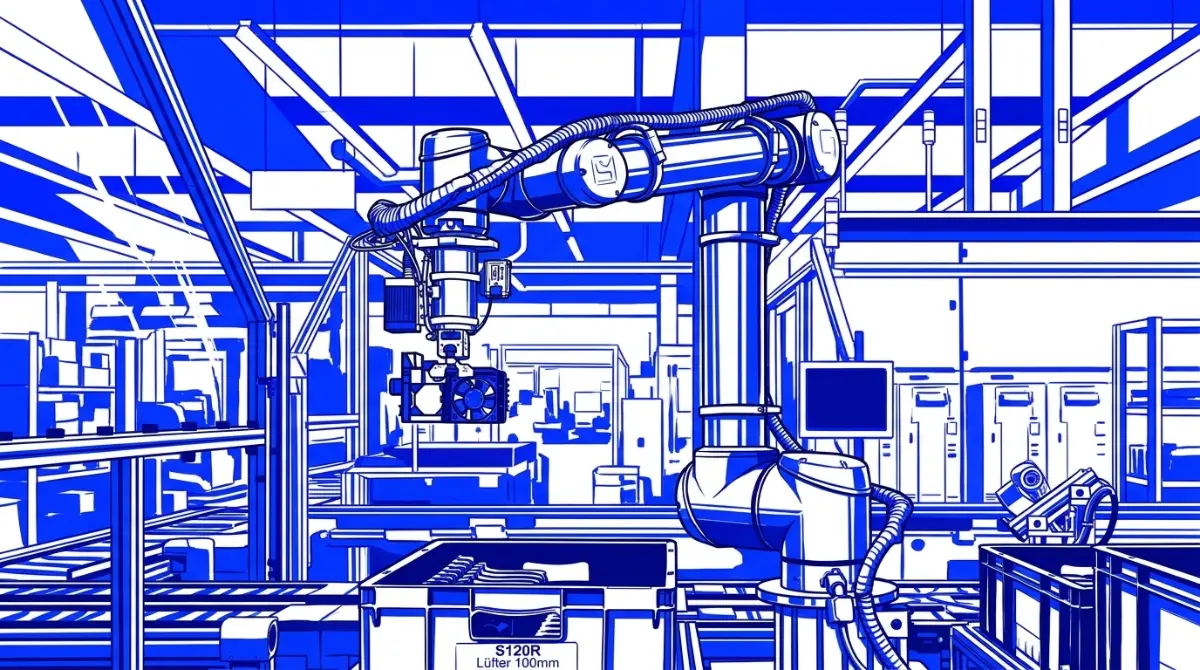


Siemens and Nvidia Deploy Industrial AI for Factories
Industrial automation giant Siemens and chipmaker Nvidia deepened their manufacturing collaboration, embedding machine reasoning into factory Programmable Logic Controllers and digital twin environments to cut programming burdens and simulate automated assembly operations before building physical machinery.
Umar Abubakar | · 10 min read

Modern factory automation has spent forty years operating on rigid, hand-written logic. When an industrial manufacturer sets up a production line to assemble automobiles, bottle beverages, or package pharmaceuticals, software engineers spend months writing ladder logic and structured text for industrial control computers. If a human worker places a mechanical part into a clamp backwards, or if a supplier ships metal brackets with minor dimensional differences, the entire assembly line shuts down. Traditional industrial machines possess zero common sense: they follow programmed movements blindly, halting operations the moment a sensor detects an unexpected condition. Engineering teams spend weeks diagnosing error codes, rewriting program routines, and testing mechanical adjustments on factory floors. German industrial automation giant Siemens and American semiconductor pioneer Nvidia moved to modernize that rigid architecture on Friday, October 23, 2026. The two companies announced an expanded operational partnership, deploying machine reasoning models and digital twin simulations directly into industrial manufacturing environments. The deployment centers on Siemens Industrial Copilot and Nvidia Omniverse libraries, connecting factory Programmable Logic Controllers with computational models that generate control code, diagnose machinery faults, and simulate assembly lines before physical metal is cut. The partnership arrives as industrial corporations automate complex engineering workflows, an enterprise expansion visible when Skild AI and Nvidia trained physical automation tools.
The joint initiative marks a calculated effort to bring advanced computing into heavy physical industry. While consumer technology companies spent three years creating conversational chatbots and image generators, industrial manufacturing represents an immense economic sector that demands absolute precision and zero operational downtime. Siemens commands a dominant market presence in industrial automation, with its hardware controllers and Totally Integrated Automation software powering manufacturing plants worldwide. Nvidia brings accelerated computing clusters, synthetic physics engines, and reasoning models tailored for physical robotics. By integrating these tools, the companies claim that industrial manufacturers can reduce engineering hours by up to 40% when designing and programming new automated assembly systems. The announcement comes as global manufacturers face severe shortages of skilled electrical and mechanical engineers, forcing industrial operators to seek automated software alternatives. Industrial computing developments match trends we followed when Schneider Electric raised revenue targets on automation demand.
The Heavy Toll of Industrial PLC Programming
To grasp why Siemens and Nvidia are collaborating on industrial computing, one must inspect how factory assembly lines are constructed. At the center of every automated plant sits a Programmable Logic Controller, or PLC: a ruggedized industrial computer that monitors physical sensors, controls pneumatic pistons, regulates electric motor speeds, and coordinates robotic arms.
Programming an industrial controller requires specialized engineering knowledge. Control engineers write code in languages defined by the IEC 61131-3 standard: Structured Text, Function Block Diagrams, and Ladder Logic. An engineer must specify every microsecond of motion: verifying that a protective safety door is locked, confirming that hydraulic pressure exceeds designated thresholds, commanding a robotic gripper to close, and monitoring proximity sensors before advancing a conveyor belt. A single modern packaging line can require hundreds of thousands of lines of code. Because industrial machinery carries safety risks: a malfunctioning robotic arm can crush human workers or ruin millions of dollars in mechanical tooling: testing and debugging this code is painstaking. Engineers spend months on factory floors conducting dry runs, manually stepping through program routines to catch logic flaws. This manual engineering represents a major expense in factory construction. Automation platforms lowering engineering expenses were detailed in our analysis of Flow Engineering securing growth capital for industrial workflows.
Siemens Industrial Copilot: Automated Code Generation
The central software deliverable in the expanded alliance is the Siemens Industrial Copilot, connected to Nvidia computational reasoning models. Instead of forcing control engineers to write thousands of lines of ladder logic manually, the system allows engineers to generate functional control code using natural language instructions.
An engineer working inside the Siemens TIA Portal can describe the desired operational sequence in plain text: "Configure a sorting station that routes aluminum cans to Conveyor A and steel cans to Conveyor B based on inductive sensor feedback, pausing movement if the bin reaches ninety percent capacity." The model analyzes the instruction, maps hardware input and output addresses, and generates clean, verified Structured Text or Ladder Logic according to corporate programming standards. The software does not merely output text; it conducts automated semantic audits: verifying that safety interlocks are respected, that timing loops do not trigger processor deadlocks, and that electrical limits are not exceeded. Engineers report that routine code generation tasks that previously required three days of manual typing can now be completed in under twenty minutes. Control engineers transition from typing repetitive code to reviewing and approving automated routines, accelerating project delivery schedules. Software tools that coordinate scattered technical data match architectures we tracked when Thally deployed automated knowledge layers across enterprise software suites.
Comparing Factory Engineering Workflows: Traditional vs. Industrial AI
| Engineering Activity | Traditional Manual Factory Setup | Siemens-Nvidia Industrial AI Pipeline |
|---|---|---|
| PLC Code Creation | Weeks of manual ladder logic typing | Minutes via natural language prompt synthesis |
| Line Commissioning | Physical trial-and-error on factory floors | Virtual physics validation inside Nvidia Omniverse |
| Machinery Fault Diagnosis | Hours inspecting electrical wiring & logs | Instant automated sensor pattern correlation |
| Assembly Reconfiguration | Complete teardown and software rewrite | Adaptive neural vision models re-trained in hours |
| Safety Verification | Manual physical checklists & safety tests | Automated code audits checking safety rules |
The comparison matrix reveals how the integration transforms factory timelines. By shifting code generation, fault diagnosis, and safety verification into automated software loops, manufacturers compress the time required to build and commission new production lines. This agility allows consumer product brands and automotive manufacturers to retool assembly plants quickly in response to shifting consumer demand. Factory monitoring and construction tracking platforms were examined in our review of Buildots securing capital for automated construction monitoring.
Virtual Commissioning Inside Nvidia Omniverse
The second pillar of the collaboration links Siemens digital twin software with Nvidia Omniverse platform. In traditional manufacturing, the most expensive phase of factory construction is physical commissioning: the period when newly assembled machines are powered on for the first time on the factory floor.
During physical commissioning, subtle engineering oversights can cause mechanical collisions: a robotic arm swings too wide and hits a steel conveyor support, bending metal components and causing weeks of repair delays. Using Nvidia Omniverse, Siemens created a complete virtual commissioning environment. Engineers import mechanical computer-aided design blueprints, electrical schematics, and sensor positions into a physically accurate digital twin. The real PLC control software connects to the digital twin over high-speed networks, controlling virtual machines that obey exact physical laws: gravity, friction, mass inertia, and material elasticity. Engineers can run millions of virtual cycles: testing emergency stops, simulating broken sensors, and fine-tuning cycle speeds: before ordering steel components or hiring construction contractors. When the physical machines arrive at the factory, the control code has already been tested and validated inside simulation, cutting physical commissioning times from months to days. Precision simulation across manufacturing pipelines was explored in our report on CloudNC automating precision manufacturing workflows.
Predictive Maintenance and Real-Time Fault Resolution
Beyond initial factory construction, the Siemens and Nvidia partnership addresses the ongoing operational expense of factory maintenance. When a critical machine breaks down unexpectedly in an automotive plant, production stops, costing automakers tens of thousands of dollars per minute in lost output.
The Siemens Industrial Copilot connects to plant telemetry systems, monitoring vibration sensors, motor temperatures, hydraulic pressures, and electrical current draws across thousands of active machines. Machine learning models analyze this real-time stream, identifying subtle anomalous patterns that precede mechanical failure. If a bearing inside a high-speed packaging motor begins to degrade, the system flags the issue weeks before the motor seizes, automatically ordering replacement parts and scheduling maintenance during planned shift changes. When a machine does experience an error, maintenance workers can consult the copilot through mobile tablets. Instead of searching through five-hundred-page technical manuals, technicians receive immediate, step-by-step repair instructions detailing which electrical relays to test, which replacement part numbers to pull, and how to verify calibration before restarting production. Corporate workforce efficiency gains from automation were detailed in our analysis of corporate technology deployments replacing administrative hours.
Overcoming the Skilled Engineering Shortage in Manufacturing
The economic driver accelerating adoption of industrial automation software is an acute demographic crisis across advanced manufacturing hubs. In Germany, the United States, and Japan, experienced industrial control engineers and plant technicians are reaching retirement age in record numbers.
Vocational programs and engineering universities are not graduating enough replacement technicians to fill the gap. Young software developers gravitate toward web applications, mobile software, and consumer artificial intelligence rather than industrial manufacturing plants. Industrial enterprises find themselves unable to expand production capacity because they cannot recruit enough control engineers to program new assembly lines. Siemens Industrial Copilot acts as a force multiplier for existing engineering staff. By automating routine code generation, technical documentation, and fault analysis, the software allows a small team of three experienced engineers to manage the workload that previously required eight full-time specialists. Junior technicians can complete complex automation tasks with software guidance, easing the demographic strain on manufacturing supply chains. Labor challenges across industrial technology sectors were examined in our review of Bill Gates warning of severe labor changes.
Industrial Cybersecurity and Operational Air Gaps
Deploying machine reasoning models inside factory environments introduces severe cybersecurity questions. In enterprise IT, a software bug causes an application to crash or display an error message. In operational technology, a compromised industrial controller can alter chemical mixing ratios, disable safety shutoff valves, or over-pressurize steam pipes, creating physical explosions and endangering human lives.
Industrial plant managers are notoriously cautious about connecting factory controllers to public cloud platforms. Siemens and Nvidia addressed these security requirements by designing their industrial software to execute locally on edge computing hardware. Using ruggedized industrial edge servers powered by Nvidia processors, the models run entirely within the factory private network perimeter, behind physical network air gaps. No proprietary machine telemetry, manufacturing blueprints, or production volumes are routed across public internet connections. The software complies with strict IEC 62443 industrial cybersecurity standards, ensuring that control code cannot be modified without cryptographic digital signatures and verified multi-level administrative approvals. Industrial network defenses against digital intrusion were detailed in our report on reinforcing network perimeters against automated intrusions, alongside systemic risks analyzed when automated tools lowered barriers for cyber intrusions.
The Road to Self-Adapting Autonomous Factories
The long-term vision guiding Siemens and Nvidia extends far beyond generating ladder logic or building virtual twins. The ultimate goal is creating self-adapting, autonomous production plants that can reconfigure themselves dynamically without human reprogramming.
In modern consumer commerce, product lifecycles are shrinking, and consumers expect personalized products. A beverage company might produce fifty different drink variations in a single week. In a traditional factory, retooling for each variation takes hours of mechanical adjustments. In an autonomous factory, neural vision models guide robotic arms to handle different container shapes on the fly, while adaptive control algorithms adjust conveyor speeds and filling volumes automatically based on real-time visual inspection. The combination of Siemens industrial hardware and Nvidia accelerated computing is building the operational operating system for this manufacturing future. As factories worldwide adopt these intelligent platforms, manufacturing is transitioning from an era of rigid, brittle automation to a new era of flexible, adaptive production that can adjust to market changes in seconds.
Read More on TechRobust:

Umar Abubakar
 LinkedIn
Umar Abubakar
Expertise:Editorial Leadership, Product Design (UI/UX), Digital Media Strategy, Technology Systems, Product Architecture
Award:TechRobust Visionary Leader of the Year 2025
Umar serves as Editor-In-Chief of TechRobust, combining editorial vision with senior product design expertise to shape how modern technology stories are built, packaged, and told. Overseeing all editorial verticals, he directs coverage across global and regional tech industry while applying deep design thinking to publication strategy and reader experience.