
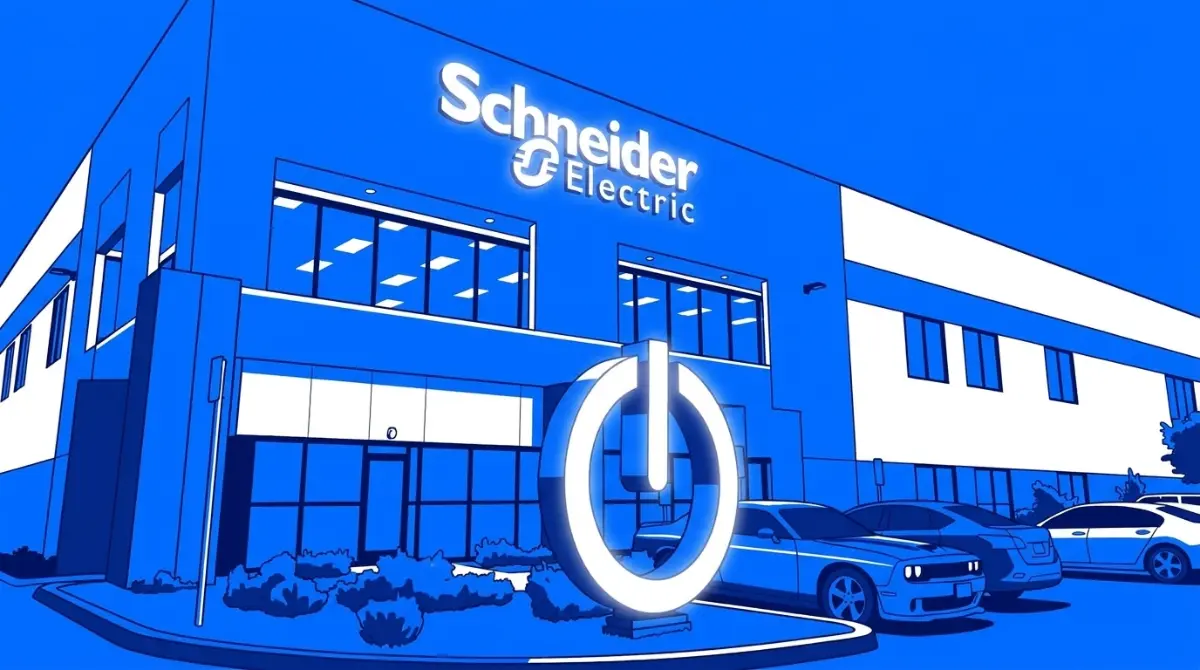


Schneider Electric Lifts 2026 Goals on Data Center Boom
French industrial manufacturer Schneider Electric raised its 2026 financial targets for the second time, forecasting organic profit growth above twenty percent as international server warehouse construction triggers an insatiable corporate appetite for electrical transformers, switchgear, and liquid cooling systems.
Umar Thariwat | 16 Oct. 2026, 2:13 AM · 9 min read

Modern machine learning models exist in code, but their survival depends on physical copper, steel, and high-voltage circuit breakers. While software startups burn through venture reserves trying to build conversational algorithms, the industrial manufacturers supplying the electrical gear behind computing centers are harvesting record profits. Rueil-Malmaison-based electrical specialist Schneider Electric confirmed that reality on Friday, October 16, 2026. The French corporate group raised its 2026 financial targets for the second time this calendar year, propelled by unrelenting demand from cloud platform operators, co-location providers, and internet conglomerates constructing massive server warehouses. Under the revised corporate outlook, adjusted earnings before interest, taxes, and amortization are projected to expand between 18% and 21% organically, while organic revenue is set to climb 12% to 14%. The raised targets prove that the most durable commercial fortunes of the computing expansion are being captured by heavy industrial suppliers rather than speculative application developers, an economic reality aligned with patterns we evaluated when the IMF reported that hardware spending supports global economic growth.
The revised numbers illustrate how the center of gravity in technology investing has migrated from software screens to the physical electrical grid. For three years, institutional investors focused almost exclusively on semiconductor foundries and chip designers. Yet thousands of advanced graphics processors cannot compute a single line of logic without high-capacity transformers stepping down transmission voltages, uninterrupted power supply banks buffering electrical surges, and chilled manifolds pulling away heat. Schneider Electric has transformed into an indispensable industrial partner for hyperscalers like Microsoft, Amazon Web Services, and Google Cloud, supplying modular substations, medium-voltage switchgear, and cooling distribution units. Chief executive Peter Herweck confirmed that order books for data center infrastructure stretched to historic records throughout the third quarter. The capital commitments flowing into physical computing facilities match patterns we documented when Crusoe secured $3B for large data center expansions.
Four Year Backlogs for High Voltage Transformers
To understand why Schneider Electric holds immense pricing power, one must look at the physical bottlenecks stalling server facility construction. Across North America, Western Europe, and parts of Asia, the primary impediment to launching a computing campus is no longer silicon procurement. The real roadblock is acquiring high-voltage electrical transformers and medium-voltage switchboards.
Procuring a large electrical substation transformer now requires lead times stretching between three and four years. These massive industrial units, which weigh hundreds of metric tons and require specialized electrical steel, copper coils, and dielectric fluids, cannot be manufactured overnight on automated assembly lines. They require skilled manual winding, extensive pressure testing, and strict safety validations. Technology conglomerates racing to bring multi-hundred-megawatt computing campuses online are placing multi-billion-dollar purchase orders years in advance, willing to pay significant cash premiums to secure manufacturing slots in Schneider factories. Because few global suppliers possess the manufacturing certifications required to interface directly with public high-voltage grids, established industrial leaders command exceptional pricing leverage. The physical energy constraints dictating data center timelines were examined in our review of water and power limits threatening multi-billion dollar server campuses.
Direct Liquid Cooling and Thermal Server Racks
Beyond electrical distribution, Schneider Electric growth is being propelled by an aggressive shift in data center thermodynamics. For decades, computer server rooms relied on air cooling: powerful computer room air handlers pushed chilled air beneath raised floors, blowing drafts across low-density server cabinets pulling five to ten kilowatts of electricity.
Modern machine learning hardware made traditional air cooling obsolete. Contemporary high-density computing cabinets pack dozens of liquid-cooled accelerators, pushing thermal output past 100 kilowatts per enclosure. Air cannot move heat away from microscopic processor dies fast enough to prevent thermal shutdowns. Server facility operators must run direct-to-chip liquid cooling loops, pumping dielectric fluids or chilled water directly across nickel-plated copper cold plates mounted to silicon dies. Schneider Electric expanded its portfolio of cooling distribution units, liquid-to-liquid heat exchangers, and closed-loop chillers to capture this mechanical transition. By selling integrated packages that combine electrical switchgear with thermal cooling distribution, the French manufacturer captures a larger share of the capital expenditure invested in every server room. The mechanics of managing server cabinet power were detailed in our report on flexible data center power saving billions for public grids.
Asian Manufacturing Hubs Lead Third Quarter Sales
The geographic distribution of Schneider revenue reveals that computational infrastructure is expanding far beyond traditional American server clusters. While North American sales remained strong, third-quarter order acceleration was spearheaded by direct deliveries across China and East Asia.
In Asian industrial hubs, domestic technology titans, regional telecommunications providers, and co-location operators are constructing dense server networks to serve domestic commerce and sovereign computing initiatives. China investment in digital infrastructure continues expanding as domestic cloud providers build facilities to power localized foundation models. At the same time, nations across Southeast Asia, including Malaysia, Thailand, and Singapore, are emerging as major regional data center corridors, attracting hundreds of billions in direct foreign investment. Schneider established localized assembly lines and supply hubs across Asia, allowing the company to deliver switchboards and transformers to regional contractors faster than competitors relying purely on Western factories. The economic momentum across Asian manufacturing corridors reflects patterns we explored when Chinese memory producers expanded high-density silicon production.
The Hardware Equipment Moat Versus Software Margins
The contrast between Schneider Electric financial performance and the struggles of consumer software startups highlights an important lesson in technology economics. Venture capital poured hundreds of billions into consumer chatbots, automated text generators, and speculative search portals, only to watch profit margins evaporate under fierce price competition and soaring cloud rental invoices.
Software code can be copied, fine-tuned, or replaced by open-weight models in weeks. Physical electrical infrastructure cannot be replicated by software code. You cannot download an electrical transformer, you cannot simulate a three-phase medium-voltage breaker, and you cannot run high-amperage current through a digital prompt. Companies that manufacture physical components, control specialized patents, and maintain certified factory workforces possess deep competitive moats that software developers can only dream of. While foundation model developers engage in price wars that compress token fees to pennies, Schneider collects dependable double-digit operating margins on every transformer shipped out of its loading docks. The commercial pressures facing speculative digital ventures were analyzed in our report on Wall Street AI earnings targets facing intense scrutiny.
Regional Grid Resistance and Municipal Utility Disputes
While industrial demand remains strong, Schneider Electric customer base faces mounting friction from public utility operators and local municipalities. In major hosting hubs like Northern Virginia, Dublin, and Frankfurt, public electrical grids are operating near maximum capacity. Regional utility operators are warning that connection requests from planned server campuses exceed total provincial power generation.
This grid congestion has led public utility commissions to freeze fresh connection applications, delaying project completions and sparking regulatory battles between technology conglomerates and residential communities. Local homeowners complain that multi-gigawatt computing campuses drive up monthly household utility rates while straining regional water reservoirs used for evaporative cooling. To overcome these delays, cloud operators are partnering with Schneider Electric to design on-site microgrids. By combining high-voltage distribution with utility-scale battery storage, natural gas generators, and solar arrays, server operators can run independently of strained municipal networks. The societal and political tensions surrounding digital energy consumption were documented in our report on growing public pushback against server facility electrical consumption.
Merging Smart Domestic Controls With Industrial Distribution
While large server facilities generate headline revenue, Schneider Electric maintains a balanced business model by serving residential and commercial buildings. The company has integrated its industrial power expertise into consumer hardware, helping ordinary homeowners manage volatile residential electricity rates.
Earlier this week, Apple introduced the Apple Home Collection, partnering directly with Schneider Electric to manufacture intelligent connected thermostats and automated climate management accessories. That commercial collaboration demonstrates Schneider ability to bridge the gap between heavy industrial infrastructure and consumer living rooms. The software algorithms that balance electricity across a 200-megawatt computing park can be adapted to manage household HVAC systems, electric vehicle chargers, and home battery units. By diversifying its revenue across corporate cloud facilities, commercial office buildings, and private households, Schneider insulates its balance sheet from sudden downturns in any single market vertical. The partnership between industrial manufacturers and consumer technology platforms was detailed in our launch coverage of the Apple Home Collection smart home accessories.
The Threat of Equipment Depreciation and Spending Cuts
Despite record targets, Schneider Electric corporate leadership must prepare for potential macroeconomic headwinds. Financial analysts caution that current data center construction schedules are predicated on aggressive capital spending commitments by a small handful of American technology monopolies. If those cloud titans encounter slowing enterprise software adoption, they could slash future capital budgets abruptly.
A sudden pause in cloud infrastructure expansion would leave equipment manufacturers with swollen inventories and excess factory capacity. Furthermore, as chipmakers design more power-conscious silicon, future server racks could require less electrical current per unit of compute, altering long-term transformer demand. Commercial operators have already demonstrated a willingness to delay projects when electricity prices spike or regulatory hurdles emerge, as evidenced when Oracle delayed data center spending over power supply disputes. Schneider must manage its factory expansions with discipline, ensuring it does not overbuild physical production lines to satisfy short-term speculative demand. The financial hazards of aggressive infrastructure spending were also examined in our analysis of economists warning of systemic risks from corporate capital spending.
The Durable Economics of Heavy Industrial Manufacturing
Schneider Electric decision to lift its 2026 financial targets confirms that the artificial intelligence era is fundamentally an industrial revolution rather than an ethereal software trend. For three decades, popular culture celebrated the software developer as the sole driver of modern prosperity, treating physical manufacturing as low-margin background work that could be outsourced without consequence.
The realities of the current computing expansion have dismantled that narrative. The digital economy cannot function without massive physical transformers stepping down electrical currents, specialized manifolds routing cooling liquids, and industrial switchboards protecting delicate microcircuits. With adjusted organic earnings projected to grow past twenty percent, Schneider Electric has positioned itself at the center of the physical computing boom. As technology giants spend hundreds of billions to construct the computational factories of tomorrow, the companies that manufacture the switches, breakers, and pipes will continue collecting handsome profits long before software developers prove their business models. The physical transition of computing spaces was also demonstrated when FTX mining assets entered the server facility buildout, while proprietary chip architectures were examined when Microsoft deployed Maia 300 custom silicon.
Read More on TechRobust:

Umar Thariwat
 LinkedIn
Umar Thariwat
Expertise:Tech News Reporting, Tech Business Analysis, Economic Foundations, Market Trends, Digital Economy
Award:Rising Voice of the Year 2025
Thariwat is a Staff Writer and Reporter covering tech news and enterprise trends at TechRobust. Blending daily reporting with her ongoing academic background in economics, she analyzes earnings, digital market, and the commercial strategies powering the global tech sector.