
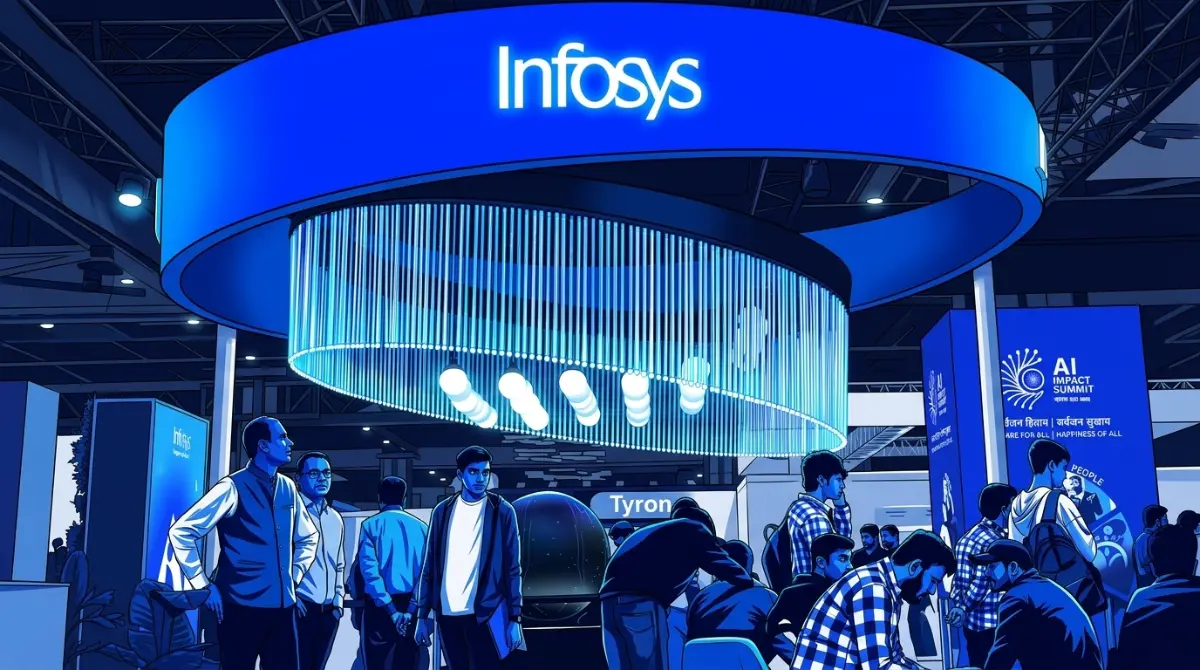


Infosys Shares Sink on AI Margin Squeeze and Fee Cuts
Shares of Indian IT services giant Infosys dropped after management lowered its annual revenue growth outlook, revealing that enterprise automation tools are compressing traditional billing hours and forcing outsourcing providers into aggressive price cuts against global software rivals.
Umar Thariwat | · 6 min read

Selling white-collar engineering labor by the hour functions smoothly until software writes the code for pennies. For thirty years, Indian information technology conglomerates built multi-billion-dollar market capitalizations by providing engineering teams to Western banks, retailers, and pharmaceutical giants. An overseas enterprise needing database maintenance or software testing hired hundreds of engineers in Bengaluru, Pune, or Hyderabad, paying predictable hourly rates. That business model is encountering structural compression. Shares of India second-largest IT services exporter, Infosys, tumbled on Monday, October 26, 2026, after management lowered its full-year revenue growth forecast. The company trimmed its fiscal 2027 revenue guidance to between 3.0% and 4.5% in constant currency, down from its earlier range of 4.0% to 5.5%. Chief Executive Officer Salil Parekh pointed to pricing pressure from enterprise clients who demand automated discounts, alongside delays in discretionary spending by American corporate customers. The guidance cut illustrates how automated software is disrupting traditional outsourcing economics, matching corporate employment trends we followed when Barclays cut corporate positions to protect profit margins.
The share decline sent ripples across Indian equity markets, pulling down the benchmark Nifty IT index. Investors reacted to the realization that software automation represents a double-sided trap for IT consultancies. When an IT services firm deploys automated coding assistants to complete client projects, the project requires fewer engineering hours. Because contracts operate on time-and-materials billing, completing tasks faster reduces gross billable invoices. Corporate clients understand this dynamic: procurement departments at Western corporations are renegotiating existing outsourcing contracts, demanding twenty to thirty percent fee reductions because service providers are using automated software tools to complete deliverables. Infosys reported a modest operating margin of 21.1% for the quarter, but warned that pricing competition from global consultancies like Accenture, Tata Consultancy Services, and Cognizant is intensifying. The margin squeeze facing IT outsourcing providers reflects commercial software trends we tracked when Cognition AI reached record coding adoption.
The Structural Contraction of Time and Materials Billing
To grasp why Infosys lowered revenue expectations, one must dissect the mechanics of enterprise outsourcing contracts. The global IT services industry generates hundreds of billions annually through three contractual structures:
- Time and Materials: The client pays an hourly or daily fee for every engineer assigned to the project.
- Fixed Price Projects: The vendor agrees to deliver a completed software application for a set fee, absorbing labor risks.
- Managed Services: The vendor manages ongoing operations, such as help desks or server maintenance, for a fixed monthly fee.
Over sixty percent of Infosys revenues originate from time-and-materials agreements. When automated coding tools, automated testing scripts, and synthetic document processors reduce the engineering hours needed to maintain a banking portal by half, Infosys cannot bill the client for those unworked hours. If an enterprise client previously paid for fifty full-time software developers, the client now contracts for twenty-five developers paired with machine assistants. Unless the IT provider can secure twice as many client accounts, total revenue declines. Transitioning existing contracts to outcome-based pricing models takes years of legal negotiations, leaving service providers caught in a revenue squeeze. Global corporate tech hiring trends were detailed in our analysis of Starbucks opening enterprise tech facilities in India.
Comparing Major Global IT Services Providers
| IT Services Firm | Revised Revenue Outlook | Operating Margin Range | Primary Geographic Exposure | Corporate Automation Strategy |
|---|---|---|---|---|
| Infosys | 3.0% to 4.5% (Lowered) | 20.5% to 21.5% | North America (60%) & Europe (25%) | Topaz enterprise automation suite |
| Tata Consultancy Services | 4.5% to 5.5% (Stable) | 24.0% to 25.0% | Global banking & manufacturing | Proprietary enterprise cloud platforms |
| Wipro | -1.0% to 1.5% (Stagnant) | 16.0% to 17.5% | Financial services & healthcare | Aggressive automation workforce restructuring |
| Accenture | 5.0% to 7.0% (Strong) | 15.0% to 16.0% | Broad global consulting & integration | Multi-billion dollar foundation model partnerships |
| HCLTech | 3.5% to 5.0% (Moderate) | 18.0% to 19.0% | Engineering R&D & infrastructure | Hybrid software and silicon engineering |
The comparative data illustrates why public equity investors punished Infosys shares. While competitors like Accenture maintain growth through strategic business consulting, pure IT outsourcing providers face revenue headwinds. Operating margins across Indian IT firms are under pressure as clients demand discounts, forcing vendors to accept lower pricing to defend market share. Corporate employment adjustments in automated environments were examined in our review of Wipro restructuring operations to preserve corporate margins.
The Discretionary Tech Spending Freeze in North America
Beyond automation pricing pressure, Infosys faces a persistent freeze in discretionary technology spending across North American financial and retail clients. American corporate clients generate roughly sixty percent of Infosys total revenue.
Facing high borrowing rates and economic uncertainty, American chief information officers are delaying non-essential software upgrades. Multi-year digital transformation projects that were approved without scrutiny three years ago are being divided into smaller, quarterly milestone phases. Procurement committees are requiring clear business cases before releasing funds for new software builds. Parekh noted that while enterprise clients continue funding regulatory compliance and cloud migration projects, spending on experimental software and custom application development has slowed sharply. This corporate caution prevents Indian IT firms from replenishing project pipelines as older contracts conclude. Macroeconomic pressures on enterprise software spending were analyzed in our report on economists warning of systemic risks from capital spending.
Retraining Three Hundred Thousand Engineers
To defend against obsolescence, Infosys launched a massive internal training program across its 315,000-person global workforce. The company integrated its proprietary Topaz platform into customer delivery centers, training over 150,000 software engineers on machine learning pipelines, prompt engineering, and automated code review tools.
Management goal is transforming entry-level coding clerks into higher-level solutions architects who can design complex, integrated software architectures for global enterprises. Retraining a workforce of three hundred thousand employees is an immense operational challenge. Senior software architects who spent twenty years writing Java code for mainframe banking databases cannot transition into machine learning systems engineers overnight. Infosys faces elevated employee turnover in specialized technical divisions, as skilled engineers leave to join American technology subsidiaries offering dollar-denominated salaries. Corporate talent retention and labor dynamics were explored in our analysis of graduate employment trends in the computational era.
The Long Term Outlook for Indian IT Services
Infosys reduced revenue outlook confirms that the golden age of labor-arbitrage IT outsourcing is ending. For three decades, Indian technology giants generated dependable wealth by deploying armies of skilled, low-cost human programmers to handle routine corporate software tasks.
As automated code engines commoditize routine programming, testing, and database maintenance, selling engineering labor by the hour is a declining business. To survive in the emerging software economy, Indian IT leaders must abandon hourly billing and transition into high-value intellectual property, proprietary software platforms, and outcome-based engineering contracts. Infosys possesses the balance sheet capital and institutional client relationships to navigate this transition, but the journey will involve slower revenue growth and compressed profit margins. As global corporations demand more automation at lower prices, the outsourcing industry must prove it can deliver genuine business value, or risk being automated out of existence by the very software tools it helped create.
Read More on TechRobust:

Umar Thariwat
 LinkedIn
Umar Thariwat
Expertise:Tech News Reporting, Tech Business Analysis, Economic Foundations, Market Trends, Digital Economy
Award:Rising Voice of the Year 2025
Thariwat is a Staff Writer and Reporter covering tech news and enterprise trends at TechRobust. Blending daily reporting with her ongoing academic background in economics, she analyzes earnings, digital market, and the commercial strategies powering the global tech sector.