
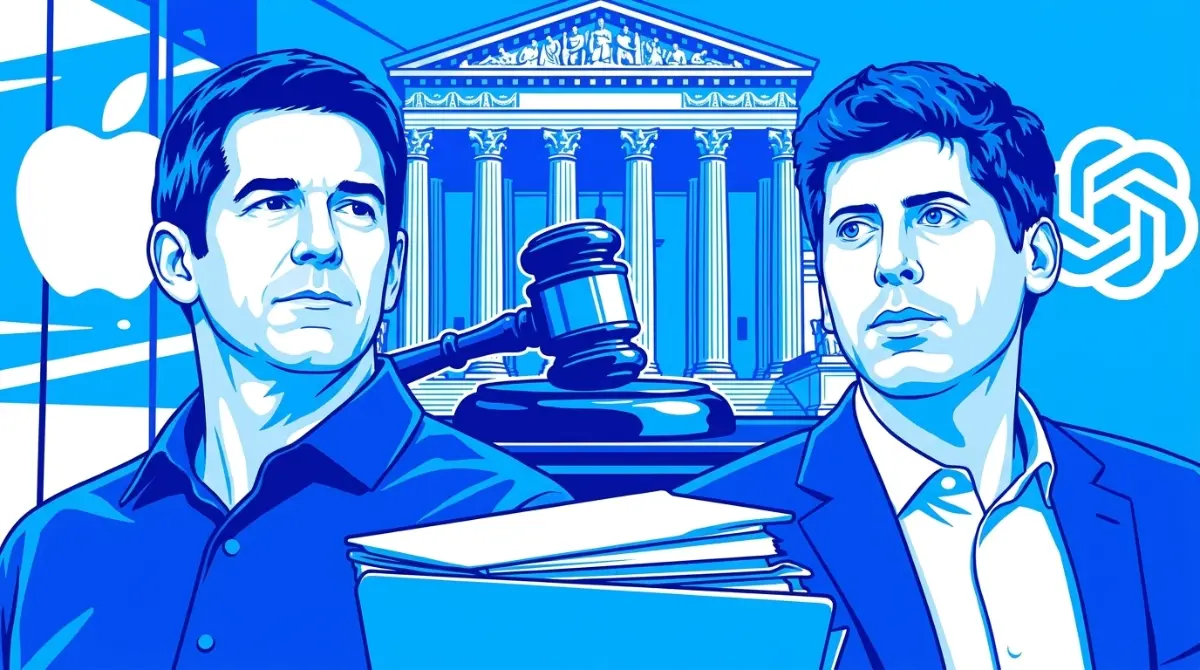


Judge Orders OpenAI to Share Apple Hiring Records
A federal judge granted Apple early discovery in its trade secret lawsuit, ordering OpenAI to disclose internal interview notes, private messages, and candidate files after Apple accused former engineers of leaking hardware blueprints to Sam Altman startup.
Umar Thariwat | 13 Oct. 2026, 4:36 PM · 9 min read

Corporate partnerships in Silicon Valley frequently mask aggressive talent poaching behind polite press releases. When Apple agreed to connect ChatGPT into iPhone system software, executives on both sides presented the deal as a peaceful commercial alignment between consumer hardware and generative models. Behind closed office doors, an intense battle for engineering talent was already escalating into legal warfare. On Tuesday, October 13, 2026, United States District Judge Edward Davila issued an order in federal court, granting Apple request for expedited discovery against OpenAI and hardware startup io Products. The court directed OpenAI to hand over internal interview evaluation rubrics, private candidate communications, and deposition transcripts concerning hundreds of former Apple hardware specialists who joined the machine learning company. The ruling marks a major legal setback for Sam Altman venture, exposing internal hiring pipelines to forensic examination. The legal fight over proprietary hardware design arrives as corporate tensions mount across the industry, a pattern we tracked when reporting on OpenAI blaming Apple iCloud policies in trade secret lawsuits.
The lawsuit claims that OpenAI orchestrated a systematic campaign of corporate misappropriation, using poached Apple managers to harvest confidential engineering files. Court filings show that OpenAI employs more than 400 former Apple employees, including senior design directors, thermal specialists, display architects, and battery chemists. Apple attorneys argue that this concentration of talent is no coincidence. The complaint alleges that job candidates were encouraged to bring proprietary Apple prototypes, internal component schematics, and confidential supplier lists directly into employment interviews. OpenAI denied the accusations, releasing a brief statement insisting that it maintains strict policies prohibiting the use of third-party confidential property. Judge Davila concluded that Apple presented enough initial evidence to warrant early document production, requiring OpenAI to turn over contested hiring files before the standard pretrial discovery schedule begins. The corporate stakes of institutional talent poaching mirror disputes we analyzed when global technology powers competed for premier machine learning researchers.
The Defection of Tang Tan and the Hardware Team
The central figure in the litigation is Tang Yew Tan, an engineering executive who spent twenty-four years inside Apple design studios. Tan served as Vice President of Product Design, reporting directly to legendary design chief Jony Ive during the creation of flagship iPhone, Apple Watch, and iPad lines. Tan supervised teams that calculated casing tolerances, internal antenna bands, and micro-component packaging across hundreds of millions of consumer electronics.
When Tan resigned from Apple to lead hardware engineering at LoveFrom and later joined OpenAI hardware project with io Products, dozens of senior design deputies followed him out the door. Apple legal team alleges that Tan departure opened a channel for confidential trade secrets to flow into OpenAI device division. According to court filings, Apple discovered that departing engineers accessed internal product roadmaps, confidential vendor pricing agreements, and unreleased sensor blueprints days before submitting resignation letters. By ordering OpenAI to produce interview notes and text messages, the court is allowing Apple to trace whether those engineering files were discussed during job interviews. How platform operators manage massive capital bets on hardware teams was explored in our analysis of OpenAI acquiring Glass Imaging for dedicated hardware expansion.
The Silicon Valley Gentleman Agreement Era Ends
The court order highlights the collapse of informal hiring truces that kept major technology giants from destroying each other businesses. A decade ago, federal antitrust regulators prosecuted Apple, Google, and Intel for maintaining illegal non-solicitation pacts that prevented companies from cold-calling rival engineers. While those anti-poaching agreements were broken up by federal courts, large technology conglomerates still maintained informal boundaries to avoid destructive trade secret litigation.
Those polite boundaries vanished as software laboratories realized that consumer software interfaces are moving away from traditional glass screens toward dedicated ambient hardware. Companies like OpenAI, Meta, and Google understand that controlling physical microphones, cameras, and wearable devices is necessary to keep users from switching to rival platforms. Because designing micro-scale consumer hardware takes decades of institutional learning, OpenAI chose to purchase that experience by recruiting Apple veteran staff. Apple legal offensive demonstrates that the company will use its legal reserves to slow down competitors seeking shortcuts in physical hardware design. The changing nature of corporate hiring disputes reflects patterns we documented when regulators demanded verified corporate transaction records for private shares.
Confidential Supply Chains and Asian Foundry Secrets
The trade secrets contested in Judge Davila courtroom extend far beyond basic software code; they touch the physical machinery of global manufacturing. Designing an electronic device requires deep relationships with specialized suppliers across Taiwan, Japan, South Korea, and China. Apple spends years working with precision factories to design custom CNC milling tools, specialized glass coatings, and miniature battery enclosures that competitors cannot buy off commercial shelves.
Apple complaint alleges that former employees shared confidential supplier pricing models, component yield figures, and proprietary manufacturing processes with OpenAI hardware planners. If a startup knows the exact production yields and vendor cost limits negotiated by Apple, it can negotiate aggressive contracts with Asian foundries without spending millions on trial manufacturing runs. The lawsuit also claims that OpenAI reached out to specific Apple suppliers, using proprietary component specifications to request identical parts for experimental prototypes. Protecting Asian manufacturing links from corporate espionage remains a priority for Western tech giants, an issue we evaluated when memory manufacturers negotiated cleanroom capacity across regional corridors.
The Discovery Scope and Private Message Production
Judge Davila order grants Apple broad access to internal OpenAI communication channels. OpenAI must search and produce messages from internal Slack rooms, Microsoft Teams channels, private Signal chats, and corporate email accounts belonging to hiring managers and recruiters involved in recruiting former Apple staff.
This level of discovery poses risks for any fast-growing startup. Fast-growing companies often maintain informal hiring chats where recruiters joke about pulling talent from incumbents or boast about candidate knowledge of competitor roadmaps. If Apple discovery lawyers uncover a single email or text message where an OpenAI manager asks a candidate to bring Apple design files, the case transforms from an ordinary employment dispute into criminal trade secret theft under the Economic Espionage Act. OpenAI legal team argued that producing these files imposes an unfair burden that disrupts daily business operations, but the court ruled that Apple claims justified prompt disclosure. Corporate exposure during legal discovery matches issues we tracked when major publishers sued artificial intelligence laboratories over data use.
The Strained Partnership Behind Siri and ChatGPT
The courtroom clash creates awkward friction for the commercial partnership connecting the two companies. Under the integration announced for iOS, Apple devices route complex user inquiries to ChatGPT servers when users request advanced text generation or photo analysis. Thousands of iPhone owners use this integration every hour, believing the two technology giants are working in close harmony.
Behind that public cooperation sits mutual corporate distrust. Apple executives view OpenAI as an aggressive commercial challenger attempting to commoditize the smartphone operating system into a dumb communication pipe. OpenAI leaders view Apple as a slow-moving platform gatekeeper that charges excessive fees while using App Store rules to restrict independent software developers. While neither company has canceled the public iOS integration, the lawsuit proves that legal warfare will continue unabated behind corporate marketing agreements. The friction between platform operators and independent software developers was examined in our report detailing Apple adjusting digital store policies to protect corporate margins.
OpenAI Balance Sheet and Hardware Ambitions
The legal fight arrives as OpenAI attempts to transform itself into a commercial enterprise capable of justifying unprecedented market valuations. The startup has explored private funding rounds valuing the business past twelve figures, while spending billions on cloud computing agreements, model training runs, and senior executive compensation packages.
Building a global consumer hardware division introduces capital requirements that software investors rarely anticipate. Fabricating physical devices requires advance payments for factory tooling, component inventory, international shipping, and retail returns. If Apple secures a preliminary injunction that bars OpenAI from using disputed hardware designs or halts device manufacturing, millions of dollars in prototype development could be rendered useless. Investor scrutiny over corporate governance and spending discipline matches issues we analyzed in our review of OpenAI exploring massive private funding rounds.
Forensic Audits of Personal Devices and Cloud Storage
A contentious element of the expedited discovery process involves the forensic inspection of personal electronics. Apple requested permission to image the personal laptops, smartphones, and cloud storage drives of key former employees who made the jump to OpenAI, arguing that proprietary design files were transferred via personal thumb drives and unmonitored cloud backups.
Judge Davila established a protocol for these inspections, requiring independent forensic examiners to run keyword searches across personal drives while protecting personal family photos and non-work communications. If an examiner discovers confidential Apple CAD files or thermal spreadsheets saved on an employee personal Google Drive or Dropbox account after their departure date, OpenAI will face severe spoliation and evidentiary sanctions. The technical challenge of tracking digital files across cloud boundaries reflects security issues we covered when researchers uncovered security vulnerabilities across corporate software platforms.
The Chilling Effect on Silicon Valley Talent Mobility
Beyond the immediate dispute between two corporate giants, the court order sends ripples through the technology employment market. California has long protected employee freedom of movement through Section 16600 of the Business and Professions Code, which voids non-compete agreements and allows engineers to move freely between competing firms.
This statutory protection allowed Silicon Valley to thrive, encouraging workers to leave large companies to build disruptive startups. If established corporations can use trade secret lawsuits and expedited discovery to inspect candidate messages and freeze hiring pipelines, smaller ventures will hesitate to hire experienced talent from incumbent leaders. Startups lack the legal budgets required to defend against years of federal litigation filed by trillion-dollar corporations. The legal tension between employee mobility and trade secret protection was examined in our coverage of employment litigation testing California corporate legal frameworks.
The Looming Injunction Hearing
With expedited discovery underway, both legal teams are preparing for an evidentiary hearing that will determine whether the court issues a preliminary injunction against OpenAI. Apple is seeking an order that would prevent former employees from working on specific hardware projects and bar OpenAI from deploying prototypes that incorporate contested engineering designs.
If Judge Davila grants an injunction, OpenAI hardware timeline will face severe disruptions, pushing product launches back by quarters. If the court denies the injunction, Apple will have to pursue its claims through standard trial schedules, where proving specific financial damages takes years. The outcome of the discovery process will show whether OpenAI built its hardware division on clean independent research or whether the startup took shortcuts that violate federal law. The fight over hardware intellectual property matches corporate disputes we tracked when Apple targeted enterprise computing costs with Mac workstations, alongside broader infrastructure spending analyzed when Crusoe secured $3B for large data center expansions.
Read More on TechRobust:
Umar Thariwat
 LinkedIn
Umar Thariwat
Expertise:Tech News Reporting, Tech Business Analysis, Economic Foundations, Market Trends, Digital Economy
Award:Rising Voice of the Year 2025
Thariwat is a Staff Writer and Reporter covering tech news and enterprise trends at TechRobust. Blending daily reporting with her ongoing academic background in economics, she analyzes earnings, digital market, and the commercial strategies powering the global tech sector.