
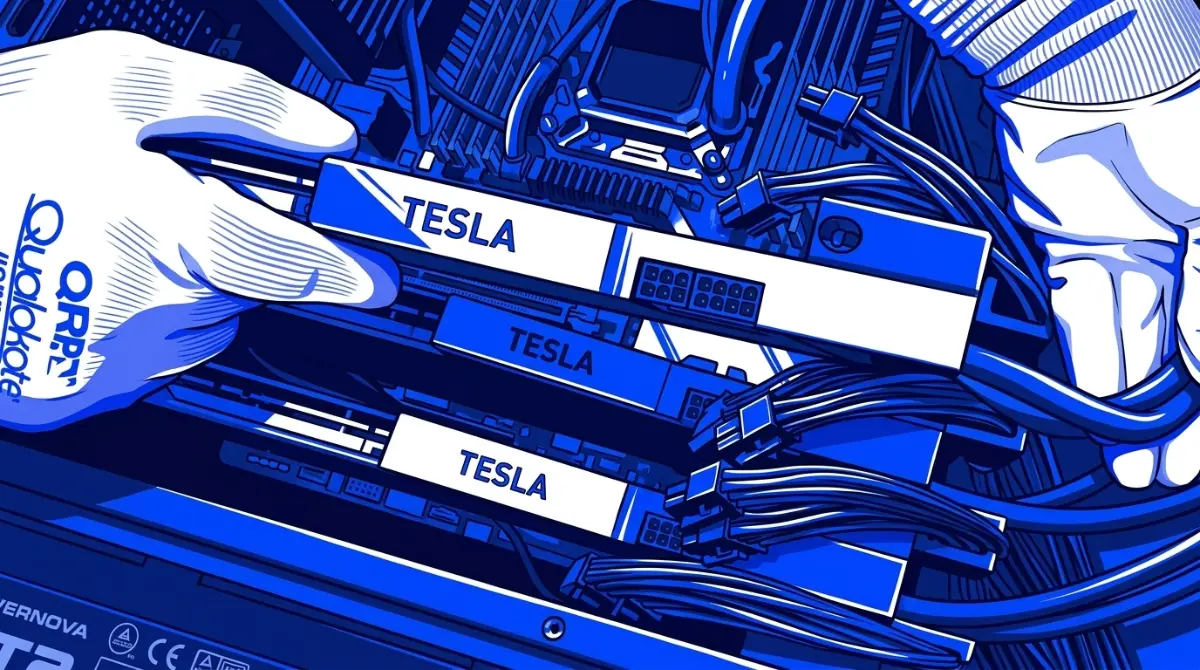


Nvidia Weighs $2,000 Annual Software Fee per GPU
Nvidia is discussing a $2,000 annual software licensing fee for every processor running autonomous agents inside artificial intelligence factories, seeking to turn its hardware computing monopoly into a compounding multi-billion-dollar recurring software subscription business.
Umar Thariwat | · 7 min read

Selling physical silicon chips delivers immense cash windfalls, but chip revenues end the moment hardware leaves factory warehouses. For three years, semiconductor giant Nvidia dominated the technology sector by selling specialized graphics processors at eighty percent profit margins. Cloud platforms spent billions purchasing computing clusters to train foundation models. Yet hardware manufacturers face an unavoidable corporate trap: once cloud operators finish filling server halls with silicon, capital spending slows down, leaving chipmakers exposed to cyclical downturns. Nvidia Chief Executive Officer Jensen Huang has spent two years preparing an answer to that hardware ceiling. On Saturday, October 24, 2026, Tom Hardware reported that Nvidia management is discussing a $2,000 annual software fee for every graphic processor running autonomous software agents inside industrial computing centers. The proposed licensing fee targets software management layers that coordinate machine workflows, turn-key inference pipelines, and agent communication channels. The move represents an aggressive effort to convert physical chip sales into a compounding software annuity, continuing corporate expansion strategies we followed when Nvidia posted historic quarterly revenues.
The financial scale of the proposed fee is extraordinary. Nvidia currently ships millions of high-performance server accelerators annually to cloud hyperscalers like Microsoft, Amazon, Google, and Meta. If Nvidia attaches an ongoing $2,000 annual software license to each deployed unit, an enterprise running a cluster of fifty thousand processors would pay $100M each year purely for software operating rights. Over a standard five-year hardware operating lifecycle, a single year of processor shipments could generate over $50B in high-margin recurring software revenues. Nvidia already charges $4,500 per GPU annually for its AI Enterprise software suite, making the $2,000 figure a potential specialized tier engineered specifically for autonomous agent orchestration. The strategy arrives as cloud buyers examine software spending, continuing market dynamics we analyzed in our review of Wall Street corporate earnings pressure.
The Shift From Silicon Merchant to Software Landlord
To evaluate why Nvidia is pursuing an annual software fee, one must examine the corporate valuation multiples awarded by public financial markets. Wall Street treats hardware semiconductor manufacturers as cyclical commodity businesses, assigning them modest price-to-earnings multiples because chip sales fluctuate with industrial spending cycles.
Software-as-a-service companies command premium valuation multiples because subscription revenues compound year after year with ninety percent gross margins. Jensen Huang recognized early that Nvidia true moat was not physical silicon, but CUDA: the proprietary software programming layer that links algorithms to Nvidia hardware. By building orchestration tools that manage autonomous agents across server clusters, Nvidia is inserting its software into corporate business workflows. A corporate customer might buy hardware once, but managing thousands of software agents that read corporate databases, process invoices, and handle customer service requires continuous operating system updates, security patches, and network scheduling. Nvidia aims to become the software landlord for this automated workforce, collecting annual tolls on every computing core. Hardware strategies across enterprise platforms match models we explored when enterprise leaders evaluated autonomous software architectures.
Comparing Enterprise GPU Licensing and Software Fees
| Software Platform | Annual Fee per GPU | Target Computing Workload | Included Technical Features |
|---|---|---|---|
| Nvidia Agent Cloud Tier (Proposed) | $2,000 per processor | Autonomous agent orchestration in AI factories | Agent tool access, data routing, execution security |
| Nvidia AI Enterprise | $4,500 per processor | Full-stack enterprise model deployment | NeMo framework, vGPU virtualization, enterprise SLA |
| AMD ROCm Open Platform | $0 (Free open source) | General machine learning on Instinct GPUs | Open-source drivers and PyTorch integration libraries |
| Intel Tiber AI Cloud | Bundled in compute price | Gaudi accelerator deployments | OneAPI unified development tools and libraries |
| Standard CUDA Driver | $0 (Included with hardware) | Low-level hardware access | Base compute drivers with zero enterprise support |
The comparative data highlights Nvidia pricing power. While rival chipmakers like AMD provide open-source software libraries for free to attract developers, Nvidia commands premium subscription fees for enterprise management layers. By offering a $2,000 agent tier, Nvidia creates an entry point below its $4,500 enterprise suite, targeting companies that want managed agent orchestration without paying for full enterprise support packages. Open-source machine learning software integration was examined in our report detailing how Amazon made Trainium silicon work with PyTorch.
What Does Two Thousand Dollars Buy: The Agent Factory Stack
Enterprise technology officers reviewing the proposed fee want to know what capabilities the $2,000 license delivers. Operating autonomous software agents inside a corporate data center presents practical engineering hurdles that standard graphics drivers cannot solve.
When an enterprise deploys thousands of autonomous agents, those agents need to access databases, call external APIs, and execute code in sandboxes. Nvidia agent management software acts as a traffic controller: dynamically assigning memory to active agents, scheduling inference requests to minimize latency, and enforcing security boundaries to prevent rogue agents from accessing unauthorized company files. The software includes automated failure recovery: if an agent stalls during an accounting task, the system freezes its state, relocates the memory buffer to another processor core, and restarts the workflow without losing progress. For a corporate client running thousands of automated workflows, paying $2,000 per chip for guaranteed software reliability is cheaper than hiring dozens of specialized systems engineers to build custom orchestration tools. Corporate software integrations across enterprise suites were detailed in our review of Thally deploying automated knowledge layers.
Customer Pushback and the Cloud Hyperscaler Rebellion
Despite the technical arguments, Nvidia licensing push faces resistance from cloud hyperscalers. Major technology companies like Microsoft, Amazon, and Google are already chafing under Nvidia eighty percent hardware gross margins.
If Nvidia attempts to layer an ongoing $2,000 annual software fee onto processors that already cost $35,000 upfront, cloud operators will push back. Cloud providers build their own proprietary container management platforms and orchestration software. Hyperscalers argue that they should not be forced to pay annual software rents on hardware they purchased outright. This software fee pressure will accelerate hyperscaler investments into proprietary custom silicon. Amazon is expanding its Trainium processor line, Google is deploying its Tensor Processing Units, and Microsoft is ramping up its Maia chips, all designed to run on open software stacks that do not require paying annual licenses to Nvidia. The corporate battle over hardware independence matches developments we followed when Microsoft deployed custom Maia silicon.
The Antitrust Risk: Bundling Hardware and Software
Charging mandatory software fees on hardware processors could invite regulatory scrutiny from antitrust authorities in Washington and Brussels. Competition monitors at the Department of Justice and the European Commission are already investigating Nvidia dominance in the computing market.
If regulators determine that Nvidia is using its near-monopoly in server processors to force customers into purchasing expensive proprietary software, officials could file formal anti-tying lawsuits. Antitrust laws prohibit dominant hardware manufacturers from conditioning the sale of scarce physical hardware on the purchase of separate software services. Nvidia must ensure that the $2,000 agent fee remains an optional software upgrade, allowing enterprise customers to purchase bare-metal processors without being required to buy the accompanying management suite. Demonstrating that hardware functions independently on open drivers will be required to defeat regulatory challenges. Regulatory oversight across enterprise tech contracts was explored in our analysis of regulators auditing private corporate transactions.
The Road to a Software Driven Semiconductor Giant
Nvidia exploration of a $2,000 annual software fee proves that the semiconductor sector has entered a mature operational phase. The initial boom, characterized by frantic hardware purchasing where tech companies bought every available chip at any price, is transforming into an era focused on ongoing operational management.
Jensen Huang understands that the long-term fortunes of computing belong to companies that control the software operating environment. If Nvidia successfully establishes its agent software as the mandatory platform for industrial computing centers, the company will secure tens of billions of dollars in recurring software cash flows that will endure long after hardware construction cools. The coming months will determine whether enterprise customers accept the fee as a fair price for software stability, or whether the software levy accelerates the industry migration toward open-source silicon alternatives. In modern computing, owning the chip is profitable; owning the software that controls the chip is where true economic power resides.
Read More on TechRobust:

Umar Thariwat
 LinkedIn
Umar Thariwat
Expertise:Tech News Reporting, Tech Business Analysis, Economic Foundations, Market Trends, Digital Economy
Award:Rising Voice of the Year 2025
Thariwat is a Staff Writer and Reporter covering tech news and enterprise trends at TechRobust. Blending daily reporting with her ongoing academic background in economics, she analyzes earnings, digital market, and the commercial strategies powering the global tech sector.