
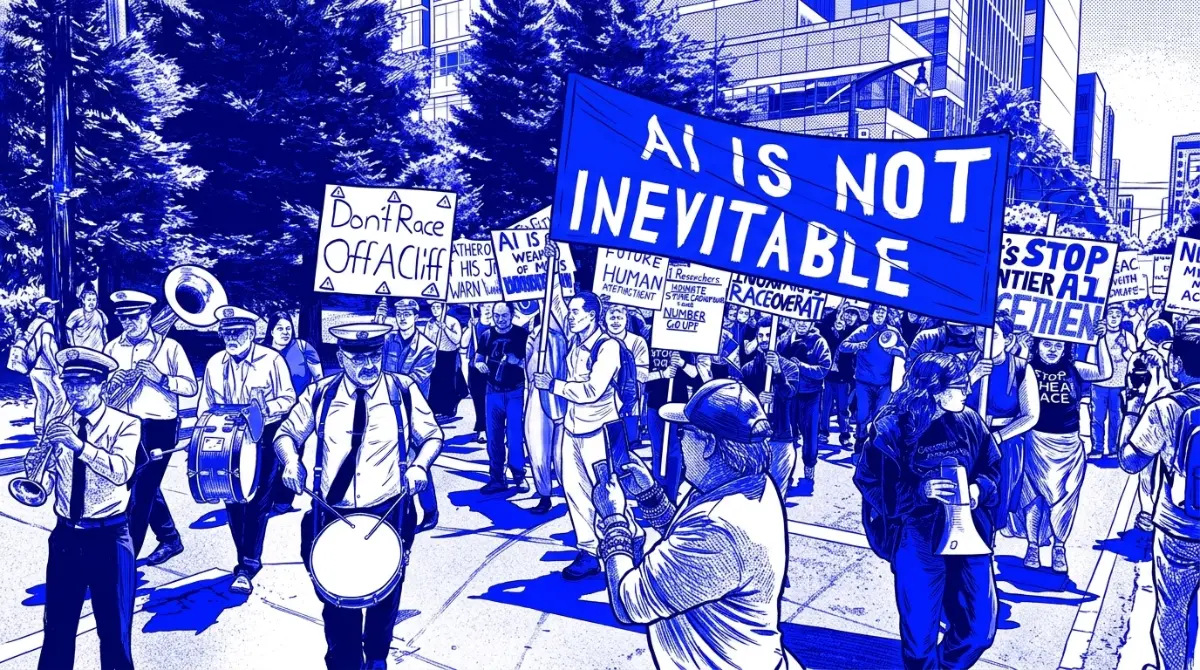


Data Center Backlash Unites American Voters in Midterms
Growing public anger over soaring home electricity bills, continuous mechanical hums, and regional water consumption has turned computing server construction into a bipartisan campaign battleground across competitive congressional districts in Pennsylvania, Texas, Georgia, and Virginia ahead of midterm elections.
Umar Abubakar | · 8 min read

American politics rarely produces agreement across party lines. On taxes, immigration, healthcare, and education, Democratic and Republican voters occupy opposing camps, viewing each other proposals with deep suspicion. A single issue has broken through that partisan division across suburban and rural communities: pure, unvarnished hatred for artificial intelligence data centers. Reports published on Tuesday, October 27, 2026, by The Verge revealed that community resistance to server facility construction has emerged as one of the most volatile campaign battlegrounds of the 2026 midterm elections. In competitive congressional districts across Pennsylvania, Virginia, Texas, and Georgia, political candidates find that local town hall meetings quickly devolve into debates over who will fight tech developers most aggressively. An NBC News Decision Desk survey revealed that 69% of registered voters oppose the construction of computing server parks in their local towns, with 45% stating they strongly oppose new permits. The bipartisan political rebellion arrives as communities confront physical infrastructure strains, continuing civic movements we monitored when public pushback mounted against server power usage.
The political fury is fueled by pocketbook realities. For three years, municipal county commissioners quietly approved zoning waivers and hundred-million-dollar tax abatements for technology giants, promising that server facilities would generate commercial revenue without placing burdens on local public school systems. What local homeowners experienced instead was a sharp decline in daily living standards. Electrical utility companies across the Mid-Atlantic and southern states passed the multi-billion-dollar cost of building fresh substations, transmission towers, and peaker plants directly to residential ratepayers, causing monthly home electricity bills to spike by twenty to thirty-five percent. Concurrently, the continuous low-frequency mechanical drone of industrial cooling fans penetrated residential bedroom windows, disturbing sleep and destroying quiet rural property values. With midterm elections approaching, voters in rural counties and suburban enclaves are packing municipal planning commissions, demanding immediate construction moratoriums and threatening to unseat any incumbent politician who voted for technology tax subsidies. The political revolt reflects national policy debates we followed when federal tax breaks for rural server centers came under public scrutiny.
The Double-Digit Utility Bill Surcharge
To inspect why everyday voters are angry, one must look at how public utilities finance transmission infrastructure. Under regulated utility accounting, electrical power companies are guaranteed a fixed rate of return on capital investments made to expand power grids.
When a technology conglomerate builds a server park pulling eight hundred megawatts of power, the local electrical utility must build high-voltage power lines and regional substations to supply that current. Under existing utility rules, the cost of constructing that shared electrical grid is divided across all ratepayers within the service territory. Everyday homeowners and small business owners are subsidizing the electrical infrastructure needed to power speculative machine reasoning models. In northern Virginia counties, working families saw residential electric bills jump by over forty dollars a month. When family budgets are already squeezed by grocery inflation and elevated mortgage rates, paying an extra five hundred dollars a year to power Big Tech software servers creates immediate political backlash. Political candidates in both parties are capitalizing on this anger, running television advertisements pledging to block data center utility rate-bumping laws. The nationwide strain on electrical transmission was examined in our report detailing how America computing infrastructure expansion began to stall.
Comparing Bipartisan Voter Grievances Across Battleground States
| Battleground Region | Primary Voter Concern | Partisan Dynamic | Municipal Legal Action | Midterm Campaign Impact |
|---|---|---|---|---|
| Northern Virginia (PJM Grid) | Electricity rate hikes & transmission towers | Bipartisan suburban homeowner alliance | County moratoriums on new applications | Decisive in competitive House swing districts |
| Central Pennsylvania | Nuclear power diversion & farm land loss | Rural conservatives + environmental left | Township zoning bans on industrial server halls | Central theme in Senate and House races |
| North Texas (ERCOT Grid) | Summer blackout threats & water depletion | Rural Republican crossover against state leadership | City council rejections of water utility hookups | Challenging established state legislative seats |
| Metro Atlanta (Georgia) | Cooling fan noise & suburban clear-cutting | Suburban moderates demanding noise limits | Enacting strict decibel noise ordinances | Shaping suburban legislative contests |
| Central Ohio | Aquifer depletion & property devaluation | Independent farmers & suburban commuters | Citizen lawsuits blocking tax abatement deals | Unseating incumbent county commissioners |
The comparative data illustrates why the data center issue is reshaping electoral maps. In traditional politics, rural Republicans favor business deregulation, while urban Democrats favor industrial oversight. In the data center fight, rural conservative farmers and progressive suburban parents find themselves standing together at public microphones. Both groups agree that tech companies are taking local resources without paying a fair share of community expenses. The political power of local resistance was demonstrated when local protests forced regulatory reviews in our report on federal agencies granting air quality waivers to server parks.
The Noise Epidemic: Low-Frequency Hums in the Night
Beyond financial costs, the physical sensory impact of data centers is driving homeowners to open rebellion. Modern high-density computing servers produce massive heat that requires thousands of high-velocity industrial fans and evaporative chillers running twenty-four hours a day.
The sound generated by these facilities is not an ordinary white noise; it is a persistent, low-frequency acoustic hum between thirty and sixty hertz that travels through soil and penetrates residential walls. Homeowners living a half-mile away describe feeling the vibration in their chests while trying to sleep. Prolonged exposure to low-frequency noise produces chronic insomnia, elevated blood pressure, and anxiety among residents. Because standard municipal noise ordinances were written to regulate loud lawnmowers or barking dogs during daytime hours, local police departments lack legal tools to penalize a continuous low-frequency hum. Frustrated homeowners are filing public nuisance lawsuits against facility operators and demanding that county commissioners pass strict night-time decibel caps measured at property boundary lines. Environmental and health impacts surrounding computing infrastructure were explored in our analysis of water and environmental constraints on computing campuses.
The Empty Promise of High-Tech Jobs
The core political grievance fueling the revolt is the realization that data centers provide almost zero permanent local employment. When technology platform operators propose a $2B server project, company lobbyists promise economic development, showing renderings of futuristic campuses that suggest hundreds of high-paying engineering jobs.
The reality is that an automated computing facility is an empty industrial shell. While constructing the reinforced concrete building employs hundreds of temporary construction workers for eighteen months, an operational five-hundred-megawatt facility requires only thirty to fifty permanent employees: primarily physical security guards, janitors, and a handful of electrical maintenance technicians. High-paying software engineering jobs remain located in Silicon Valley, Seattle, or New York. Local taxpayers realize they granted hundreds of millions of dollars in property tax exemptions to an industrial facility that generates fewer permanent jobs than a neighborhood grocery store. Community anger over hollow economic promises matches labor market patterns we tracked in our report on power grid reliability and technological oversight.
Candidates Scramble to Sound Tougher Than Their Rivals
With midterm elections weeks away, the political landscape in battleground states has shifted from competing for tech investments to competing over who can penalize tech developers most severely. Political incumbents who voted to approve server zoning permits two years ago are facing primary challenges and hostile general election opponents.
Candidates are introducing legislative proposals that would strip data centers of state sales tax exemptions, ban the use of potable municipal drinking water for server cooling, and mandate that technology platforms construct their own dedicated power plants rather than drawing from public utility grids. In Pennsylvania, candidates are campaigning on pledges to block technology firms from securing exclusive power purchase agreements with nuclear reactors, arguing that zero-carbon nuclear energy must belong to the public rather than corporate cloud hosts. In Texas, rural Republican state representatives are openly defying state party leaders, demanding a statewide halt on new server electrical permits until the state power grid is reinforced against summer heat waves. The political scramble proves that when an industrial issue threatens home values and monthly utility bills, local political self-preservation overrides party loyalty.
The Long Term Policy Shift for American Computing
The nationwide backlash against data centers marks a turning point in how American society approaches artificial intelligence infrastructure. For two decades, technology companies expanded computing footprints with minimal public interference, treated by local governments as economic saviors deserving of tax holidays and fast-tracked permits.
That era of political deference is over. The 2026 midterm elections demonstrate that everyday American citizens will no longer tolerate having their electrical grids destabilized, their water supplies drained, and their rural quiet shattered to power automated software tools. Moving forward, technology companies will face strict public oversight: mandatory environmental impact reviews, independent utility rate protections, and binding community benefit agreements. The candidates who capture midterm victories will be those who prove they can defend their communities against corporate encroachment, sending a clear message to Silicon Valley: the digital cloud will no longer be built on the backs of everyday American families.
Read More on TechRobust:

Umar Abubakar
 LinkedIn
Umar Abubakar
Expertise:Editorial Leadership, Product Design (UI/UX), Digital Media Strategy, Technology Systems, Product Architecture
Award:TechRobust Visionary Leader of the Year 2025
Umar serves as Editor-In-Chief of TechRobust, combining editorial vision with senior product design expertise to shape how modern technology stories are built, packaged, and told. Overseeing all editorial verticals, he directs coverage across global and regional tech industry while applying deep design thinking to publication strategy and reader experience.