
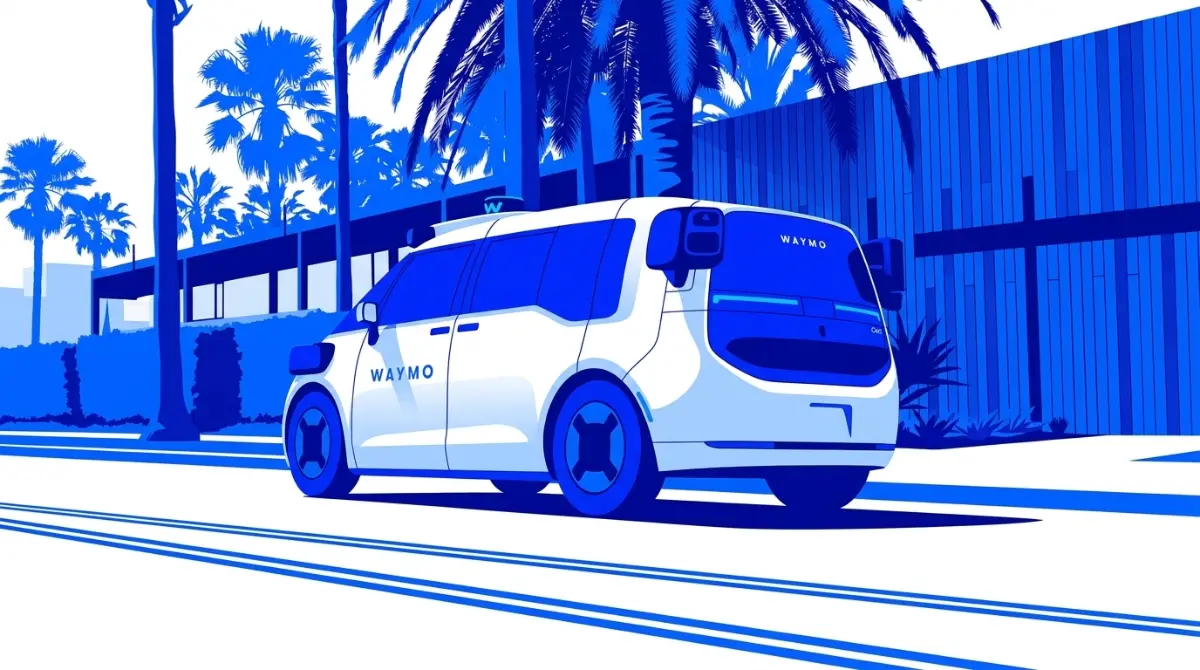


Waymo Launches Driverless Airport Rides in Las Vegas
Waymo introduced autonomous airport rides at Harry Reid International Airport in Las Vegas, routing passengers through Terminals 1 and 3 across a 24-square-mile territory as commercial driverless vehicles enter congested passenger drop-off lanes.
Umar Abubakar | · 10 min read

Airport arrivals curbs represent the ultimate trial for autonomous vehicles. Airport terminals pack hundreds of idling cars, hurried pedestrians stepping off medians, baggage trolleys rolling across traffic lanes, and police officers waving flashlights into tight lanes. For years, computer engineers kept self-driving test fleets on wide suburban avenues, avoiding the chaotic loading zones of major transit centers. That technical boundary broke open on Wednesday, October 21, 2026. Alphabet autonomous vehicle subsidiary Waymo confirmed it has started picking up and dropping off passengers at Harry Reid International Airport in Las Vegas. The service operates across both Terminal 1 and Terminal 3, connecting air travelers directly to the Las Vegas Strip, downtown casinos, and local event centers. The expansion establishes Las Vegas as the sixth commercial airport market served by Waymo, proving that machine-guided cars can navigate high-density transit corridors without human oversight. The rollout lands as municipal regulators monitor autonomous passenger fleets, an issue highlighted when cities enforced robotaxi emergency vehicle penalties to keep lanes open.
The airport launch marks a rapid operational advance for Waymo in Nevada. The company began public ride-hailing across Las Vegas earlier this year, building corporate relationships with regional destinations. Waymo signed agreements as the official transportation partner for the Las Vegas Raiders at Allegiant Stadium and secured dedicated pickup points at The Venetian Resort. Adding the airport links those hotel and stadium partnerships directly to the arrival gate. Under the initial phase, rides to and from the airport are available to a trusted group of local riders before expanding to all travelers using the Waymo app in coming weeks. Riders can travel across a 24-square-mile territory spanning Paradise, Winchester, and the resort corridor, with Clark County aviation directors clearing the vehicles for regular commercial curb access. The competitive push into commercial travel corridors coincides with rival tests, such as ongoing commercial cybercab public trials in competing states.
The Sixth Major Hub in Waymo Airport Network
Entering Harry Reid International Airport represents a deliberate corporate milestone. Transporting tourists between baggage claim and resort hotels generates reliable ride-hailing revenue. Unlike residential commuters who take short trips to local grocery stores, airport travelers carry luggage, travel longer distances, and accept higher ride prices during peak flight arrival banks.
Las Vegas joins an airport network that includes Phoenix Sky Harbor, San Francisco International, and regional flight centers across Arizona and California. Phoenix served as the initial test bed, where Waymo spent two years carrying passengers to regional terminals before expanding to main passenger drop-offs. In San Francisco, municipal disputes slowed airport curb access, forcing operators to stage vehicles at external rental lots. In Las Vegas, airport managers welcomed the technology with fewer bureaucratic hurdles. Clark County Director of Aviation James C. Chrisley stated that the airport serves tens of millions of visitors each year, noting that adding automated vehicles gives travelers additional transit choices while easing congestion on access roads. Staging automated shuttles inside major transport centers mirrors lessons learned during earlier autonomous shuttle testing in commercial office parks.
Terminal Geometry and Parking Garage Pickups
Navigating Harry Reid International Airport requires solving complex physical traffic patterns. The facility splits passenger traffic across two distant terminals that do not connect behind security gates, each featuring separate road loops, multi-story parking structures, and designated commercial pickup zones.
To avoid jamming the crowded departures curbs where private cars drop off ticketed passengers, airport authorities directed Waymo to use established app-based rideshare pickup areas. At Terminal 1, which handles domestic airlines like Southwest and Allegiant, Waymo vehicles pick up travelers on Level 2 of the passenger parking garage. Arriving passengers walk from baggage claim, take elevators near Door 2 up to the pedestrian skybridge, and cross into the garage pickup zone. At Terminal 3, which serves international arrivals and carriers like United and Delta, pickups take place on the Valet Level of the Terminal 3 parking garage. Riders take elevators from doors 52, 54, or 56 down to the valet area. Drop-offs, by contrast, occur directly at the standard departures curbs outside both terminals, allowing travelers to unload luggage steps away from airline check-in counters.
Hardware Sensing Under Desert Heat and Glare
Operating driverless vehicles in southern Nevada presents distinct environmental challenges that differ from coastal California or temperate Arizona. Summer temperatures in Las Vegas routinely exceed 115 degrees Fahrenheit, turning road asphalt into baking surfaces that strain vehicle cooling systems and degrade battery chemistry.
Waymo deploys an all-electric fleet of Jaguar I-PACE sports utility vehicles equipped with its fifth-generation driving hardware. The sensor setup mounts high-resolution rotating lidar domes on the roof, supported by perimeter lidar sensors on the bumpers, long-range radar pods, and dozens of optical cameras. These sensors must track pedestrians carrying wide roller bags, identify luggage carts left in parking stalls, and read electronic overhead signs through desert sun glare. High temperatures can cause optical sensors to overheat, so Waymo engineered liquid-cooling lines that route refrigerant directly across sensor mounts and onboard computer trunks. The software uses machine vision to filter out heat shimmer rising from the runway access tarmac, preventing phantom obstacle detections that cause vehicles to brake abruptly on open airport ramps.
Waymo Airport Operations Across Major Metropolitan Hubs
| Airport Location | Commercial Launch | Terminals Served | Pickup Zone Design | Operating Territory Size |
|---|---|---|---|---|
| Harry Reid International (LAS) | October 2026 | Terminal 1 & Terminal 3 | Garage Level 2 and Valet Level | 24 square miles |
| Phoenix Sky Harbor (PHX) | December 2022 | Terminals 3 & 4 + Sky Train | Dedicated outer ground curbs | 225+ square miles |
| San Francisco International (SFO) | Mid 2025 | Domestic & International | Dedicated staging structure | 55 square miles |
| Austin-Bergstrom (AUS) | Early 2026 | Barbara Jordan Terminal | Consolidated rental center | 35 square miles |
| Los Angeles International (LAX) | Mid 2026 | LAX-it transit lot | Off-terminal shuttle lot | 80 square miles |
The operational comparison demonstrates how airport authorities manage driverless fleets. While Phoenix allows vehicles directly along outer ground curbs, high-traffic hubs like Las Vegas and Los Angeles route driverless cars into parking structures or remote transfer lots to avoid blocking main roadway loops. The arrangement minimizes conflicts with municipal buses and commercial hotel shuttles.
The Battle for the Las Vegas Tourist Corridor
Las Vegas represents one of the most profitable transportation markets in North America. Unlike sprawling cities where riders take twenty-minute trips through quiet residential neighborhoods, Las Vegas concentrates immense passenger volume along a four-mile strip of South Las Vegas Boulevard. Millions of tourists land at Harry Reid Airport each month, and almost all of them head directly to the same two dozen casino resorts.
This compact geography creates ideal economics for electric vehicle fleets. Cars spend less battery power driving empty miles between customer requests, completing rapid loops between terminal garages and resort valet entrances. However, the Strip also presents aggressive competition. Amazon subsidiary Zoox has conducted extensive testing of its custom bi-directional passenger pods in Las Vegas, preparing for its own commercial passenger launch. Concurrently, human rideshare drivers working for Uber and Lyft have formed organized labor coalitions, protesting outside municipal council chambers against corporate driverless permits. Drivers argue that automated vehicles will wipe out working-class livelihoods that depend on airport passenger fares. Traditional taxi companies, which held exclusive franchised concessions in Nevada for generations, are also lobbying state legislators to impose strict vehicle caps on autonomous fleets.
Rider Flow, Trunk Space, and Passenger Baggage Friction
Carrying passengers between city neighborhoods is simple compared to airport logistics. When an individual orders a ride to an office building, they step inside with a backpack, buckle their seatbelt, and exit upon arrival. Airport passengers present physical baggage that complicates automated service.
A family landing from an overseas flight often carries four heavy roller bags, garment bags, and strollers. In a traditional taxi, a human driver steps out, opens the trunk, and packs heavy luggage into the cargo compartment. In a Waymo vehicle, passengers must load their own luggage. The Jaguar I-PACE offers a rear hatch that opens automatically through an app command, revealing adequate trunk volume for two large suitcases and two smaller carry-on bags. If a passenger tries to load five oversized bags, the trunk will not close, preventing the car from starting its route. Waymo added automated trunk sensors that detect unclosed latches and prevent movement until cargo is secured. Inside the cabin, passenger touchscreens display step-by-step instructions for unloading items before ending the ride, accompanied by chime alerts to remind hurried travelers not to leave mobile phones or passports on the rear seats.
Aviation Authorities and Municipal Concession Fees
Commercial airports do not let transportation providers operate on municipal property for free. Concession revenues from parking, rental cars, and rideshare fees account for a major portion of airport operating budgets, funding runway repairs, terminal cleaning, and airport security staffing.
Clark County requires every app-based mobility provider to pay a per-trip pickup fee, typically ranging between $2 and $4 per airport ride. Waymo agreed to these exact concession terms, ensuring that the county collects identical revenue whether a traveler hires a human driver or rides inside a machine-driven vehicle. The company integrated geofenced airport gates into its dispatch software. When a Waymo car enters airport property through Paradise Road or Swenson Street, local transponders log the vehicle ID, recording the entry time and reporting the fee directly to airport accounting ledgers. Coordinated payment clearing ensures that local governments do not lose revenue as vehicle fleets transition to automated hardware.
Software Routing Through Dense Parking Structures
Driving inside an open-air terminal road is difficult, but driving inside a multi-story concrete parking structure is an engineering maze. Parking garages block satellite global positioning signals, turning standard GPS navigation useless. Thick concrete pillars, low clearance ceilings, and tight spiral ramps create blind turns where human drivers frequently scrape bumpers.
To navigate the Level 2 garage at Terminal 1, Waymo uses local geometric mapping. The car does not rely on space satellites; it matches its live lidar scans against high-resolution three-dimensional maps of the garage interior. The vehicle calculates its exact position relative to concrete support columns, directional arrows painted on asphalt, and overhead support beams. The software must also negotiate tricky multi-way stop signs inside the garage, where distracted drivers search for parking spaces without looking at road signs. If an oncoming car cuts a corner too sharply on a parking ramp, the Waymo system yields, stopping smoothly to allow the human driver to pass. Developing software that handles tight enclosed spaces shows how autonomous platforms have advanced past basic highway lane-keeping.
Expanding Beyond the Twenty-Four Square Mile Boundary
While the airport connection represents a triumph for Waymo, the current service boundary remains confined to urban resort corridors. The 24-square-mile zone covers the airport, the Strip, downtown Fremont Street, and adjacent entertainment arenas, but leaves out vast residential communities across Henderson, Summerlin, and North Las Vegas.
Local residents who work at Strip casinos cannot yet use the driverless fleet to commute home to outer suburbs. Waymo confirmed that it plans to expand its geographic footprint across the wider Las Vegas Valley over the coming year, adding residential neighborhoods and commercial districts as mapping fleets complete street validations. Expanding into residential suburbs requires training models on school zones, residential cul-de-sacs, and complex suburban arterial streets. For now, concentrating vehicles around the airport and resort corridor allows Waymo to capture profitable visitor spending while building operational miles in a well-defined territory.
What the Las Vegas Airport Launch Proves
The introduction of driverless rides at Harry Reid International Airport confirms that autonomous mobility has moved beyond experimental pilot tests. Managing airport passenger routes proves that machine-driven vehicles can handle the most complex transportation corridors in modern cities.
By coordinating with Clark County aviation officials, integrating garage pickup logistics, and managing baggage requirements, Waymo has built a commercial blueprint for airport integration that other metropolitan centers will study. While labor disputes and competitive battles with Zoox and Tesla will continue across Nevada, the presence of driverless cars picking up passengers outside baggage claim proves that the future of travel has arrived. For millions of tourists visiting Las Vegas, their first taste of driverless transportation will begin the moment they step off an airplane and enter a machine that takes them down the Strip without a driver behind the wheel.
Read More on TechRobust:

Umar Abubakar
 LinkedIn
Umar Abubakar
Expertise:Editorial Leadership, Product Design (UI/UX), Digital Media Strategy, Technology Systems, Product Architecture
Award:TechRobust Visionary Leader of the Year 2025
Umar serves as Editor-In-Chief and CEO of TechRobust, combining editorial vision with senior product design expertise to shape how modern technology stories are built, packaged, and told. Overseeing all editorial verticals, he directs coverage across global and regional tech landscapes while applying deep design thinking to publication strategy and reader experience.