


 LinkedIn
 Taja Tops 50,000 Users Across Seven African Markets
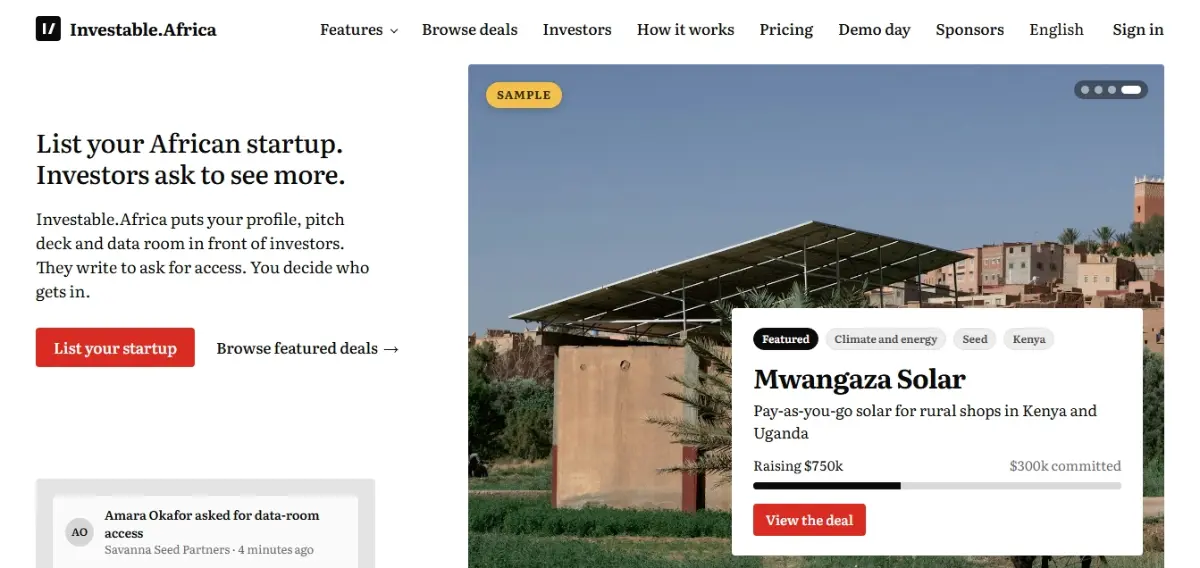
Investable.Africa Debuts Platform to Link Startups, Funds
Investable.Africa, African startups, venture capital, angel investors, startup funding, early stage tech, Africa & Emerging Markets, tech news
Inioluwa Ademidun | · 9 min read

Early-stage entrepreneurs building commercial technology outside established African metropolitan centers face severe fundraising hurdles. When an ambitious software developer in Gaborone, Lusaka, or Cotonou finishes a functional software product, finding equity capital often requires cold messaging hundreds of foreign accounts on social media or borrowing money to attend expensive overseas conferences. Western venture capitalists rarely visit secondary African markets, while local angel networks outside the largest four economies remain thin and disorganized. African startup tracking publication Disrupt Africa stepped forward on Wednesday, October 28, 2026, to address that geographical imbalance. The media enterprise announced the open beta release of Investable.Africa, an online discovery and networking platform designed to link African founders directly with global investment firms. The service provides registered founders with access to a structured database detailing more than four thousand investment groups, angel syndicates, and family offices actively backing developing market enterprises. The debut arrives as international capital groups reassess startup financing across regional industrial corridors, an investment shift visible when African tech ventures reported strong quarterly funding totals.
The operational framework of Investable.Africa addresses a persistent distribution failure in African early-stage finance. While tech giants and late-stage fintech unicorns attract institutional checks, early-stage ventures struggle to gain visibility with relevant partners. Disrupt Africa co-founders Tom Jackson and Gabriella Mulligan built the platform using twelve years of gathered investment data, tracking who writes checks, which sectors they prefer, and what funding stages they support. Founders can build initial business profiles for free, with public profile listings costing $99 per month or $299 per year. Crucially, the platform operates as a neutral matchmaking directory rather than an unlicensed broker-dealer: it takes zero percent commission on closed financing rounds and does not handle investor funds directly. The focus on expanding capital access beyond traditional tech centers matches funding priorities we tracked when Grindstone Ventures debuted a dedicated fund for African startups.
The Opacity of Private African Deal Flow
To understand why a dedicated matchmaking database is necessary, one must look at how venture funding operates across developing economies. Venture capital in Africa is an informal, relationship-driven business. Investment partners in London, Paris, and New York frequently deploy capital into founders who graduated from specific American universities or completed elite Silicon Valley accelerator programs.
This closed network model leaves thousands of capable operators invisible to international capital. A logistics founder running a profitable distribution network in Douala or an agricultural supply company serving farmers in Lilongwe rarely possesses warm personal introductions to institutional investment committees. Finding active angel investors becomes an exercise in guesswork: founders email generic contact addresses at foreign venture funds, only to receive silence because the fund is fully deployed, mandates different geographic territories, or invests strictly in medical biotechnology rather than agricultural trade. Investable.Africa removes this opacity by cataloging verified investment mandates. Founders can filter funds by specific operational criteria: identifying which investment groups write $50,000 pre-seed checks in Francophone West Africa, or which family offices back renewable energy assets in Central Africa. Removing friction between operators and investors reflects early-stage venture strategies we analyzed when founders entered startup grant and pitch competitions.
The Zero-Commission Neutral Directory Model
A notable structural choice in Investable.Africa corporate design is its rejection of transaction fees. In traditional corporate finance, placement agents and intermediary brokers charge between three and seven percent of any equity capital raised, alongside monthly cash retainers.
For an early-stage startup trying to raise an initial $200,000 round to build its engineering team, paying twelve thousand dollars to an intermediary broker drains working capital. Intermediary structures also introduce complex legal liabilities, as handling investment funds requires registration with national securities regulators and capital market authorities across dozens of separate jurisdictions. Investable.Africa avoids these legal complications by positioning itself strictly as an information utility. By charging a predictable annual listing fee of $299, the platform aligns incentives with founders: the startup keeps one hundred percent of its raised equity, while the directory covers operational expenses through software subscriptions. Investors browse vetted founder profiles, review traction summaries, and reach out directly to founding teams via verified communication links without middleman interference. Independent venture structures across distributed technology centers were explored in our analysis of Ventures Platform closing an institutional venture fund.
Comparing African Startup Capital Access Channels
| Capital Channel | Founder Financial Cost | Geographic Reach | Equity Dilution Impact | Onboarding Barrier |
|---|---|---|---|---|
| Investable.Africa Directory | $299 annual listing fee | All 54 African countries | Zero equity taken; 0% commission | Open beta registration with verified data |
| International Accelerators | Zero cash upfront; travel costs | Concentrated in tier-one tech hubs | 7% to 10% standard equity dilution | Intense application filters (under 2% accepted) |
| Unregistered Placement Brokers | 3% to 7% of total funds raised | Limited personal contact books | High cash fee deducted from round | Informal negotiations; variable trust |
| Cold LinkedIn Messaging | Free; requires personal time | Unfiltered global search | Zero direct dilution | Very low conversion rate (under 1% replies) |
| Regional Angel Syndicates | Standard legal closing fees | Strictly local domestic markets | Standard negotiated round terms | Requires local social standing and introductions |
The comparative data demonstrates why an open directory model fills an operational void. While elite accelerator programs offer valuable mentorship, they demand seven percent or more in equity dilution, which can leave early founders over-diluted before reaching Series A. Unregistered brokers take cash commissions that starve young businesses of capital. Investable.Africa provides an accessible channel for founders who have working products and verified customer receipts, allowing them to broadcast traction to thousands of institutional eyes simultaneously. The challenges of managing early equity dilution were examined in our review of Flow Engineering securing growth capital for industrial workflows.
Dismantling the Monopoly of the Big Four Markets
The strategic promise of Investable.Africa is geographic decentralization. For a decade, venture capital data recorded an overwhelming concentration: Nigeria, Kenya, South Africa, and Egypt: collectively known as the Big Four: absorbed over seventy-five percent of all equity financing entering the African continent.
This concentration created a self-fulfilling dynamic. Venture funds opened offices in Lagos and Nairobi, hired local associates in Johannesburg and Cairo, and funded companies operating in those four urban zones. Meanwhile, equally promising markets: including Ghana, Senegal, Rwanda, Ivory Coast, Uganda, and Morocco: received fractional scraps of venture funding. A merchant software firm in Kampala with stellar unit economics struggled to raise $500,000, while a speculative consumer app in Lagos raised $5M on pitch decks alone. By mapping startups across all fifty-four countries, Investable.Africa gives capital providers visibility into overlooked regions. International family offices seeking exposure to mineral supply chains, cross-border agricultural logistics, or renewable mini-grids can discover regional champions before valuations get bid up by mainstream funds. The uneven distribution of venture capital across emerging ecosystems was detailed in our analysis of how African funding totals hide the missing middle for growing startups.
The Investor Dilemma: Deal Flow Verification Without Local Offices
From the institutional investor perspective, discovering verified early-stage opportunities in developing economies presents difficult logistical problems. An endowment fund in Boston or a family office in Zurich cannot afford to maintain full-time investment scouts across twenty different African nations.
Hiring local research teams, conducting physical site inspections, and verifying local corporate registrations requires substantial administrative outlays. Many global funds want exposure to high-growth emerging economies, but lack the bandwidth to sift through hundreds of unvetted pitch decks sent via social channels. Investable.Africa serves as an initial discovery screen. The platform organizes company profiles by verified traction indicators: customer growth, monthly recurring revenue, regulatory licensing status, and corporate incorporation records. Institutional analysts can identify interesting businesses in seconds, review pitch materials, and initiate direct communication with founders who match their precise portfolio criteria. The need for verified company performance data matches investor practices we followed when venture capitalists evaluated founder sales tests before investing.
Navigating the Global Venture Capital Contraction
The introduction of Investable.Africa arrives amid a protracted contraction in international private capital. Rising central bank borrowing rates and macroeconomic uncertainty prompted Western institutional investors to retreat from frontier markets over the past twenty-four months.
Global venture syndicates that wrote multi-million-dollar checks during the 2021 funding boom have curtailed emerging market allocations, focusing capital on domestic opportunities and machine intelligence infrastructure. African startups can no longer rely on easy foreign capital to subsidize cash-burning business models. Founders must demonstrate capital discipline, fast paths to profitability, and transparent unit economics. Tools like Investable.Africa help operators diversify their funding search: moving beyond traditional venture funds to connect with development finance institutions, corporate innovation arms, and regional angel syndicates that maintain steady capital reserves throughout market cycles. Entrepreneurial resilience across changing funding conditions was examined in our report detailing the ten-year outlook for African technology founders.
Due Diligence Standards and the Battle Against Platform Spam
The primary operational hurdle confronting Investable.Africa is data quality maintenance. If an open directory allows unverified, low-quality submissions to flood search results, institutional investors will abandon the tool within minutes.
To preserve platform credibility, the Disrupt Africa editorial and data teams apply manual screening filters to incoming company submissions. Profiles must demonstrate verifiable operations: registered corporate entities, live software products or services, clear customer value metrics, and functional team rosters. The team flags exaggerated claims, unverified revenue numbers, or misleading intellectual property representations. By maintaining strict baseline standards, Investable.Africa protects investors from deal fatigue, ensuring that the four thousand registered funds encounter serious, investable enterprises. Sustainable development projects and green technology initiatives were explored in our analysis of African startups competing for sustainability prizes, alongside localized funding programs detailed when Madica backed early-stage African tech teams.
The Long-Term Outlook for African Startup Discovery
Investable.Africa represents an important step in the maturation of the African technology landscape. For twelve years, Disrupt Africa documented the financial progress of the continent, recording historic funding rounds and painful startup shutdowns as independent journalistic observers.
By translating that vast reservoir of market intelligence into a functional software directory, the organization is actively helping to solve the funding bottlenecks it spent over a decade documenting. As the open beta expands and thousands of founders build verified profiles, the platform will help dismantle the geographical and social barriers that have long determined which entrepreneurs receive capital. The future of African innovation will not be defined by a handful of well-connected founders in coastal capitals, but by hundreds of determined builders across all fifty-four nations who possess the tools, visibility, and global connections needed to turn local ideas into enduring commercial realities.
Read More on TechRobust:

Inioluwa Ademidun
Inioluwa Ademidun
Expertise:African Tech Ecosystem, Early-Stage Startups, Emerging Market Dynamics, Venture Capital & Tech Reporting, Product Management
Award:TechRobust Contributor of the Year 2025
Inioluwa is a Senior Product Manager by day and an investigative technology reporter by night, bridging the gap between scalable software architecture and high-impact journalism. She delivers deep-dive analysis on venture-backed founders, regulatory shifts, and grassroots tech ecosystems across Africa and global emerging markets.
Related Stories
Taja Tops 50,000 Users Across Seven African Markets Ugandan Startup XenFi Helps Hotspot Operators Sell Wi-Fi
 Airtel Money Revenue Jumps 34% to $830M Post-IPO