
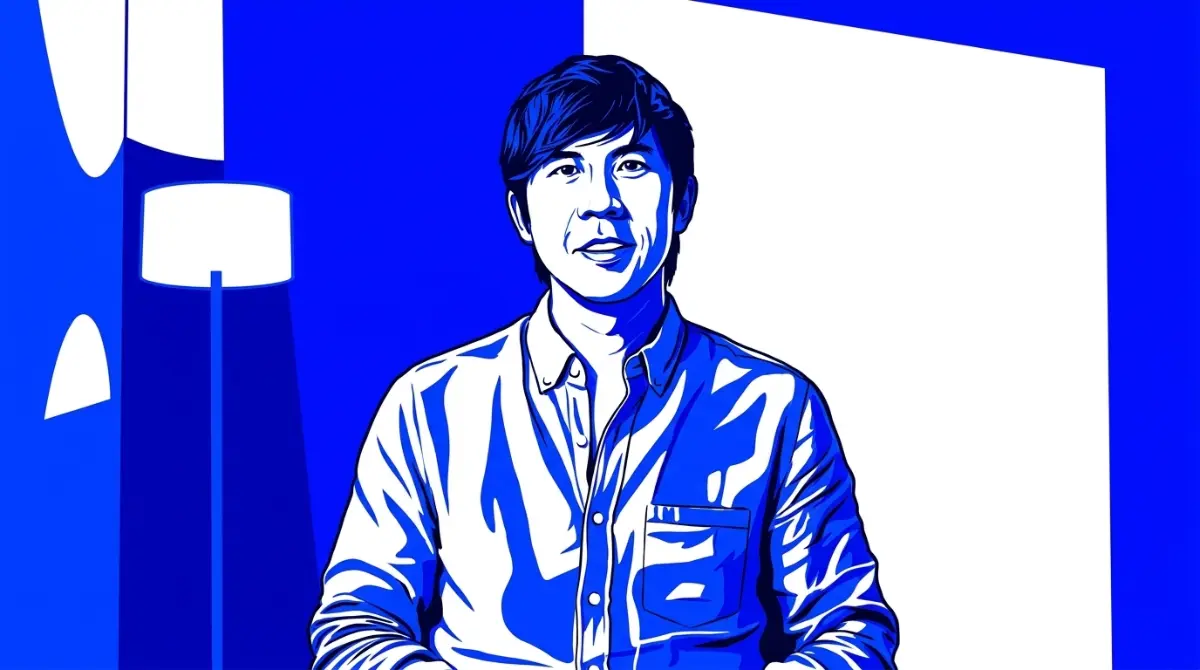


Elorian Launches Glimpse for Native Visual Reasoning
Former Google DeepMind scientists at Elorian introduced Glimpse, a visual model featuring dynamic image scratch space that reasons directly through spatial imagery instead of converting pictures into lossy text descriptions, outperforming frontier text systems on scientific chart evaluations.
Oladipupo Ajayi | 16 Oct. 2026, 1:30 AM · 9 min read

Computer vision systems have spent a decade pretending to see while remaining fundamentally blind. In the current crop of multimodal models, an artificial intelligence does not actually reason inside the visual medium. Instead, when a user uploads an image, the software runs a rapid encoder pass that flattens the picture into discrete text-like tokens. From that moment onward, the underlying model reasons entirely in words, behaving like a person who took a split-second glance at a complex painting and now tries to answer detailed questions about it from memory. This two-step process breaks down when dealing with spatial geometry, architectural blueprints, medical scans, or physical motion. Artificial intelligence startup Elorian stepped into public view on Thursday to correct that structural limitation. Founded by former Google DeepMind researchers including Andrew Dai, the firm unveiled Glimpse, its inaugural model engineered to reason with images rather than merely describing them. The debut lands as software developers push past flat text interfaces, a technical transition we followed when Google DeepMind launched post-training reasoning updates.
The foundational thesis behind Elorian challenges the language-centric orthodoxy that has dominated research laboratories since the release of the transformer architecture. Human beings do not navigate the physical world through internal verbal monologues. An athletic coach spotting an error in a runner stride, an architect sketching a building facade, or an infant stacking wooden blocks reasons through spatial coordinates, visual balance, and physical geometry long before words form in the mind. By forcing visual data through narrow text tokenizers, modern multimodal systems lose subtle geometric relationships, causing systems to hallucinate spatial details or fail simple diagrammatic logic tests. Glimpse introduces an interactive visual scratchpad that allows the model to look back at the original image, zoom into specific coordinates, trace lines, and verify spatial hypotheses before producing an answer. The effort to build models that deliberate before answering matches architectural patterns we analyzed when Meta showed why raw compute fails without strategic controllers.
The Flaw of One Shot Vision Encoders
To understand why Elorian approach marks an important scientific break, one must look at how existing frontier models process visual inputs. In leading proprietary models, vision is treated as a secondary input channel. A separate vision transformer divides an image into a grid of sixteen-by-sixteen pixel patches, transforms those patches into mathematical vectors, and feeds them into the main text decoder.
Once those visual tokens enter the decoder, the original image is discarded. If the model needs to solve a complex five-step geometry problem, it cannot re-examine the image to double-check an angle or verify a line intersection. It must rely on its initial compressed representation. This lossy translation explains why an advanced model that can write graduate-level legal essays will stumble when asked to count the number of overlapping circles in a simple diagram or read an unusual scientific chart. The two-step translation chain is fragile; any error made during the initial visual-to-text compression persists throughout the entire response. Elorian replaces this static setup with a bidirectional processing loop, keeping the high-resolution image active throughout the reasoning process. How visual models process continuous video streams was explored in our analysis of TwelveLabs translating video records into training data.
The Visual Scratch Space and Dynamic Gaze Mechanics
The core technical innovation inside Glimpse is what Elorian terms the visual scratch space. When human experts analyze complex imagery: such as a radiologist reading an MRI scan or an engineer inspecting an integrated circuit layout: they do not stare blankly at the center of the image. Their eyes move dynamically across the surface, darting between reference points, zooming into anomalous regions, and comparing relative dimensions.
Glimpse replicates this active visual gaze. As the model processes an inquiry, it can generate internal visual queries that crop, re-sample, or mask specific sections of the source image at native resolutions. If an engineering prompt asks whether a pipe on a technical schematic connects to valve B or valve C, Glimpse traces the pixel path along the blueprint, verifying each junction sequentially before confirming the answer. This continuous grounded feedback loop prevents the hallucinated connections that plague standard vision models. In public evaluation disclosures, Elorian demonstrated that Glimpse outperforms proprietary baselines like GPT-6 Astra on scientific chart comprehension and complex infographic interpretation. The development of specialized spatial reasoning matches techniques we examined when Skild AI and Nvidia trained physical automation tools.
Pedigree From Google DeepMind and Academic Labs
The technical credibility of Elorian is anchored in the background of its founding team. Founder Andrew Dai spent more than a decade at Google and Google DeepMind, contributing to foundational machine learning breakthroughs including early language models, semi-supervised sequence learning, and neural machine translation. His research has accumulated tens of thousands of academic citations, shaping how industrial laboratories train large-scale neural networks.
Dai assembled a technical team drawn from top research centers, including Carnegie Mellon University, UC Berkeley, and the Massachusetts Institute of Technology. The team recognized that while the industry was racing to scale text models to hundreds of billions of parameters, visual intelligence had plateaued because everyone was using the same flawed vision-language pre-training recipes. By starting with a clean slate, Elorian raised $300M in early valuation backing to build foundation models designed for visual thought from the ground up. The migration of premier researchers from corporate conglomerates to focused research startups reflects patterns we tracked when DeepSeek backed former Tencent vision scientists at Winverse.
Benchmark Standings on Scientific Charts and Geometry
In standardized evaluations published alongside the launch, Elorian positioned Glimpse against the strongest multimodal systems in the world. On the ChartQA benchmark, which measures the ability to extract data and answer mathematical questions from complex business and scientific graphs, Glimpse achieved a top score, beating both commercial and open-weight models.
The model demonstrated wide leads on tasks involving spatial reasoning and geometric proofs, such as GeoQA and MathVista. When asked to determine whether physical objects would remain stable or topple over under gravitational forces in a two-dimensional schematic, Glimpse predicted physical outcomes with high accuracy. The model was also evaluated on short-form video captioning, where it tracked the motion of fast-moving sports equipment without blurring temporal details. These benchmark results suggest that retaining access to raw pixel arrays during deliberation delivers tangible improvements over pure text tokenization. The race to capture top scores across specialized reasoning benchmarks mirrors competitive dynamics we followed when Meta launched Muse Wonder with chain-of-thought capabilities.
The Bridge to Physical Robotics and Spatial Automation
While scientific document parsing provides an immediate commercial market, Elorian broader ambition is building brains for physical robotics. A humanoid robot or an industrial manipulator cannot operate in the real world using models that only understand text descriptions of rooms. To pick up a glass, navigate a cluttered warehouse, or plug in an electrical cable, a robot must perceive spatial depth, surface friction, and object geometry in real time.
Dai confirmed that the underlying architecture behind Glimpse is designed to serve as a spatial world model for embodied systems. By maintaining a visual representation of a scene and updating that model as cameras move, Glimpse can plan physical manipulation steps and issue motor control commands directly. This eliminates the need for expensive, brittle rule-based computer vision pipelines that fail whenever ambient lighting shifts. If Elorian can scale Glimpse to run on low-power edge processors, the company could become a primary software supplier for the global humanoid robotics industry. The development of foundational world models for physical hardware matches developments we documented when Amazon opened talks to acquire world-model pioneer Decart.
The Compute Overhead of Iterative Visual Search
Despite its impressive reasoning accuracy, the visual scratchpad architecture introduces significant computational trade-offs. In standard multimodal models, processing an image is cheap: you run the vision encoder once, generate a set of tokens, and proceed with standard text generation. In Glimpse, the model continuously queries, crops, and re-processes image regions during its reasoning chain.
This iterative visual search increases inference latency and consumes substantial graphic processor memory. If a model performs four separate visual re-inspections to solve a single engineering diagram, the inference cost per query climbs sharply. For high-volume consumer chat applications where users expect instant two-second answers, that computational overhead can be commercial suicide. Elorian is addressing this constraint by launching Glimpse as a restricted research preview with private API access, targeting high-value enterprise use cases in medical imaging, patent analysis, and structural engineering where accuracy is far more important than raw query speed. Managing model operating costs across enterprise pipelines was analyzed in our coverage of Anthropic cutting API expenses for specialized workloads.
Data Scarcity and the Visual Reasoning Moat
A central barrier protecting Elorian from immediate duplication by tech conglomerates is the scarcity of visual reasoning training data. Scraping millions of image-caption pairs from the public web is straightforward, but those captions almost always provide surface descriptions, such as "a dog running on grass" or "a chart showing sales."
They do not explain the spatial reasoning required to construct the scene. To train Glimpse, Elorian had to construct specialized synthetic datasets where models were taught to answer questions by showing their visual work: annotating bounding boxes, drawing geometric construction lines, and verifying coordinate transformations. This custom training curriculum teaches the model how to look at images methodically rather than relying on associative text memory. Constructing defensible data moats in machine learning matches trends we evaluated when Google launched Gemini 4 Argon for complex enterprise tasks.
The Road to General Visual Intelligence
Elorian introduction of Glimpse marks an important conceptual shift in the evolution of artificial intelligence. For four years, the computing industry operated under the assumption that language was the universal operating system of thought, and that if you simply fed enough text into a transformer, spatial understanding would emerge automatically.
Glimpse proves that genuine visual understanding requires specialized architectural mechanisms that respect the spatial nature of sight. Over the coming year, Dai and his team must prove that their visual scratchpad can scale efficiently across millions of enterprise queries without stalling server facilities. If Elorian succeeds, it will open an entirely new frontier in machine perception, giving computers the power to truly see, navigate, and build in the physical world around us. The commercial battles surrounding specialized enterprise reasoning models were detailed in our analysis of compact models matching frontier performance, while structured memory systems were examined when Thally launched automated knowledge layers for software teams.
Read More on TechRobust:
Oladipupo Ajayi
 LinkedIn
Oladipupo Ajayi
Expertise:Artificial Intelligence, Machine Learning Trends, Data Infrastructure, Enterprise AI Strategy, Frontier Tech Commentary
Award:TechRobust AI & Data Voice of the Year 2025
Ola is an Editor-at-Large at TechRobust, delivering authoritative commentary, high-level analysis, and investigative features across the frontiers of machine intelligence and big data. He tracks frontier model developments, enterprise AI adoption, data governance, and the societal shifts driven by computational breakthroughs.