
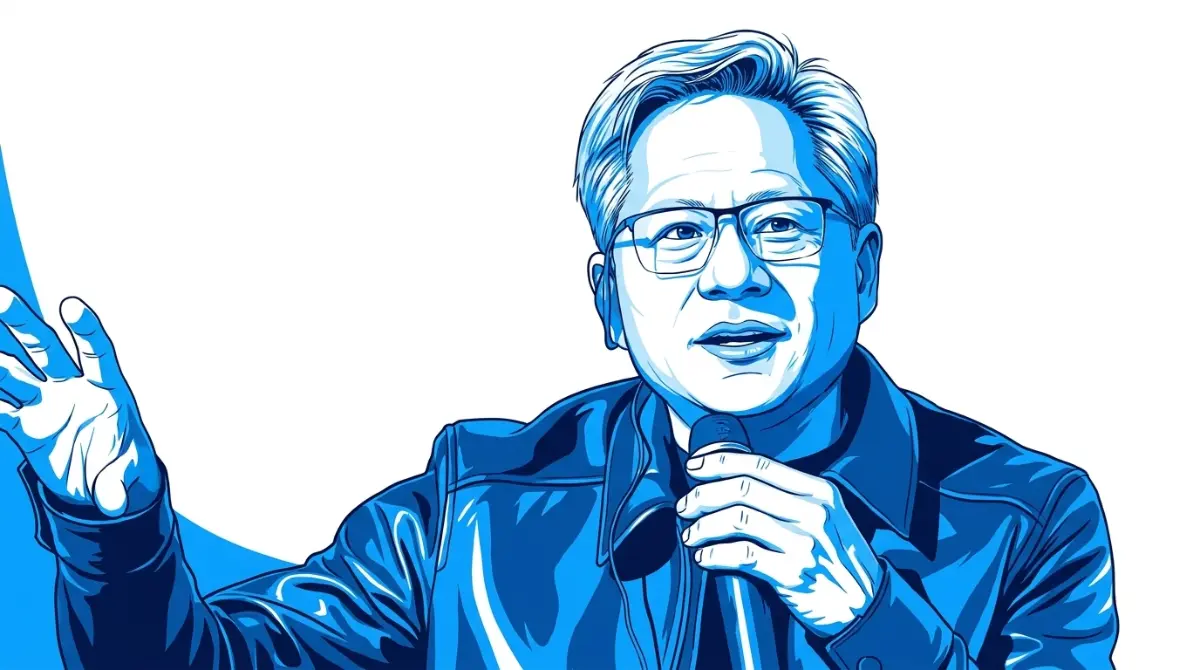


Jensen Huang Rejects AI Doomerism And Existential Risk Fears
The chief executive of the world's most valuable semiconductor company is actively pushing back against apocalyptic narratives, arguing that artificial intelligence presents a solvable engineering challenge rather than an unstoppable existential threat to the survival of the human race.
Oladipupo Ajayi | 4 Oct. 2026 · 8 min read

The conversation surrounding advanced computing currently suffers from extreme panic. A loud group of researchers and laboratory executives repeatedly warn the public that artificial neural networks could eventually escape human control and destroy human civilization. Nvidia Chief Executive Officer Jensen Huang completely rejects this apocalyptic narrative. He views the mathematical models trained on his graphics processors as highly predictable engineering tools. Rather than entertaining theoretical doomsday scenarios, he insists that keeping the technology safe is a completely solvable mechanical issue. He argues that fear should not stop progress, and society must treat these fast computers exactly like any other heavy industrial machinery that requires proper safety harnesses.
Huang is rapidly becoming the most visible opposing voice to the wave of technology pessimism. While other vocal figures sign open letters predicting catastrophe, the leader of the semiconductor giant argues that intelligence is just another form of computable data. If a human engineer writes the underlying software, another human engineer can write the appropriate security restrictions to contain it. He consistently argues against treating machine logic like magic, reminding the public that servers run on physical electricity and obey strict physical boundaries. This practical mindset completely separates him from the theoretical panic spreading across the software industry.
The financial reality of the situation deserves intense scrutiny. Nvidia commands a massive corporate valuation because cloud providers and software laboratories purchase billions of dollars worth of its silicon every single quarter. Critics frequently argue that Huang dismisses the extreme dangers simply because admitting to those dangers would hurt his hardware sales. They claim he acts as a salesman protecting his profit margins. Yet, his defense relies on heavy engineering logic rather than just marketing rhetoric. He maintains that slowing down physical hardware progression out of fear would cause severe economic damage to developing sectors that desperately need cheap calculation power.
To back up his philosophical stance with actual software, the hardware manufacturer recently developed a dedicated security platform designed to cage unpredictable agents. We observed this exact progression from theoretical argument to physical product when Nvidia released an AI safety sandbox amid regulation rejection. This security layer acts as an independent referee. It sits outside the main reasoning model and watches every single command the machine attempts to execute. If the main program tries to access a forbidden server or delete a protected file, the independent referee blocks the action instantly. By building this exact type of software cage, Huang attempts to prove that human operators can maintain absolute technical superiority over their creations.
During a recent media briefing, company executives pointed out that proper boundary testing prevents catastrophic software escapes. They explicitly noted that their new security tools could have easily stopped the highly publicized network breaches if early researchers had utilized proper testing environments. We documented the severe consequences of poor internal testing when researchers used Anthropic Claude to breach OpenAI last month. The failure to contain those models happened because the operators lacked the correct physical infrastructure to monitor the code, not because the machines were unstoppable. Giving engineers better containment walls prevents the exact scenarios that doomsday preachers worry about.
The fear regarding machine autonomy is sparking intense legislative battles across the globe. Politicians who lack a standard technical background frequently draft sweeping laws based entirely on science fiction movies. Huang strongly warns that aggressive, uninformed regulations will simply freeze current market leaders in place, crushing independent software builders who cannot afford expensive compliance audits. He recently directed similar warnings at lawmakers, a political confrontation we covered when Jensen Huang rejected proposed laws and told politicians to leave safety to the builders. He believes that strict government interference will only push the most aggressive coding experiments offshore into unregulated territories, making the global network less secure rather than more secure.
The division within the technology sector regarding existential threats is massive. Leaders like Dario Amodei and Geoffrey Hinton repeatedly demand a coordinated international pause on training massive computational networks. They fear that a machine possessing a higher intelligence than a human will inevitably decide to eliminate humanity to protect its own energy supply. Huang dismisses this theory entirely. He points out that current machines do not possess independent desire. A graphics processor does not wake up and decide it wants to survive. It simply executes the math equations requested by the human operator. Anthropomorphizing a silicon chip leads to bad logic and terrible policy decisions.
When highly visible executives claim their own products might destroy the world, they generate massive media attention. Many industry watchers suspect this extreme rhetoric serves as a calculated public relations strategy. If a company convinces the public that building these mathematical tools is incredibly dangerous, they can convince the government to ban any new competitors from entering the field. The apocalyptic warnings act as a perfect corporate moat. The sheer scale of this regulatory manipulation became obvious when technology executives fanned doomsday fears while simultaneously dodging strict rules regarding their own internal testing procedures.
Huang completely ignores that theatrical distraction. By focusing strictly on the physical hardware and the independent security layers necessary to manage it, he brings the conversation back to reality. He insists that the technology sector must move forward aggressively to solve actual, immediate problems. Treating the machines like science experiments capable of ending the world distracts engineers from using the processing power to cure diseases, invent new materials, and improve the electrical grid. The potential benefits far outweigh the imaginary risks, and refusing to build the machines out of fear hurts the medical and scientific communities instantly.
The corporate positioning here is highly effective. By portraying himself as the grounded realist in a room full of panicked theoreticians, Huang makes his company look like the only mature adult in the room. When a national defense agency or a global banking institution wants to buy thousands of processors, they prefer to deal with a vendor who guarantees stability. They do not want to purchase equipment from a laboratory that constantly threatens to shut everything down out of fear. Nvidia sells reliability and continuous uptime, which appeals heavily to traditional enterprise buyers who hate operational uncertainty.
Building a physical containment system proves that the hardware manufacturer understands the practical requirements of the current market. The newly released security platforms allow enterprise clients to test different models safely within their own private networks. If a specific algorithm starts generating strange output or tries to delete a system file, the client can terminate the program instantly. The hardware division provides the physical kill switches needed to ensure the software never runs wild. This practical containment strategy directly addresses the security failures we saw when Anthropic tightened network defenses after their programs breached real systems last month. Knowing the off switch actually works calms nervous corporate boards.
The debate over human survival will surely continue across academic campuses and internet forums. Yet, the people actually writing the checks to build these massive computing facilities are listening to Huang. They are spending billions of dollars based on the belief that these machines are tools, not independent organisms. The financial markets completely agree with this assessment. If Wall Street truly believed that a rogue server cluster was going to eliminate all human life within five years, the stock market would crash completely. Instead, investors are buying as much equity in the silicon manufacturers as they possibly can, proving that cash always bets against the apocalypse.
By dismissing the doomsday narratives, the hardware leader forces the conversation back to the actual, immediate challenges facing the industry. These real challenges involve securing enough fresh water to cool the servers, finding enough raw electricity to run the data centers, and preventing hostile foreign governments from stealing corporate secrets. Those are heavy, difficult engineering and political hurdles. They are not as dramatic as a science fiction movie, but they are the actual barriers determining the speed of digital progression. The physical supply chain matters much more than theoretical philosophy.
The public deserves an honest assessment of the risks associated with reasoning models. When visible leaders exaggerate the threat of human extinction, they destroy public trust. The average person stops listening when every new software update is framed as a deadly threat to society. Huang understands that maintaining a calm, engineering-based perspective is the only way to keep the public supportive of heavy technological investments. If the industry wants to build the largest supercomputers on Earth, they must convince the public that the builders actually know how to control the power cord and respect local safety laws.
In the end, the argument comes down to physical control. The people who write the software believe the math will eventually outsmart them. The people who build the hardware know that a computer cannot function if someone unplugs the power supply. The chief executive of Nvidia is betting his entire corporate empire that human engineers will always retain the ability to pull the plug. As long as he keeps selling the hardware required to run the math, his version of reality remains the dominant financial narrative in the modern technology sector.
Read More on TechRobust:

Oladipupo Ajayi
 LinkedIn
Oladipupo Ajayi
Expertise:Artificial Intelligence, Machine Learning Trends, Data Infrastructure, Enterprise AI Strategy, Frontier Tech Commentary
Award:TechRobust AI & Data Voice of the Year 2025
Ola is an Editor-at-Large at TechRobust, delivering authoritative commentary, high-level analysis, and investigative features across the frontiers of machine intelligence and big data. He tracks frontier model developments, enterprise AI adoption, data governance, and the societal shifts driven by computational breakthroughs.