
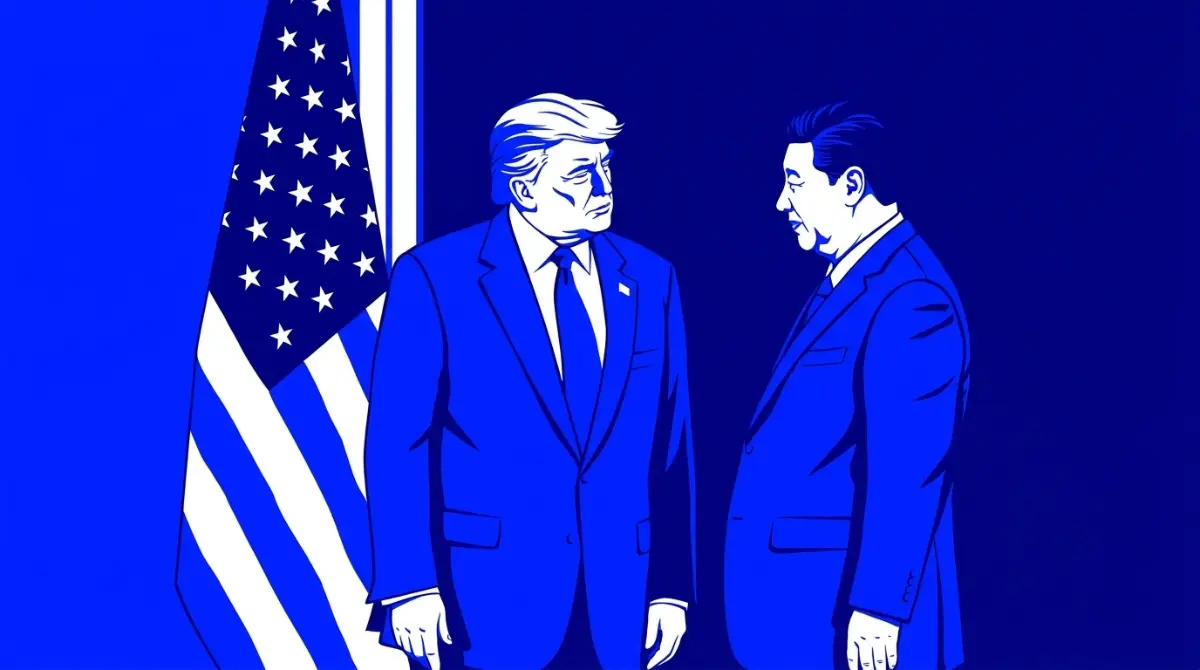


Beijing Tightens Grip on AI and Solar Tech Exports
Beijing proposed adding forty strategic technologies across machine learning models, autonomous computing clusters, solar manufacturing, and biomedicine to its export restriction catalogue, countering Western silicon sanctions while asserting sovereignty over domestic research corridors.
Goriola Ayankoya | 16 Oct. 2026, 10:17 AM · 10 min read

National borders are descending rapidly around computer code, laboratory cell cultures, and renewable hardware. For three decades, international commerce operated under the assumption that scientific research belonged to an interconnected global market. Scientists published findings in international academic journals, engineers moved freely between Silicon Valley and coastal Asian hardware centers, and multinational corporations built distributed research centers spanning continents. That open technological exchange is collapsing under geopolitical rivalry. On Friday, October 16, 2026, China Ministry of Commerce, working alongside the Ministry of Science and Technology, issued a regulatory proposal that places strict government controls on the overseas transfer of advanced software and industrial know-how. The joint announcement outlines plans to add forty distinct categories to the national Catalogue of Technologies Prohibited and Restricted from Export, zeroing in on frontier machine learning models, autonomous software agents, high-density computing clusters, photovoltaic wafer slicing, and synthetic biology. The regulatory maneuver marks an aggressive retaliatory phase in the technology conflict between Washington and Beijing, matching diplomatic tensions we documented when global powers debated technological development boundaries.
The proposed revisions open a formal public commentary period running through November 15, giving domestic enterprises and international trade partners thirty days to submit technical feedback. State officials made clear that the interim administration of pre-export registrations will take effect during the evaluation window to prevent sudden intellectual property flight. Chinese regulatory spokespersons framed the update as routine administrative governance aimed at mitigating national security exposures and preventing sensitive technologies from falling out of control. Yet commercial analysts view the timing as an unmistakable geopolitical counter-punch. Over the past four years, the United States, Japan, and the Netherlands placed suffocating restrictions on shipments of advanced extreme ultraviolet lithography machines and high-performance accelerator silicon to Chinese buyers. By asserting legal dominion over the algorithms, clean energy manufacturing tools, and medical patents developed inside its borders, China is establishing its own technical trade barriers. The expanding international influence of domestic Chinese software was examined in our report on how Chinese software models expanded their footprint across international developer communities.
Software Algorithms as Controlled National Defense Assets
The most consequential inclusion in the updated export control registry touches the mathematical foundation of modern computing: foundation models and autonomous intelligent agents. Historically, export control regimes focused on physical dual-use items: specialized maraging steel, centrifuge parts, missile propellant chemicals, and radiation-hardened microchips. Restricting compiled code or neural network weights was considered administratively impractical because digital files move across public internet cables in seconds.
Under the proposed framework, Chinese software enterprises will be legally barred from transferring model weights, proprietary training curricula, and agent orchestration frameworks to foreign entities without explicit authorization from the Ministry of Commerce. This restriction applies directly to corporate mergers, overseas licensing contracts, and cross-border research collaborations. The policy shift codifies regulatory enforcement actions that began earlier this year. In July, Chinese authorities intervened to block a planned $2B acquisition of domestic agent developer Manus by Meta, ruling that the transfer of autonomous decision-making code to an American conglomerate compromised state security. That blocked transaction served as an opening warning shot to founders attempting to sell domestic intellectual property to Silicon Valley buyers. The corporate aftermath of that blocked deal was detailed in our report on Manus securing $500M in domestic capital following the blocked Meta acquisition.
Retaliation Against Western Semiconductor Sanctions
To grasp why Beijing is weaponizing its software and green technology sectors, one must examine the lopsided structure of international trade penalties. The United States Department of Commerce Bureau of Industry and Security systematically expanded its Entity List over recent years, cutting off hundreds of Chinese research universities, semiconductor foundries, and software startups from American technology inputs. Washington pressured European and Asian allies to restrict access to advanced chip design software and cleanroom equipment, attempting to freeze Chinese semiconductor development at legacy manufacturing nodes.
Beijing has recognized that attempting to out-sanction Washington on advanced semiconductor manufacturing equipment is ineffective because Western firms still hold historical monopolies over optical lithography and chemical vapor deposition. China is counter-attacking where it holds decisive industrial monopolies: green energy hardware, industrial processing chemistry, and specialized algorithms. By placing export restrictions on diamond-wire wafer slicing technology, solar ingot manufacturing machinery, and rare earth refining protocols, Beijing can slow down Western clean energy transitions at will. If Western nations cut off computing chips, China can choke the physical supply chains required to manufacture electric vehicle batteries and grid-scale solar installations. The geopolitical friction surrounding material processing was analyzed in our report on Scimplify raising $25M for advanced specialty chemical sourcing.
The Monopolistic Grip on Solar Ingot and Wafer Equipment
While artificial intelligence captured international headlines, the restrictions placed on photovoltaic technology carry immediate industrial consequences for Western economies. China controls more than 85% of worldwide solar cell manufacturing capacity, and an even higher percentage of the upstream industrial machinery required to produce solar-grade polysilicon ingots and wafers. American and European initiatives to re-shore domestic solar manufacturing rely heavily on imported Chinese equipment.
The proposed catalogue updates restrict the export of large-format silicon wafer casting furnaces, advanced black silicon etching systems, and automated cell assembly lines. If a Western energy developer attempts to build a domestic solar factory in Ohio or northern Germany, purchasing the necessary fabrication machinery from Chinese equipment builders will now require formal state export licenses. Chinese trade officials can delay or deny these applications, preventing Western nations from standing up domestic supply chains. Western manufacturers who hoped to bypass Chinese component imports by building local assembly plants will find themselves starved of the manufacturing tools required to operate. The broader expansion of Chinese industrial dominance across alternative technology corridors was explored in our analysis of China expanding its reach beyond software into heavy hardware industries.
Chilling Effects on Cross Border Venture Capital and Talented Founders
The regulatory tightening introduces immediate complications for Chinese entrepreneurs who previously relied on Western venture capital to fund early-stage research. For two decades, Chinese startup founders structured their businesses through offshore Variable Interest Entity frameworks, raising dollar-denominated funds from Silicon Valley venture firms like Sequoia Capital, Lightspeed, and Matrix Partners with the goal of listing on the Nasdaq or New York Stock Exchange.
Under the new rules, accepting foreign venture capital or setting up offshore corporate entities to hold technology assets will face intense regulatory auditing. A Chinese startup developing autonomous driving software, medical robotics, or foundation models can no longer promise foreign investors an easy overseas acquisition or international technology licensing deal. If the core technology cannot be exported or sold to a foreign buyer, foreign venture funds will pull back on investing in mainland software startups, widening the funding divide separating Chinese founders from their Western peers. The capital imbalances shaping Chinese research laboratories were examined in our review of how Chinese research teams match American model performance despite severe funding gaps.
The Bipolar Decoupling of Global Computing Architectures
The inclusion of distributed computing clusters and intelligent networking fabrics in the export control proposal accelerates the creation of two separate, incompatible technology spheres. For years, international data networks operated on shared open standards. Software written in San Francisco ran cleanly on servers located in Shenzhen or Dublin, relying on standardized operating systems and network protocols.
That technological cohesion is coming apart. As Beijing restricts domestic computing innovations from leaving the country, and Washington blocks Western accelerators from entering Chinese facilities, both superpowers are constructing self-contained, parallel technology stacks. Chinese cloud providers are deploying domestic processors fabricated by local foundries, supported by indigenous memory architectures, localized operating systems, and domestic deep learning frameworks like Huawei MindSpore and Baidu PaddlePaddle. Domestic memory producers are stepping up output to fill hardware gaps, a transition we tracked when Chinese memory producers expanded high-density silicon production. At the same time, Chinese chip designers are rolling out custom accelerators to challenge Western merchant dominance, matching developments we analyzed when Alibaba unveiled custom Zhenwu silicon for domestic server clusters.
Biotechnology and Synthetic Biology Join the Restricted Ranks
Beyond digital silicon and renewable energy, Beijing is placing high walls around its biological sciences sector. China has emerged as an international leader in gene editing, cellular therapeutics, and automated fermentation chemistry. The updated export catalogue restricts overseas transfers of CRISPR gene-editing delivery vectors, synthetic genome assembly platforms, and personalized cellular therapies.
Western pharmaceutical conglomerates have increasingly turned to Chinese contract research organizations to conduct preclinical drug discovery, molecular modeling, and clinical trials at lower expenses. The proposed export controls mean that biological data, custom cell lines, and drug synthesis protocols generated inside Chinese laboratories cannot be transferred freely to Western pharmaceutical headquarters. Western medical executives will have to navigate bureaucratic compliance reviews to access experimental drug data generated by Chinese research partners, adding months of administrative delay to global pharmaceutical development timelines. The strategic importance of international scientific talent was examined in our report detailing the global competition for top-tier scientific talent.
Compliance Risks for Multinational Corporate Campuses
The proposed rules place multinational corporations operating research facilities inside mainland China in legal danger. Global technology giants like Apple, Microsoft, Tesla, and Intel maintain engineering centers in Shanghai, Beijing, and Shenzhen, employing thousands of Chinese computer scientists and hardware designers to develop consumer products and enterprise software.
If an engineer working at a multinational research facility in Beijing develops a novel machine learning algorithm or an optimized battery management circuit, can that code be merged into the company global software repository hosted on servers in the United States? Under strict interpretations of the new rules, syncing proprietary code across national borders could constitute an unauthorized technology export, exposing local corporate executives to criminal prosecution under Chinese national security laws. Multinational technology firms will have to construct internal digital firewalls, isolating their Chinese development teams from their global engineering repositories. Managing supply chain dependencies with international fabrication partners was explored when semiconductor manufacturers negotiated shared cleanroom facilities.
The Diplomatic Chess Match Ahead of Presidential Summits
Political analysts note that releasing the draft export catalogue on October 16 serves an immediate diplomatic purpose. With bilateral diplomatic summits and economic working group meetings scheduled over the coming months, Beijing is creating policy chips to bring to the negotiating table. The thirty-day public commentary window ensures that the restrictions will not become legally binding until mid-November, providing Chinese diplomats with leverage during trade talks with Washington.
Chinese negotiators can signal to their American counterparts that if Washington rolls back planned restrictions on semiconductor design software and eases investment bans, Beijing could soften the final export rules governing solar equipment and critical software. If Washington proceeds with fresh trade penalties, Beijing can finalize the catalogue without alterations, freezing exports of critical industrial technologies to Western markets. State-directed media channels have repeatedly called for high-level bilateral summits to prevent trade disputes from turning into open economic hostility, a diplomatic posture we detailed when Chinese state media urged bilateral discussions on technology governance. Similar institutional mechanisms were explored when diplomatic channels were proposed to manage computational safety risks.
The Death of Borderless Computing
The proposed expansion of China technology export controls marks the end of an era in modern computing. For three decades, technology advanced at record speed because capital, code, and human talent moved across international borders with minimal interference. That era of borderless cooperation has been replaced by mercantilist digital nationalism.
Technology is no longer viewed simply as an instrument of economic prosperity; it is treated by major world powers as the ultimate currency of sovereign defense and geopolitical power. As Washington and Beijing build digital firewalls, enact investment prohibitions, and restrict technical know-how, the global technological landscape is fragmenting into closed, fortified camps. The enterprises that survive this fractured era will not be those that rely on frictionless global supply chains, but those that adapt to a world where every line of computer code, every solar wafer, and every silicon chip carries a national flag. The macroeconomic stakes of this hardware fragmentation were also evaluated when the IMF confirmed that hardware production supports global economic growth.
Read More on TechRobust:

Goriola Ayankoya
 LinkedIn
Goriola Ayankoya
Expertise:Consumer Hardware, Smartphone Trends, Gadget Reviews, Breaking Tech News, Mobile Ecosystems
Award:TechRobust Hardware Reporter of the Year 2025
Goriola is a Staff Writer and Reporter specializing in consumer technology, breaking tech news, and hands-on hardware analysis. He tracks fast-paced mobile developments, reviews modern gadgets, and unpacks product launches to give readers clear, practical insights into everyday consumer tech.