
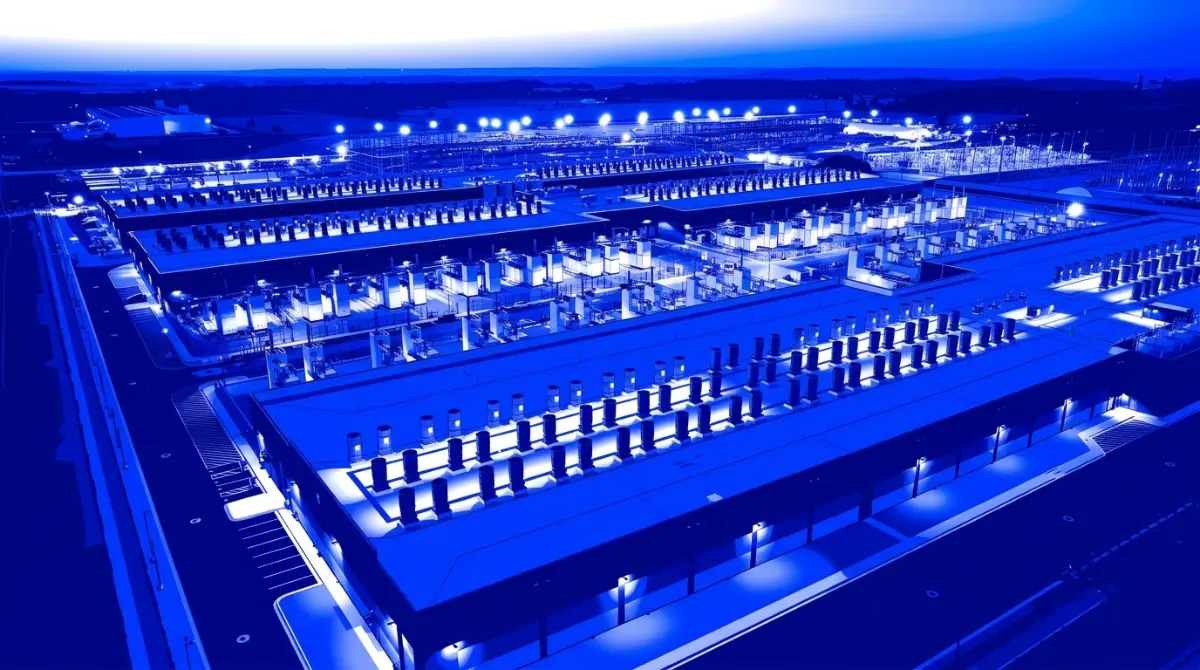


Data Center Spending to Hit $2.1T by 2028 Says BofA
Bank of America Global Research projected global data center spending will reach $1T this year before doubling to $2.1T by 2028, warning that surging electrical loads, silicon procurement, and utility delays will test the balance sheets of major technology operators.
Umar Thariwat | · 8 min read

Corporate capital spending on digital computing infrastructure is outstripping historical records. For half a century, telecommunications networks and petroleum pipelines represented the most capital-intensive physical developments in the global economy. Companies spent billions laying undersea fiber and constructing refinery complexes over multi-year cycles. That physical scale has been eclipsed by server warehouses and computational clusters. In a research note published on Friday, October 23, 2026, Bank of America Global Research reported that total global data center spending will hit $1T this calendar year and more than double to $2.1T by 2028. The forecast, authored by senior equity analysts at the bank, illustrates the unprecedented scale of capital flowing into computer hardware, cooling facilities, electrical substations, and fiber networks. Hyperscale cloud operators and sovereign states are spending fortunes to secure computing capacity. The massive capital wave lands as power grids struggle to deliver promised electricity, an industrial bottleneck visible when America computing infrastructure expansion began to stall under utility delays.
The projections highlight a profound transformation in corporate balance sheets. Building modern computing parks is no longer an ordinary information technology expense; it has become an industrial construction enterprise requiring gigawatts of continuous power generation. Technology conglomerates including Microsoft, Amazon Web Services, Alphabet, and Meta have committed hundreds of billions in capital expenditures to purchase high-bandwidth processors, liquid-cooling manifolds, and private power generation equipment. BofA analysts noted that compute demand generated by machine reasoning models and generative software tools shows zero signs of cooling, forcing infrastructure builders to lock in multi-year equipment backlogs. Still, Wall Street asset managers are asking sharp questions regarding financial returns. Spending $2.1T on physical infrastructure by 2028 requires technology companies to generate massive software revenues to justify carrying heavy hardware depreciation charges on their ledgers. The mounting financial scrutiny matches warnings we analyzed when Wall Street set impossible profit targets on corporate technology earnings.
The Math Behind the Two Trillion Dollar Buildout
To evaluate BofA $2.1T projection, one must dissect where capital is being deployed inside modern server campuses. A decade ago, server racks were air-cooled cabinets pulling five to ten kilowatts of power, filled with generic central processors rented from standard hardware vendors. Building an enterprise data center cost tens of millions of dollars.
Modern server campuses behave like heavy industrial complexes. High-performance computing racks housing advanced accelerators pull up to one hundred kilowatts per cabinet. Dissipating that concentrated heat requires direct-to-chip liquid cooling loops, cooling towers, and closed-loop heat exchangers. BofA research team divided projected 2028 spending across four major capital categories:
- Accelerators and Memory Silicon: Specialized processing chips, high-bandwidth HBM4 memory stacks, and host processors account for roughly 48% of total expenditure.
- Power Generation and Electrical Grid Equipment: Dedicated natural gas peaker plants, high-voltage transformers, switchgear, and uninterruptible power supply batteries represent 22% of outlays.
- Thermal Cooling and Mechanical Systems: Liquid-cooling manifolds, chillers, pumps, and water recycling systems capture 16% of capital commitments.
- Physical Real Estate and Structural Construction: Reinforced concrete server halls, optical conduits, and security perimeters account for the remaining 14%.
The capital distribution demonstrates that spending has shifted outward from pure software code into heavy civil and electrical engineering. Managing cabinet power without triggering utility disputes was explored in our report on flexible data center power management.
The Electrical Power Wall: Substation Delays and Grid Congestion
The primary constraint threatening to slow down BofA $2.1T projection is not capital availability; it is the physical capacity of electrical grids. In traditional technology hubs like Northern Virginia, Silicon Valley, and Dublin, regional power utilities have run out of transmission capacity.
Commercial developers face interconnection queues stretching between four and seven years. Regional transmission operators like PJM Interconnection have warned that adding multi-gigawatt industrial data center loads threatens grid stability for residential ratepayers. These delays have forced cloud operators to abandon planned developments, a reality highlighted when Microsoft terminated its data center contract with Nscale over multi-year transmission connection delays. To bypass grid bottlenecks, tech operators are adopting behind-the-meter generation: purchasing on-site natural gas combustion turbines or signing direct deals with nuclear plants to supply dedicated baseload current. The political friction surrounding industrial energy consumption was examined when public pushback mounted against data center power consumption.
Comparing Capital Expenditure Projections Across Major Institutions
| Research Institution | Projected Total Spend | Target Horizon Year | Primary Growth Engine | Identified Risk Factor |
|---|---|---|---|---|
| Bank of America | $2.1 Trillion | 2028 | AI model training and enterprise reasoning inference | Electrical grid substation shortages & transformer backlogs |
| PwC Global | $3.1 Trillion | 2050 | Long-term industrial automation & sovereign clouds | Global carbon regulations & cooling water limits |
| Morgan Stanley | $1.8 Trillion | 2027 | Hyperscaler cloud capex & custom silicon chips | Enterprise software monetization slowdown |
| Goldman Sachs | $1.0 Trillion | 2026 | GPU cluster replacement & data center retrofits | Semiconductor packaging bottlenecks at foundries |
| McKinsey & Company | $2.5 Trillion | 2030 | Edge computing hubs & autonomous agent networks | Municipal zoning moratoria & environmental lawsuits |
The comparative data illustrates broad consensus across financial institutions: data center capital spending has decoupled from traditional economic cycles. While macroeconomic growth hovers around three percent globally, computing infrastructure spending is expanding at compound annual rates exceeding twenty-five percent. Investors view computing capacity as a non-discretionary utility required for modern corporate competition. Long-term infrastructure forecasts were detailed in our analysis of PwC projections on computational capital spending.
The Nuclear Renaissance: Restarting Reactors for Clean Base Load
To supply clean, uninterrupted power to multi-gigawatt computing parks without violating corporate carbon reduction pledges, technology operators are turning to nuclear power. Over recent months, cloud platforms signed landmark power purchase agreements to restart decommissioned nuclear reactors.
Constellation Energy agreed to restart the Three Mile Island Unit 1 reactor in Pennsylvania under a twenty-year power commitment with Microsoft. Alphabet partnered with small modular reactor developer Kairos Power to deploy advanced fluoride-salt-cooled reactors by 2030, while Amazon secured direct nuclear power from Talen Energy Susquehanna facility. BofA analysts noted that nuclear energy provides the high capacity factor (exceeding 90%) required to run server racks continuously without relying on weather-dependent solar panels or wind turbines. However, nuclear regulatory licensing remains slow, meaning conventional natural gas generation will supply the bulk of new data center power through 2028. The commercial test facing nuclear energy in computing centers was examined in our report detailing how nuclear power faces operational tests in data centers, alongside commercial utility goals detailed when Schneider Electric raised revenue targets on data center demand.
Water Resource Depletion and Community Fights
Beyond electrical current, the physical expansion of data centers is creating severe water resource disputes. Evaporative cooling systems inside modern server halls consume millions of gallons of potable water daily to prevent processor chips from overheating.
In arid regions across Arizona, Nevada, and Utah, municipal utility boards have faced public outrage from local residents over water allocations granted to technology conglomerates. Community organizers argue that municipal drinking water supplies should not be diverted to cool computer servers while agricultural farmers face water rationing. In response, infrastructure operators are transitioning to closed-loop liquid cooling and direct-to-chip dielectric fluid systems that circulate refrigerant without evaporating local water. Still, retrofitting existing server halls with liquid cooling requires substantial capital investments, contributing to BofA projected spending surge through 2028. Water and cooling constraints confronting server parks were documented in our report on water constraints threatening large server campuses.
The Hardware Depreciation Trap: Software Margins Under Pressure
The central financial risk highlighted in the BofA report touches corporate accounting. When a technology company builds a software application, software code does not wear out or rust. Once written, distributing software carries high gross margins exceeding eighty percent.
When a company spends billions purchasing physical data center hardware, accounting rules require depreciating those assets over their useful operating lives. Graphics accelerators and high-speed networking switches carry short depreciation windows of four to five years, because newer, faster chips render older hardware economically obsolete. A company that spends $20B on server hardware must absorb $4B to $5B in annual non-cash depreciation charges against operating income. If enterprise software subscription revenues fail to expand quickly enough to cover those depreciation charges, corporate net profit margins will compress sharply. Economists warning of systemic financial risks from concentrated capital spending were featured in our review of economic warnings regarding capital expenditure bubbles.
The Long Term Outlook for Computational Real Estate
Bank of America forecast that data center spending will reach $2.1T by 2028 confirms that computing has become the foundational physical utility of the modern economy. Just as steel mills, railroads, and electrical grids defined the industrial power of the twentieth century, liquid-cooled server campuses will define economic leadership in the twenty-first century.
The journey to $2.1T will test the industrial capacity of the global economy. Technology conglomerates must navigate transformer shortages, negotiate regional power contracts, and defend local community relationships while proving to Wall Street that physical capital spending yields profitable software returns. The companies that navigate this capital wave will command the computing platforms that govern international commerce for decades to come. In the emerging technological order, power is measured not in software downloads or social media followers, but in the gigawatts energizing the digital factories of the modern world.
Read More on TechRobust:

Umar Thariwat
 LinkedIn
Umar Thariwat
Expertise:Tech News Reporting, Tech Business Analysis, Economic Foundations, Market Trends, Digital Economy
Award:Rising Voice of the Year 2025
Thariwat is a Staff Writer and Reporter covering tech news and enterprise trends at TechRobust. Blending daily reporting with her ongoing academic background in economics, she analyzes earnings, digital market, and the commercial strategies powering the global tech sector.