
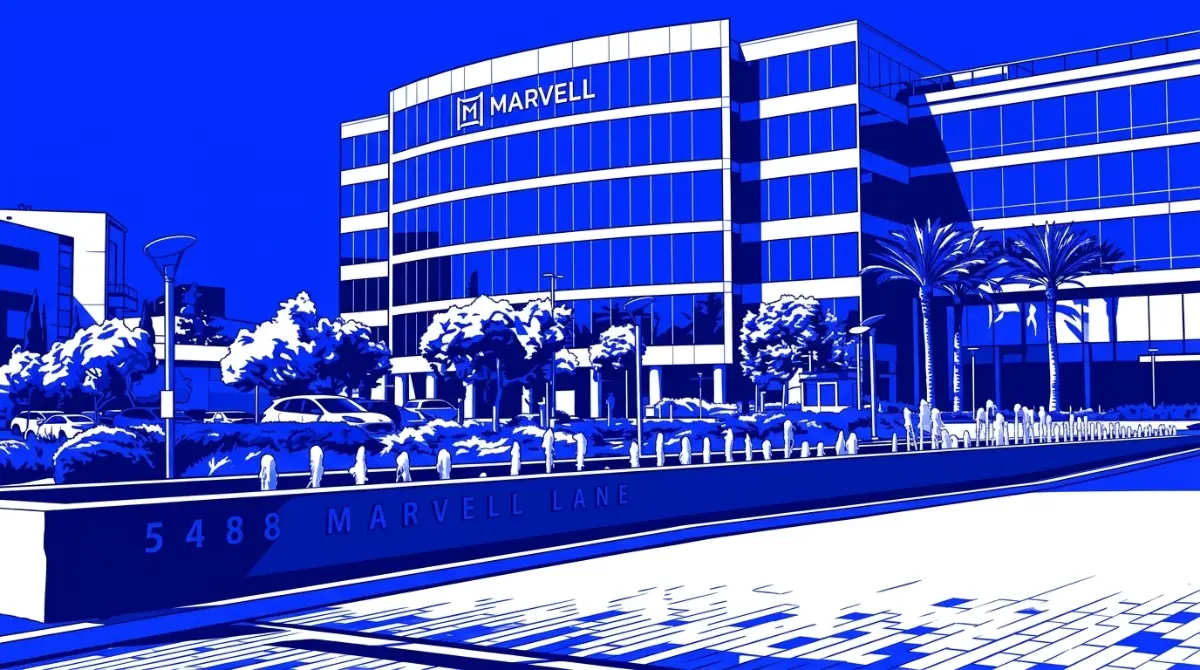


Marvell Acquires Lumentum in $115B Optical AI Deal
Custom semiconductor designer Marvell Technology agreed to purchase optical components manufacturer Lumentum in an all-stock transaction valued at $115B, combining specialized processor silicon with high-speed laser interconnects to take on Broadcom inside artificial intelligence computing centers.
Umar Thariwat | · 6 min read

Copper wiring has carried electrical signals through computer networks for over a century, but copper has hit a physical wall. Inside modern computing server centers, thousands of graphics processing units must communicate at speeds exceeding 800 gigabits per second to train complex reasoning models. At those extreme frequencies, electrical signals traveling through traditional copper cables generate intense heat and degrade within a few inches, creating severe communication bottlenecks across server racks. Connecting modern processor clusters requires replacing copper cables with microscopic laser beams of light. Semiconductor designer Marvell Technology executed a massive corporate move to control that optical transition on Monday, November 2, 2026. The California company agreed to acquire optical components manufacturer Lumentum Holdings in an all-stock transaction valued at $115B, including assumed debt. The transaction represents one of the largest technology acquisitions of 2026, pairing Marvell custom silicon and networking switches with Lumentum laser transceivers to take on semiconductor giant Broadcom in computing infrastructure. The mega-deal arrives as server builders invest hundreds of billions into facilities, continuing infrastructure trends we documented when Bank of America projected global data center spending will reach two trillion dollars.
The acquisition delivers immediate industrial scale to Marvell Chairman and Chief Executive Officer Matt Murphy, who will continue leading the combined enterprise. Murphy stated that computing infrastructure is undergoing an architectural shift toward optical connectivity, creating an opportunity that comes along once in a generation. The two companies estimate that the market for high-speed optical networking and custom computing silicon will reach $550B over the coming decade. While Lumentum shares slipped 1.5% and Marvell dipped 0.7% in pre-market trading as Wall Street evaluated shareholder dilution and integration costs, institutional analysts recognized the strategic logic. Hyperscale cloud operators: including Amazon, Google, Microsoft, and Meta: are constructing multi-gigawatt computing parks that require millions of optical transceivers to link server racks together. By absorbing Lumentum into its corporate umbrella, Marvell can sell integrated silicon packages that combine processing chips, memory controllers, and laser optical links on unified circuit boards. Optical interconnect advances match deeptech developments we followed when Cscale secured Series C funding for optical interconnects.
The Physics of Co-Packaged Optics: Light Replaces Copper
To grasp why Marvell is spending $115B on an optical components company, one must inspect the physical boundaries of high-speed data transmission. When thousands of processors work in parallel on a single machine learning model, transferring parameter data between server racks is the primary performance bottleneck.
In traditional server halls, electrical signals travel from processor dies across printed circuit boards to pluggable optical transceivers mounted on the front of server chassis. Converting electrical signals to light at the edge of the server chassis consumes up to thirty percent of the server total power budget. Marvell and Lumentum are collaborating to pioneer Co-Packaged Optics: mounting microscopic laser emitters and silicon photonics dies directly onto the same substrate as the central processor. Placing the laser transceivers millimeters away from the computing silicon eliminates long copper board traces, cutting data transmission latency by eighty percent while reducing power consumption by up to forty percent. In a computing campus consuming five hundred megawatts of electricity, saving forty percent on networking power frees up hundreds of megawatts to run additional processor chips. High-speed networking hardware and server procurement were analyzed in our review of Marvell raising revenue targets on data center surges.
Challenging the Broadcom Monopoly in Enterprise Networking
The strategic target pursued by Marvell through this $115B acquisition is market leader Broadcom. Broadcom Chief Executive Officer Hock Tan built a semiconductor empire by dominating custom Application-Specific Integrated Circuits and Ethernet networking switches, commanding gross profit margins exceeding seventy percent.
Broadcom custom silicon division designs specialized processors for hyperscalers like Google and Meta, pairing those chips with proprietary Tomahawk Ethernet switches. Marvell had established a strong second place in custom chips, winning contracts to design custom processors for Amazon Web Services and Microsoft. Marvell lacked Lumentum specialized manufacturing capacity in laser diodes, optical modulators, and optical circuit switches. By acquiring Lumentum, Marvell can offer hyperscale cloud clients a complete, unified hardware stack: designing custom processor silicon, high-speed Ethernet controllers, and proprietary optical transceivers simultaneously. Cloud operators prefer working with vendors that can guarantee end-to-end component compatibility, allowing Marvell to challenge Broadcom for multi-billion-dollar custom chip contracts. Enterprise hardware alliances across cloud hyperscalers match moves we tracked when Nvidia invested $3B into Meta to secure hardware ties.
Comparing Major Semiconductor and Optical Networking Giants
| Corporate Entity | Combined Market Valuation | Primary Product Architecture | Optical Interconnect Strategy | Target Data Center Market |
|---|---|---|---|---|
| Marvell + Lumentum | $115B transaction value | Custom ASIC + InP Laser Transceivers | Co-packaged optics & 1.6T transceivers | AWS, Google Cloud, Microsoft Azure |
| Broadcom | $800B+ public market cap | Custom XPUs + Tomahawk Ethernet | Internal optical DSPs & silicon photonics | Google TPU, Meta MTIA, Apple silicon |
| Nvidia (Networking) | $3.5T+ corporate valuation | Quantum InfiniBand & Spectrum-X | Optical NVLink interconnect bridges | DGX SuperPOD clusters globally |
| Coherent Corp | ~$15B public market cap | Laser materials & optical transceivers | Indium phosphide wafer fabrication | Telecom operators & cloud data centers |
| Cisco Systems | ~$220B public market cap | Silicon One routers & enterprise switches | Acacia pluggable optical modules | Enterprise IT & telecom backbones |
The comparative data illustrates how the semiconductor industry is consolidating around complete hardware stacks. Pure-play optical transceiver makers cannot survive independently when computing architectures demand co-packaged optics. By combining Marvell digital signal processors with Lumentum laser foundries, the combined company controls the entire optical data path. Corporate restructuring and hardware buyouts were examined in our review of IDG Capital leading the buyout of ASMPT surface-mount unit.
The Shareholder Dilution and Integration Risk
While the strategic logic is compelling, an all-stock transaction of $115B carries significant execution risks for Marvell shareholders. Issuing tens of billions in new common stock dilutes existing investors, requiring the combined company to generate substantial revenue growth to justify the share expansion.
Marvell must also manage the complex operational task of integrating Lumentum global manufacturing facilities across North America, Europe, and Asia. Operating cleanroom wafer foundries that fabricate indium phosphide lasers requires different manufacturing disciplines than managing fabless silicon chip designs subcontracted to TSMC. If integration hurdles delay product shipments or manufacturing yields on next-generation 1.6-terabit optical modules falter, hyperscale customers will redirect purchase orders to Broadcom or Coherent. Matt Murphy must execute factory integration with surgical precision, proving to Wall Street that the $115B price tag will deliver the operating margin expansion promised in corporate presentations. Enterprise valuation multiples and private share trading were detailed in our analysis of Anthropic finance chief Krishna Rao preparing for public listing audits.
The 2028 Horizon: Light Powers the Computational Future
The acquisition of Lumentum by Marvell marks the official end of the copper era in high-performance computing. For fifty years, computer engineers squeezed more data through copper traces by boosting frequencies and adding complex error-correction software.
As computational models scale into multi-gigawatt facilities housing hundreds of thousands of processors, copper has reached its physical limits. Light is the only medium capable of carrying petabytes of information across data center halls without overheating server racks. By spending $115B to secure the lasers, transceivers, and optical packaging technology that control the flow of light, Marvell positioned itself at the center of the hardware economy. The coming years will prove whether Matt Murphy bold acquisition can unseat Broadcom, but the physical reality remains undeniable: the future of computing will not travel on wires, but on beams of light.
Read More on TechRobust:

Umar Thariwat
 LinkedIn
Umar Thariwat
Expertise:Tech News Reporting, Tech Business Analysis, Economic Foundations, Market Trends, Digital Economy
Award:Rising Voice of the Year 2025
Thariwat is a Staff Writer and Reporter covering tech news and enterprise trends at TechRobust. Blending daily reporting with her ongoing academic background in economics, she analyzes earnings, digital market, and the commercial strategies powering the global tech sector.