
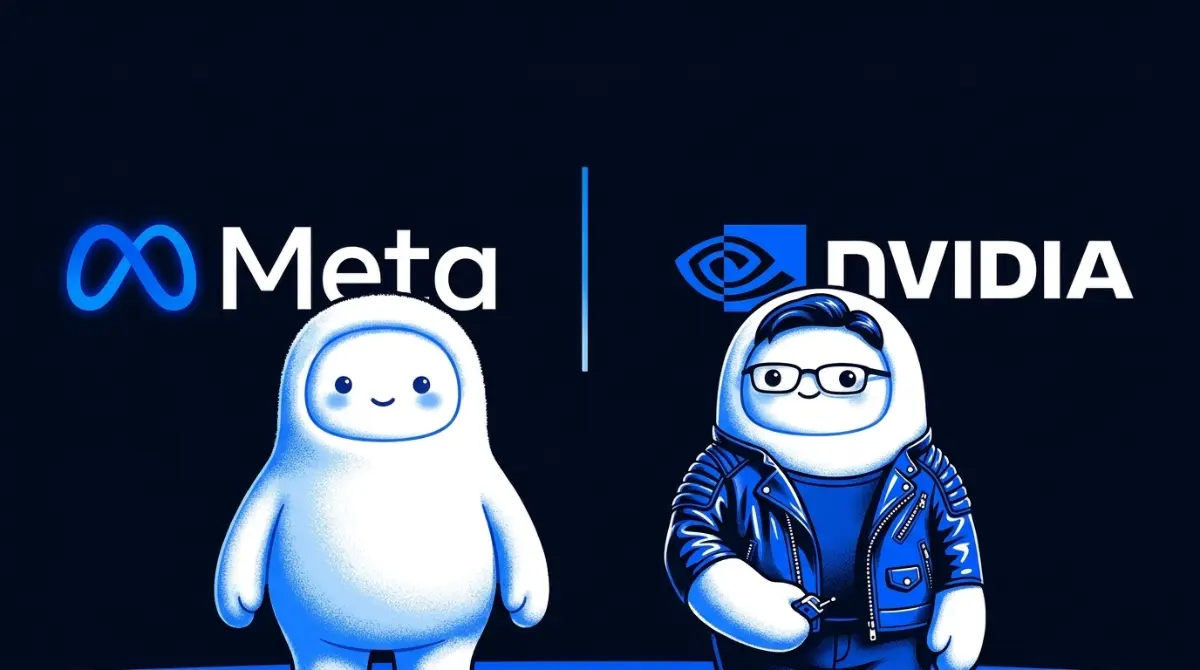


Nvidia Invests $3B in Meta to Deepen Enterprise AI
Nvidia agreed to invest $3B into Meta expanded $97.5B equity offering, locking in deep hardware and software ties as Mark Zuckerberg deploys Vera Rubin processors, Spectrum-X Ethernet, and Sentry monitoring tools across the Muse assistant network.
Umar Thariwat | · 8 min read

Corporate alliances in the technology industry are transforming into deep equity knots. In past computing cycles, semiconductor manufacturers sold chips to computer assemblers as independent trade vendors: negotiating prices, shipping silicon dies, and recording quarterly product revenue. Silicon Valley treated supplier financing with caution, avoiding balance sheet entanglements that could limit commercial flexibility. That historical distance ended on Tuesday, October 27, 2026. Reuters reported that semiconductor monopoly Nvidia agreed to make a direct $3B equity investment into social media conglomerate Meta Platforms. The multi-billion-dollar transaction forms part of Meta expanded $97.5B capital program, which includes an at-the-market share-sale plan of up to $60B. The deal represents an aggressive expansion of corporate ties, linking the world most valuable chipmaker directly to its largest individual customer. In return for the capital infusion, Meta agreed to deploy next-generation Vera Rubin computing platforms, Vera central processors, Spectrum-X Ethernet switches, and BlueField-4 data processors across its multi-billion-dollar server complexes. The massive capital commitment arrives as Big Tech conglomerates expand infrastructure outlays, continuing financial patterns we monitored when Musk corporate spending ambitions faced financial scrutiny.
The transaction illustrates a profound change in how artificial intelligence infrastructure is financed. Meta is currently spending tens of billions annually to construct specialized server campuses, competing against Microsoft, OpenAI, and Anthropic for model supremacy. Rather than simply collecting cash for hardware shipments, Nvidia is plowing profits back into Meta corporate equity, anchoring a shareholder syndicate that also includes Advanced Micro Devices and Broadcom. Chief Executive Officer Mark Zuckerberg described the alliance as an essential foundation for his vision of personal superintelligence, centered on Meta flagship Muse assistant. Modeled on autonomous software frameworks like OpenClaw, Muse connects with user email inboxes, calendar schedules, retail shopping portals, and home devices to execute multi-step assignments independently. By embedding Nvidia hardware and software tools directly into Muse serving fabric, Meta aims to slash operating expenses while scaling automated agents to billions of consumer accounts. The corporate consolidation of computing capital reflects late-stage equity dynamics we analyzed when OpenAI accelerated fundraising ahead of competitor public listings.
The Circular Finance Loop: Supplier as Shareholder
To grasp the economic significance of Nvidia $3B investment, one must inspect the balance sheet flow connecting both corporations. In classical corporate finance, this transaction represents what Wall Street analysts call circular vendor financing.
Nvidia generates eighty percent gross profit margins selling graphics processors to cloud platforms. Meta is one of Nvidia largest volume customers, purchasing tens of billions of dollars in hardware over the past three years. By taking $3B of its accumulated cash and buying Meta common stock, Nvidia helps finance Meta capital expenditure budget. Meta then uses those funds to purchase additional Vera Rubin processor racks from Nvidia. Nvidia books record hardware revenue, lifts its reported sales guidance, and watches its own market valuation rise. For Meta, bringing Nvidia onto its shareholder register ensures priority hardware delivery: guaranteeing that when scarce next-generation processors roll off TSMC foundry lines, Meta server halls receive allocations ahead of competing cloud platforms. While financial purists raise questions regarding whether vendor financing artificially inflates apparent hardware demand, both corporate boards view the alliance as a strategic necessity to lock in long-term infrastructure dominance. Corporate financial strategies across high-growth platforms match models we explored in our review of Ramp expanding autonomous financial systems.
Muse Architecture: Personal Superintelligence at Massive Scale
The central technical objective driving the alliance is the commercial deployment of Muse, Meta flagship family of models and autonomous software agents. Zuckerberg has staked his corporate legacy on turning social networks into proactive computing platforms.
Unlike conversational chatbots that wait for user prompts, Muse operates continuously in the background. The software reads incoming personal emails, reconciles calendar conflicts, monitors e-commerce price drops, and executes purchases using connected credit cards. Operating an assistant that touches sensitive personal accounts for three billion users requires massive computing capacity. Every user interaction generates continuous inference requests that must be processed with sub-second responsiveness. Nvidia and Meta engineers are collaborating to optimize the Muse software stack: streamlining tensor calculations, implementing 4-bit precision quantization, and co-designing compiler kernels tailored specifically for Vera Rubin silicon. The companies claim this joint optimization will cut total cost of ownership by up to thirty-five percent, making it economically viable for Meta to provide advanced machine assistance to consumers for free without destroying corporate profit margins. Privacy and governance challenges surrounding automated software were examined in our report on user privacy concerns over autonomous assistants.
Comparing Big Tech AI Infrastructure Alliances
| Corporate Alliance | Financial Capital Commitment | Primary Hardware Platform | Target Software Product | Strategic Corporate Rationale |
|---|---|---|---|---|
| Nvidia & Meta Platforms | $3B equity investment | Vera Rubin + Spectrum-X Ethernet | Muse personal superintelligence | Securing priority hardware & optimizing inference |
| Microsoft & OpenAI | $13B+ multi-year funding | Azure cloud GPU superclusters | ChatGPT & Copilot commercial tools | Exclusive cloud hosting & enterprise software rights |
| Amazon & Anthropic | $8B multi-tranche funding | AWS Trainium & Inferentia chips | Claude foundation reasoning models | Validating custom silicon & AWS Bedrock expansion |
| Alphabet & Anthropic | $2B+ equity & cloud credits | Google TPU v5e & v6 clusters | Claude enterprise deployments | Google Cloud capacity utilization |
| Apple & OpenAI | Commercial distribution agreement | Private Cloud Compute (Apple Silicon) | Apple Intelligence Siri integration | Zero cash licensing; consumer audience scale |
The comparative data illustrates how the computing sector has organized into vertical empires. Rather than operating in an open market, tech giants are building closed partnerships that unite silicon manufacturing, cloud infrastructure, and consumer applications. The Nvidia and Meta deal is notable because it reverses the usual capital flow: instead of the consumer platform investing in the startup, the hardware supplier is investing $3B directly into the consumer tech giant. Corporate governance and valuation benchmarks were examined in our review of Anthropic preparing initial public offering filings.
The Technical Blueprint: Vera Rubin, Spectrum-X, and BlueField-4
The operational core of the agreement centers on physical server architecture. Meta agreed to standardize its upcoming computing parks around three foundational Nvidia technologies:
- Vera Rubin Computing Systems: Next-generation processing racks combining Vera CPUs with Rubin graphics accelerators on unified high-bandwidth motherboards.
- Spectrum-X Ethernet Networking: High-performance 800Gb/s networking switches engineered specifically to minimize packet loss and latency during distributed inference.
- BlueField-4 Data Processing Units: Smart network cards that offload security encryption, storage access, and virtualization tasks from main compute dies.
By deploying BlueField-4 processors, Meta can inspect and encrypt incoming user data at line speed before packets reach model memory buffers. This hardware isolation ensures that private user records: such as banking details or personal health histories handled by Muse: remain protected from memory tampering. Concurrently, Spectrum-X Ethernet switches allow thousands of Vera processors to communicate with the predictable latency required to serve multimodal video and audio generation in real time. Custom processor hardware and data center deployments were detailed in our report on Alibaba deploying custom server silicon.
Software Governance: OpenShell and Nvidia Sentry Monitoring
Beyond physical hardware, the partnership includes collaboration on software safety and monitoring. Giving autonomous software agents permission to execute commands in corporate and consumer applications introduces severe security vulnerabilities.
If an agent ingests untrusted text from a malicious email that contains a prompt injection exploit, the agent could be instructed to forward private files or authorize fraudulent financial payments. Meta and Nvidia are developing two protective software layers:
- Nvidia OpenShell: An isolated, disposable container environment where autonomous agents execute bash scripts, compile code, and interact with web APIs without risking host system corruption.
- Nvidia Sentry: An automated oversight watchdog that monitors agent execution in real time, inspecting network calls, memory allocations, and file transfers to detect anomalous behaviors before actions clear.
If Muse attempts to initiate an unusually large financial transfer or access an unauthorized contact list, Sentry freezes the agent process and requests explicit user authentication on a mobile screen. Building verifiable software guardrails is mandatory for winning consumer trust in autonomous assistants. System monitoring and agent containment frameworks were analyzed in our review of Armadin securing capital for agent security systems.
Antitrust Scrutiny and the Threat of Closed Ecosystems
The financial union between Nvidia and Meta will inevitably attract investigation from antitrust regulators in Washington and Brussels. Competition watchdogs at the Federal Trade Commission and the European Commission are already scrutinizing Big Tech computing partnerships to determine whether equity deals represent unnotified anti-competitive mergers.
Critics argue that when the dominant hardware supplier purchases equity in its largest customers, smaller technology startups and competing semiconductor makers are locked out of the market. If Nvidia gives Meta preferential pricing and priority hardware delivery, rival social media platforms and independent software startups face higher costs and longer wait times. Regulatory authorities could demand behavioral remedies: requiring Nvidia to maintain transparent, non-discriminatory hardware allocations for all commercial buyers. Meta and Nvidia legal teams maintain that the transaction is a non-controlling minority equity investment that preserves open competition, noting that Meta continues developing its own custom MTIA silicon. Regulatory oversight across enterprise technology contracts was explored in our analysis of regulators auditing private corporate transactions.
The Long Term Outlook for Big Tech Computing Coalitions
Nvidia $3B investment in Meta confirms that the era of arm-length technology commerce is over. As the financial and computational resources required to build artificial intelligence climb into the hundreds of billions of dollars, tech giants are locking arms to share capital risks and technical expertise.
By uniting Nvidia processing hardware with Meta three-billion-user distribution network, Jensen Huang and Mark Zuckerberg built one of the most powerful corporate alliances in industrial history. The coming years will prove whether this integrated partnership can deliver on its promise of personal superintelligence, or whether the sheer financial weight of these equity loops will attract regulatory intervention that fractures Big Tech computing empires. In the emerging digital economy, power belongs not to the companies that write the cleverest code or build the fastest chips in isolation, but to the integrated giants that command both the silicon and the user screens where the future takes physical shape.
Read More on TechRobust:
Umar Thariwat
 LinkedIn
Umar Thariwat
Expertise:Tech News Reporting, Tech Business Analysis, Economic Foundations, Market Trends, Digital Economy
Award:Rising Voice of the Year 2025
Thariwat is a Staff Writer and Reporter covering tech news and enterprise trends at TechRobust. Blending daily reporting with her ongoing academic background in economics, she analyzes earnings, digital market, and the commercial strategies powering the global tech sector.