


 LinkedIn
 British Hackers Face Prison for GTA 6 and Crypto Thefts
Elon Musk Compares Jensen Huang Ouster to Michael Jordan
Tesla chief Elon Musk told the DealBook Summit that forcing founder Jensen Huang out of Nvidia is like kicking Michael Jordan off a championship roster, deepening Silicon Valley clash with Nvidia board and Washington lawmakers ahead of December congressional testimony.
Umar Thariwat | · 8 min read

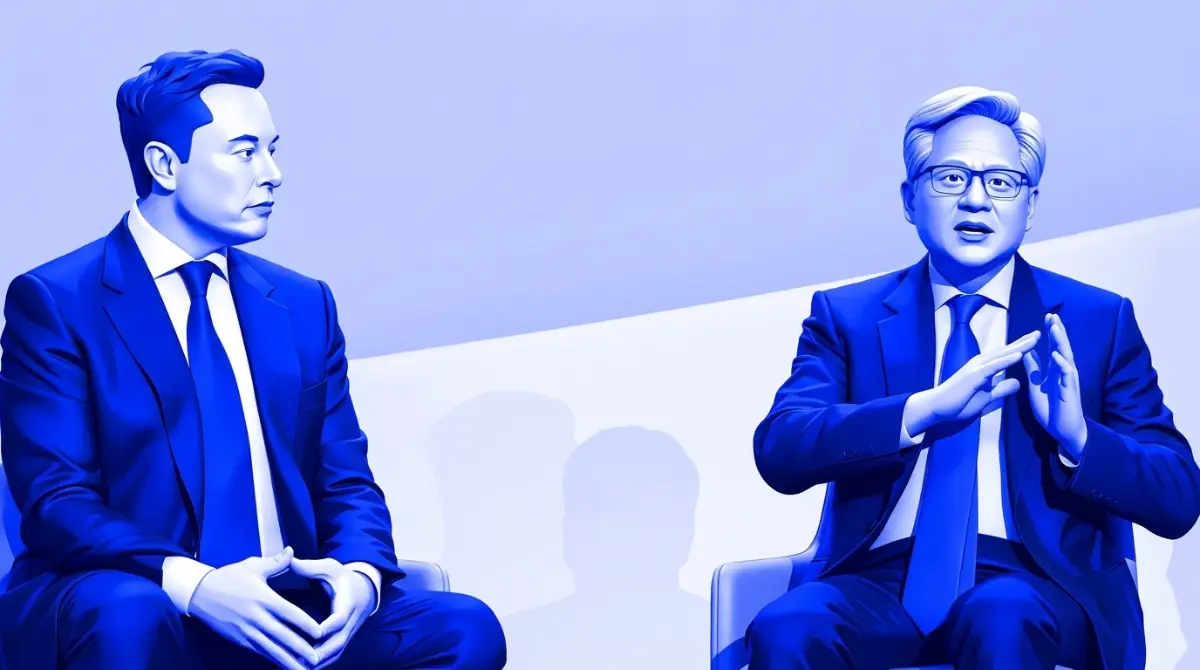
Elon Musk never hides his opinions about corporate boards, and on Wednesday, November 18, 2026, he took direct aim at the directors running the world most valuable semiconductor company. Speaking with Andrew Ross Sorkin at the New York Times DealBook Summit, the Tesla, SpaceX, and xAI chief executive blasted Nvidia decision to part ways with co-founder Jensen Huang, comparing the departure to a basketball franchise benching its greatest superstar in the middle of a championship run. "Jensen is an old friend of mine," Musk told the crowd. "I would call Jensen Michael Jordan, perhaps at his peak level, in terms of what he means to a team." Asked about Nvidia board refusing to reinstate Huang despite an online petition topping 200,000 signatures, Musk did not soften his critique. "It is like kicking Michael Jordan off your team when you are on a winning streak, and it just does not seem like a good thing for shareholders," he said.
Musk onstage defense captured an extraordinary fracture now splitting American technology and Washington politics right down the middle. On one side stand aggressive founder-CEOs like Musk and defense tech builder Palmer Luckey, who argue that pushing Huang out weakens American computing leadership and invites Chinese semiconductor rivals to close the gap. On the opposing side stand Nvidia newly assertive board of directors, seasoned corporate chiefs like Microsoft Satya Nadella, and congressional leaders who warn that personal misconduct tied to an alleged Chinese intelligence operative cannot be brushed aside at a $4T company anchoring national security. Less than twenty-four hours before Musk spoke, Nvidia board chairman Harvey Jones confirmed on the chipmaker earnings call that directors have no intention of bringing Huang back, even after Huang publicly offered to return. The public battle extends the governance storm we tracked when Nvidia placed Colette Kress in interim control.
Musk Pitch to Hire Huang and the Talent Retention Warning
Beyond criticizing Nvidia directors, Musk doubled down on a recent social media post saying he would gladly bring Huang onto his own payroll. Questioned onstage about whether that offer was serious, Musk laughed off any doubt. "Well, of course. Who would not want to hire Jensen? He is one of the most talented entrepreneur-CEOs in history," Musk said, adding that Huang is obviously not job hunting and likely remains stunned by how fast his thirty-three-year run ended. Comparing the sudden corporate exit to a shock twist in a George R.R. Martin novel where a central character vanishes without warning, Musk insisted that Nvidia cannot find a single executive capable of filling Huang shoes.
As detailed in Benzinga coverage of Musk DealBook interview, Musk pointed to three operational assets that walked out the door with Huang: thirty-three years of personal supplier relationships across Asian chip foundries, deep hands-on mastery of transistor and networking engineering, and fierce personal devotion from senior technical staff. Musk warned bluntly that Nvidia faces an immediate brain drain without its founder. "His team loves him, and many of them are there because of him, and have higher offers to go elsewhere, and have turned them down because of personal loyalty to Jensen," Musk said. With rival semiconductor startups in Tel Aviv and Silicon Valley already courting veteran Nvidia architects, that retention warning touches a real nerve inside Santa Clara engineering campuses, mirroring competitor moves we covered when Israeli VCs spotted an opening in Nvidia turmoil.
Musk also waved away Washington fears that Huang extramarital relationship with former Megaspeed executive Alice Huang, whom United States intelligence officials suspect of collecting information for Beijing, posed a treasonous threat. While admitting his friend "certainly made some mistakes," Musk drew a sharp line on patriotism. "I do not think he is disloyal to the United States," Musk told the summit, echoing arguments made by retail shareholders who lost billions during Nvidia sharp stock selloff. Reporting by NDTV Profit on Musk defense of Huang noted that Musk own ventures, including xAI giant data centers and Tesla self-driving supercomputers, count among Nvidia largest hardware customers, giving Musk a direct commercial stake in keeping Santa Clara chip roadmaps stable.
Palmer Luckey Turns the Boardroom Fight Into a China Battle
Musk was not the lone founder blasting Nvidia directors at DealBook on Wednesday. Earlier in the day, Anduril Industries co-founder Palmer Luckey framed Huang removal as an unforced geopolitical gift to Beijing. "China wants Jensen out, so I want him in," Luckey declared onstage, repeating a fiery position he posted online last week. "They are thrilled to have Jensen out. There is a reason it is knocking a trillion dollars off Nvidia market cap. They know it makes America weaker to knock him out."
Luckey argument carried an ironic geopolitical twist. For years, Luckey disagreed sharply with Huang lobbying for looser export rules so Nvidia could keep selling artificial intelligence processors into mainland China. Yet Luckey argued on Wednesday that Beijing actually prefers blocking Nvidia hardware rather than buying it, because Chinese regulators want domestic technology firms forced onto homegrown silicon instead of relying on American processors. That dynamic showed up clearly on Nvidia earnings call Tuesday, when interim chief executive Colette Kress confirmed that Nvidia will stop selling its H200 processors in China altogether after Beijing blocked import permits despite American export licenses. From Luckey vantage point, crippling Nvidia leadership at home gives Chinese foundry rivals precious breathing room to catch up, adding new urgency to the broader technology rivalry we analyzed in our report on the US-China AI talent race.
Nadella and Altman Back Continuity While Congress Closes the Door
While founder-activists rallied behind Huang, the institutional chief executives running Nvidia biggest cloud customers struck a far calmer, board-friendly tone on the exact same New York stage. Microsoft CEO Satya Nadella declined to second-guess Nvidia directors and offered a warm personal endorsement of interim leader Colette Kress, who spent years working at Microsoft before becoming Nvidia finance chief in 2013.
"It is the Nvidia board decision, but I will just say this one thing," Nadella told DealBook attendees. "Colette worked at Microsoft for a long time. I have known her for a long time. She is a tremendous person. I have a lot of confidence in the Nvidia team and their ability to continue to do the good work." OpenAI Chief Executive Sam Altman took a similarly measured line earlier Wednesday: praising Huang as an early believer who bet on OpenAI when few others did, yet refusing to endorse calls for a comeback and dismissing outside theories about Nvidia boardroom politics. Both Nadella and Altman run massive public or enterprise-scale organizations that must buy hundreds of thousands of Blackwell and Vera Rubin processors from whoever signs the delivery contracts in Santa Clara next year.
In Washington, opposition to Huang returning is even firmer. As reported by Arirang News on congressional reactions, House Democratic Leader Hakeem Jeffries flatly rejected any push to put Huang back in charge, calling the prospect of sensitive American computing technology being diverted toward Beijing unacceptable. Meanwhile, The Guardian coverage of Huang congressional testimony confirmed that Huang has agreed to appear for a transcribed interview before three House committees on December 1 to answer questions regarding his relationship with Alice Huang and export control compliance. Separate reporting by The Guardian on Commerce Secretary Howard Lutnick noted that lawmakers are also demanding answers from federal trade officials next month over how export oversight handled Southeast Asian chip buyers. Those federal hearings follow directly from legislative action we tracked when Congress summoned Jensen Huang over the spy scandal.
Why Silicon Valley Founder Loyalty Collides With Public Governance
The split on display at DealBook exposes a deep cultural gap between how startup founders view leadership and how public corporate law operates. Founders like Musk, Luckey, Tim Sweeney, and Garry Tan built companies through sheer personal force of will; in their eyes, an extraordinary builder who created trillions in shareholder wealth should never be discarded over private moral failures unless hard criminal proof emerges in court. They remember Apple firing Steve Jobs in 1985 and watching the Mac maker stumble for a decade before begging him to come back.
Public company directors live under completely different legal liabilities. Nvidia is no longer an insurgent startup fighting for survival; it is a $4T pillar of Western computing and defense supply chains facing an active Securities and Exchange Commission review, shareholder fraud lawsuits, and congressional subpoenas. On Tuesday earnings call, Chairman Harvey Jones confirmed that directors established a dedicated board committee to tighten oversight of national security policies and export control rules while launching an external search for a permanent chief executive. Bringing Huang back before federal investigators and outside lawyers finish reviewing his communications with a suspected foreign intelligence asset would invite immediate regulatory retaliation and expose every board member to personal fiduciary lawsuits.
Musk Michael Jordan analogy works cleanly as a rallying cry for furious shareholders watching stock charts swing wildly, yet it misses one hard reality about modern geopolitics. Basketball franchises do not answer to counterintelligence agencies, export control regulators, or House national security committees. Even if tens of thousands of engineers and billionaire friends wish Jensen Huang were still walking the halls in his black leather jacket, the road back to the Santa Clara corner office runs straight through Capitol Hill on December 1. Until lawmakers and federal investigators settle what happened behind closed doors, Nvidia board has made its verdict clear: the team is playing the next season without its founding star.
Read More on TechRobust:
Umar Thariwat
Umar Thariwat
Expertise:Tech News Reporting, Tech Business Analysis, Economic Foundations, Market Trends, Digital Economy
Award:Rising Voice of the Year 2025
Thariwat is a Staff Writer and Reporter covering tech news and enterprise trends at TechRobust. Blending daily reporting with her ongoing academic background in economics, she analyzes earnings, digital market, and the commercial strategies powering the global tech sector.
Related Stories
British Hackers Face Prison for GTA 6 and Crypto Thefts Sam Altman Says Hard to Imagine AI Without Jensen
 Microsoft Restores Global Cloud Services After Outage