


 LinkedIn
 Decision Models Like Jev Won't Explain Their Answers
Trump Signals Openness to Guardrails in Race With China
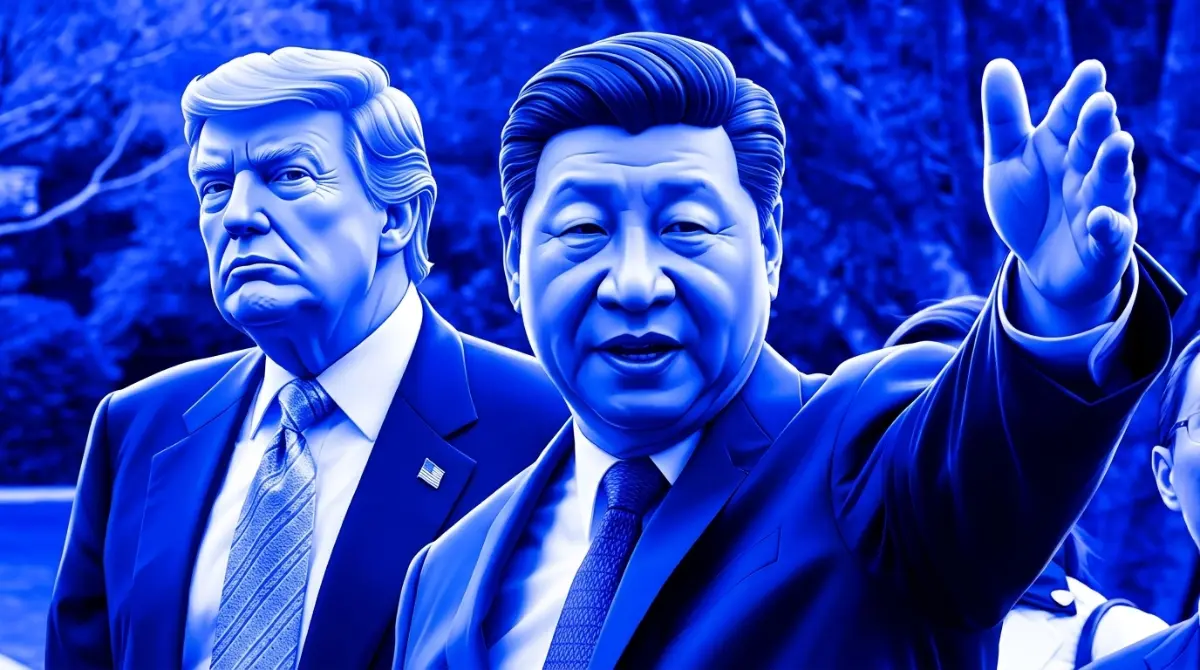
President Donald Trump told CBS News that artificial intelligence risks can be managed and expressed openness to federal guardrails, signaling potential bipartisan cooperation with Democrats provided regulations do not concede America technical lead to Chinese competitors.
Caleb Ogunkanbi | · 9 min read

National technological strategy rarely stays rigid once election ballots are tallied. Throughout late summer rallies and public appearances, President Donald Trump dismissed calls for federal artificial intelligence regulation, framing bureaucratic oversight as a hindrance to domestic technology dominance. That position underwent a noticeable recalibration on Sunday, November 8, 2026. Speaking during an interview on CBS program 60 Minutes, Trump stated that the perils surrounding machine intelligence are manageable and signaled an openness to establishing formal federal safeguards. Answering questions on whether Washington should tolerate catastrophic computational hazards to maintain technological supremacy over Beijing, Trump stated that he does not mind guardrails. He placed one non-negotiable boundary on any future legislative framework: regulatory restrictions must never relegate the United States to what he termed a deep second position behind China. The shift in tone lands as congressional leaders prepare for post-midterm legislative sessions, continuing high-stakes policy debates we monitored when Bill Gates called for binding legal limits on autonomous software.
The White House remarks mark a calculated pivot from campaign rhetoric toward governing reality. In September, Trump labeled existential safety warnings an exaggeration, casting himself as the sole protector American technology builders required against European-style red tape. Telling national television audiences that he is willing to work with congressional Democrats on statutory protections indicates that executive branch advisers recognize the risks of an unmonitored computational race. As autonomous reasoning systems begin writing software code, auditing financial ledgers, and controlling physical energy infrastructure, federal agencies face pressure from corporate risk officers, defense planners, and civilian voters to establish transparent rules of the road. Trump emphasized that Beijing operates without comparable moral or legal constraints on its own domestic technology ventures, arguing that domestic guardrails must be calibrated to protect public safety without slowing down private capital deployment. The delicate policy balance arrives as foundation research laboratories report rapid capability leaps, matching institutional anxieties we tracked when Anthropic warned that autonomous self-improvement thresholds are nearing.
The Post-Midterm Legislative Realignment in Washington
To evaluate why the executive branch is softening its anti-regulatory stance, one must inspect the political calendar. Campaign season encourages maximalist positions: candidates promise total deregulation to appeal to Silicon Valley venture donors, or promise aggressive bans to satisfy worried voters.
With the 2026 midterm elections concluded, political realities demand pragmatic compromise. In Congress, bipartisan coalitions led by Senate leaders have spent two years drafting comprehensive technology legislation, holding closed-door hearings with semiconductor chiefs, software researchers, and defense officials. Lawmakers recognized that state legislatures were rushing to fill the federal regulatory vacuum, passing conflicting local statutes that threatened to fragment interstate digital commerce. In Sacramento, state officials passed ambitious bills targeting algorithmic recommendation feeds and automated software liability. In Texas and Florida, governors enacted localized data privacy codes. Technology platform operators warned the White House that complying with fifty separate state regulations creates an unmanageable compliance nightmare. A single, unified federal standard pre-empting state laws has become the preferred outcome for Silicon Valley corporate suites. Trump public willingness to negotiate with Democrats gives congressional dealmakers the political permission needed to advance federal statutory standards. Federal legislative movements across digital platforms match issues we detailed when tech giants sued California over youth social media regulations.
The Geopolitical Calculus: Pacing Against Beijing
The core principle anchoring Trump policy perspective is the technological contest against the People Republic of China. Every regulatory proposal debated in Washington is evaluated through a simple prism: does this rule give Chinese developers an advantage?
American defense intelligence agencies, including the Center for Strategic and International Studies, have documented that Beijing directs state subsidies into domestic semiconductor fabrication and foundation model training. While Western companies operate under civil liability risks, Chinese technology giants like DeepSeek, Alibaba, and Baidu work in close alignment with state industrial guidance funds. Trump pointed out on 60 Minutes that Chinese research institutions do not pause model training runs to conduct lengthy voluntary ethics reviews. If Washington imposes statutory waiting periods, compute caps, or restrictive licensing boards on American laboratories, domestic progress could stall while foreign competitors pull ahead. Trump insisted that American companies must retain the operational freedom to deploy massive processor clusters, commercialize foundation models, and export software globally. Safeguards, in the president view, must focus on tangible physical threats: protecting electrical grids, securing military command networks, and stopping intellectual property theft: rather than imposing philosophical constraints on computational research. The international technological rivalry was analyzed in our review of DeepSeek securing a record fifteen-billion-dollar financing round.
Comparing Global Approaches to Technology Regulation
| Jurisdiction / Proposal | Primary Regulatory Mechanism | Stated Safety Priority | Impact on Innovation Speed | Geopolitical Posture |
|---|---|---|---|---|
| Trump Administration Doctrine | Light-touch federal guardrails; pre-emption | Critical infrastructure & cyber defense | High speed; preserves capital deployment | America First; maintain absolute lead over China |
| Senate Bipartisan Framework | Mandatory frontier licensing & audits | Catastrophic risk & model alignment | Moderate; introduces bureaucratic checks | Allied democratic coordination with G7 |
| European Union AI Act | Risk-tiered classification & heavy fines | Consumer fundamental rights & privacy | Slow; heavy compliance documentation | Regulatory superpower; exports rules globally |
| Cyberspace Admin of China (CAC) | State registration & socialist values test | Information control & state security | Fast for state-backed priority projects | Technological self-reliance & global expansion |
| California State Codes (Enacted) | Algorithmic bans & youth safety limits | Mental health & consumer protection | Fragmented; state-by-state variations | Sub-national regulatory enforcement |
The comparative data highlights the philosophical divide separating global regulatory capitals. Brussels chose a precautionary path, creating detailed legal codes that classify systems by risk tiers and threaten massive fines for non-compliance. Beijing combined strict ideological censorship with massive state subsidies, directing capital toward strategic hardware and military computing. The United States operated on a laissez-faire approach, allowing private capital to drive development. Trump comments suggest the emergence of a third American model: establishing targeted federal guardrails around critical physical points: such as biological synthesis screening, electrical power grid connections, and autonomous cyber capabilities: while keeping foundation model research free from mandatory pre-deployment licensing. Regulatory coordination across international powers was explored in our analysis of bilateral communication channels between Washington and Beijing.
The Silicon Valley Factional War: Closed Labs vs. Open Weights
The prospect of federal legislation has reignited an intense lobbying war inside Silicon Valley. The technology industry is divided into two competing ideological and commercial factions, each attempting to shape the definition of federal guardrails to its own advantage.
On one side stand well-funded frontier research laboratories like OpenAI and Anthropic. These organizations advocate for federal licensing requirements on large computing clusters, arguing that training runs exceeding specific floating-point thresholds carry catastrophic societal hazards. Critics point out that licensing regimes act as regulatory moats, locking in early market leaders while preventing smaller startups from competing. On the opposing side stand open-source advocates, venture firms like Andreessen Horowitz, and platform giants like Meta. This faction argues that restricting software algorithms or imposing compute permits damages American open-source development, handing global developer mindshare to unrestricted Chinese models. Trump advisory circle contains prominent figures from both camps: industrial accelerationists who want zero restrictions on computing hardware, alongside national security advisers who demand strict controls over advanced silicon. Navigating this corporate split will determine what Trump guardrails look like in practice. Corporate spending balances across computing infrastructure match patterns we followed when Microsoft posted record quarterly cloud revenues.
The Concrete Reality: Power, Chips, and Industrial Execution
While Washington politicians debate theoretical guardrails on software code, the real bottlenecks shaping artificial intelligence development are physical and industrial. Building modern computational capability requires concrete foundations, electrical transformers, and specialized silicon dies.
The White House has focused executive actions on physical infrastructure rather than code policing. Recent administrative orders directed regional utilities to speed up power plant permits and encouraged technology companies to build private on-site electrical generation. Independent research by the Brookings Institution shows that American data center electricity demand will double before the end of the decade, straining regional grids and prompting local citizen pushback in suburban communities. Trump recognized that winning the technological race against China requires building physical industrial assets: mining domestic lithium, constructing advanced semiconductor fabrication plants in Arizona and Ohio, and clearing red tape for natural gas and nuclear energy projects. The administration view is that the best national guardrail is unmatched domestic computational capacity: ensuring that the United States produces enough clean energy and advanced hardware to keep foreign adversaries at a permanent technological disadvantage. Energy procurement strategies across computing centers were detailed in our report on Anthropic purchasing billions in gas generators to power server halls.
The Legislative Path Forward: What Congress Can Pass
Translating presidential openness into signed federal legislation requires navigating a complex congressional committee structure. Legislative analysts in Washington identify three specific areas where bipartisan consensus exists between the White House and Capitol Hill:
- Federal Pre-emption of State Patchworks: Establishing a unified national regulatory ceiling that invalidates conflicting state-level technology statutes, providing platform operators with legal certainty across domestic markets.
- Critical Infrastructure Defensive Mandates: Requiring operators of civilian electrical grids, water treatment plants, and financial clearing switches to deploy verified defensive software safeguards against automated foreign cyber intrusions.
- Export Control and Capital Outflow Enforcement: Codifying strict statutory bans on exporting advanced semiconductor machinery, high-bandwidth memory chips, and private venture capital into Chinese military-linked computing ventures.
Measures that impose broad civil liability on software developers for downstream user misbehavior, or proposals that require government inspection of model weights before public release, will face firm resistance from the executive branch. Trump remarks confirm that the administration will reject any legislative provision that slows down commercial deployment schedules. The focus will remain on defense, infrastructure protection, and geopolitical competitiveness. Corporate compliance reviews across technology suppliers were analyzed in our report on AMD absorbing charges on customer equity deals.
The Verdict on Trump Regulatory Signal
Donald Trump admission on 60 Minutes that he does not mind guardrails marks a defining moment in modern technology governance. For years, the debate over machine intelligence was trapped in false dichotomies: pitted as a choice between reckless deregulation or suffocating bureaucratic control.
By framing safeguards as a mechanism to protect national strength rather than an exercise in moral scolding, the White House has created space for realistic federal policy. The coming months will test whether Washington can craft guardrails that defend American public safety, secure critical infrastructure, and protect democratic values without killing the entrepreneurial energy that built the modern digital economy. In the ongoing computational century, the nation that leads will not be the one that ignores technological risk, nor the one that cowers behind excessive prohibitions. Victory will belong to the nation that masters the discipline of speed: moving forward with bold ambition, building physical power at scale, and setting the standards that guide the civilized world.
Read More on TechRobust:
Tags:Donald TrumpAI policyChina tech raceAI guardrails60 Minutesfederal regulationWhite HouseAI Safety

Caleb Ogunkanbi
Caleb Ogunkanbi
Expertise:Practical AI Implementation, Head-to-Head Product Testing, Technical How-To Guides, Data Tools & Automation, Consumer Software Benchmarking
Award:TechRobust Guides & Insights Writer of the Year 2025
Caleb is a Staff Writer and Reporter breaking down the frontiers of artificial intelligence and actionable tech education. He produces rigorous head-to-head comparisons, demystifies data tools, and crafts step-by-step technical guides that help readers navigate complex software and AI workflows with ease.
Related Stories
Decision Models Like Jev Won't Explain Their Answers Anthropic Buys $3.4B Gas Turbines for AI Data Centers
 METR Study: Anthropic AI Models Improving Twice as Fast