
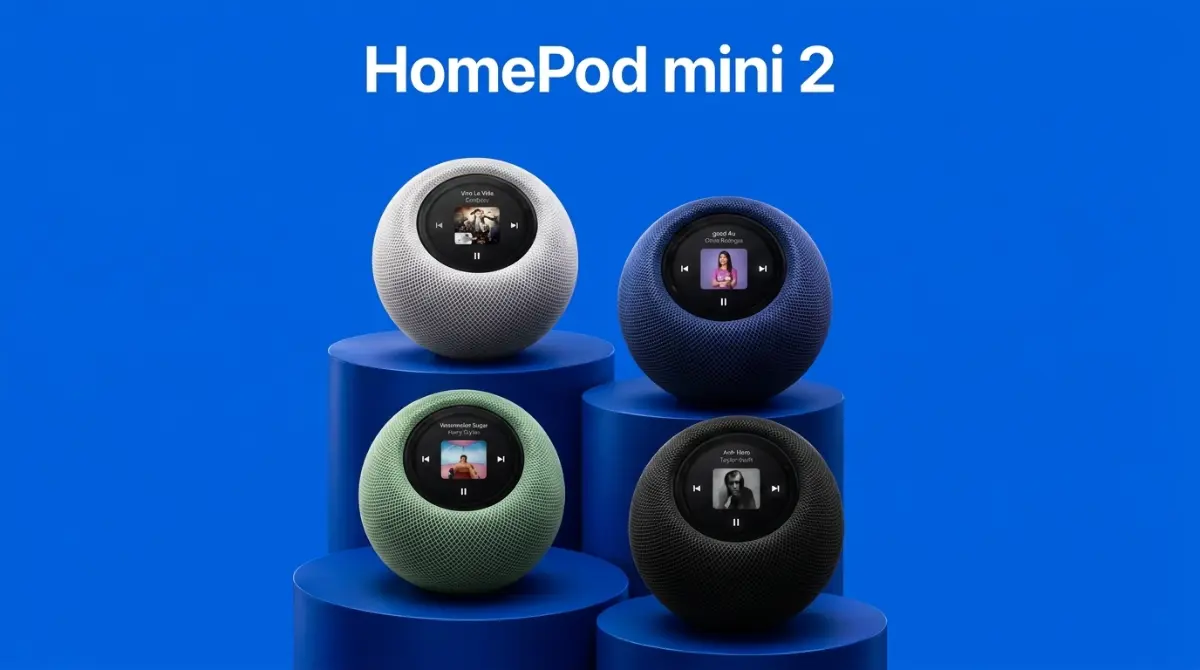


Apple Unveils HomePod Mini 2 With S10 Chip at $149
Apple refreshed its compact smart speaker after six years, packing the S10 processor, Sound Glow interactive lighting, and multi-speaker surround audio into the HomePod mini 2 while raising the entry price to $149 ahead of planned conversational updates.
Goriola Ayankoya | 13 Oct. 2026, 9:38 AM · 10 min read

Small desktop speakers rarely receive major hardware overhauls once they establish steady sales. Hardware makers prefer to leave cheap audio pucks untouched for years, relying on seasonal discounts to move inventory while concentrating engineering resources on expensive television displays and portable smartphones. The original HomePod mini survived in that exact corporate holding pattern since its debut in late 2020. While consumers appreciated its compact round body and balanced acoustics, the internal silicon grew dated, struggling to process modern home automation commands without noticeable pauses. Apple broke that hardware freeze on Tuesday, October 13, 2026. The Cupertino consumer electronics giant unveiled the HomePod mini 2, swapping out the aging S5 watch processor for custom S10 silicon, introducing an interactive Sound Glow top panel, and unlocking four-speaker surround sound configurations with the companion Apple TV 4K. The refresh brings an immediate retail price bump to $149, up $50 from the previous $99 price point. The hardware debut lands alongside broad home accessory announcements, matching product rollouts we analyzed when Apple prepared multiple hardware release waves.
The revised pricing places the HomePod mini 2 into a distinct market bracket. For six years, the original $99 price tag served as an impulse purchase for iPhone owners seeking an affordable bedroom clock or kitchen music streamer. At $149, the speaker moves out of the bargain accessory lane, demanding that buyers evaluate whether upgraded acoustic processing and future conversational software justify spending fifty percent more cash. Pre-orders commenced immediately across twenty-four countries, with retail deliveries and physical store availability scheduled for Friday, October 30. Customers can select from five exterior fabric finishes: pink, green, blue, white, and midnight. How premium consumer brands manage price tier adjustments reflects pricing maneuvers we tracked in our evaluation of the AirPods 5 wireless charging edition buyer guide.
The S10 Processor and Local Processing Speeds
The defining technical upgrade inside the small mesh enclosure is the transition to Apple S10 processor. The original 2020 model ran on the S5 chip, an architecture originally designed for the Apple Watch Series 5. While the S5 handled basic audio streaming and simple HomeKit light toggles adequately, it lacked the computational capacity required to run modern on-device machine models. Commands had to travel to remote cloud servers, causing annoying two-second pauses between speaking a request and watching living room lamps illuminate.
The S10 processor changes that response speed. Built on advanced fabrication lines, the chip includes dedicated neural processing cores capable of parsing natural language requests locally. When a homeowner commands the speaker to adjust blinds, mute speakers, or check door sensors, the audio request is decoded directly on the device without pinging remote cloud centers. This local execution cuts command latency down to milliseconds while ensuring that spoken requests stay private inside the residence. The processor also handles dynamic acoustic tuning in real time, measuring internal driver excursion over two thousand times per second to prevent audio distortion when playing bass-heavy tracks at maximum volume levels. Upgrading silicon architecture across personal hardware mirrors developments we followed when reviewing the Googlebook Gemini portable computer.
Sound Glow and Interactive Music Visuals
On the top surface of the spherical speaker sits an updated visual touch interface called Sound Glow. On the original model, the top glass display featured a small, cloudy LED circle that swirled with colored light only when voice commands were active or when volume buttons were pressed. During normal music playback, the top panel remained dark and inert.
Sound Glow turns the entire top glass surface into an active visual canvas. Using multi-color LED arrays linked to the audio processing pipeline, the panel samples the color palette of active album artwork, pulsing with ambient light in sync with musical rhythms. When playing jazz records or acoustic tracks, the lighting shifts gently between warm amber and deep indigo tones, adding a subtle visual presence to bedside tables. Users can also select ambient soundscapes, including rainfall, fireplace crackles, or ocean waves, which trigger corresponding animated light sequences designed to help people wind down before sleep. The capacitive touch controls remain responsive, letting users tap to pause, double-tap to skip tracks, or hold down to summon voice assistance. Interactive physical lighting designs match hardware trends we examined in our review of Nothing CMF portable wireless speakers.
Four Speaker Surround Sound and Living Room Home Theater
For home theater enthusiasts, the most practical software inclusion in HomePod software 27.2 is support for four-speaker surround sound setups. Previously, users could pair only two identical HomePod speakers to create a left-and-right stereo soundstage in front of a television. While a stereo pair sounded good, it could not replicate the immersive directional audio provided by dedicated rear surround channels.
Paired with the updated Apple TV 4K, owners can now place two HomePod mini 2 units at the front of the room beside the screen and two additional units behind the couch as dedicated rear surround satellites. The S10 processor uses beamforming microphone arrays to measure room reflections, calculating distances between walls and furniture to balance audio delay automatically. When watching films mixed in Dolby Atmos, background sound effects, passing vehicles, and overhead weather cues pan across the room with realistic physical placement. Given that four HomePod mini 2 units cost roughly $600 combined, the setup offers a modular alternative to traditional soundbar and subwoofer packages, allowing apartment dwellers to build a capable cinema sound system without running speaker wires across living room floors. Multi-device audio synchronization matches hardware features we detailed when testing the Sennheiser Momentum 5 wireless headphones.
Mac Desktop Pairing and Clean Workspace Audio
Beyond living room television setups, Apple is positioning the HomePod mini 2 as an audio companion for Mac workstations. In previous years, routing computer audio through an original HomePod was frustrating due to AirPlay transmission delays, which caused YouTube video dialogue and video editing cuts to lag behind on-screen actions.
With updated wireless protocols and the S10 processor, the HomePod mini 2 functions as a default system output for Mac computers with zero perceptible audio lag. Users can place two color-matched speakers on either side of an Apple Studio Display or Mac mini workstation to create an uncluttered desktop listening station. During FaceTime video conferences and corporate Zoom meetings, the speaker microphone array isolates the user voice while suppressing room echo, delivering clean vocal transmission without requiring a dedicated headset. The acoustic volume easily fills office rooms, delivering clear instrumental separation when streaming music while working. Workspace peripheral choices and desktop hardware setups were analyzed in our review of Anker multi-port desktop docking stations.
The Promise and Delay of Conversational Siri AI
While the physical hardware improvements are substantial, the software narrative surrounding the HomePod mini 2 carries noticeable caveats. Promotional materials emphasize that the speaker is built to support Siri AI, an updated conversational engine designed to handle multi-turn dialogues, understand personal context, and execute complex cross-application tasks using natural speech patterns.
Apple confirmed that the conversational software will not be available on retail launch day. Buyers paying $149 on October 30 will interact with standard voice commands, with the full conversational upgrade arriving through a software update scheduled for early 2027. This delayed rollout means early adopters must buy the hardware based on audio quality and smart home control, waiting months for the headline intelligence features to materialize. Delivering hardware ahead of planned software features has become a common pattern across technology firms, similar to software timelines we explored when Google DeepMind scheduled multi-stage model releases.
Geopolitical Friction and the European Union Exclusion
The rollout of Apple updated smart home technology highlights mounting regulatory tensions between American technology giants and European Union authorities. Due to ongoing legal disputes surrounding the Digital Markets Act and antitrust scrutiny over closed software platforms, Apple confirmed that its advanced conversational voice features will face significant distribution delays across EU member states.
European buyers will be able to purchase the HomePod mini 2 for music streaming and basic home automations, but the conversational capabilities that justify the $149 price tag will remain restricted until Apple and the European Commission resolve regulatory compliance debates. This geographic fragmentation creates two distinct tiers of consumer utility, leaving European consumers paying premium prices for hardware while American users receive full software capabilities. How sovereign regulations restrict platform features was examined in our report detailing Apple adjusting corporate store policies across international borders.
Acoustic Architecture and Driver Limits
Inside the spherical frame sits a custom full-range acoustic driver powered by a neodymium magnet, flanked by dual force-canceling passive radiators. The acoustic layout matches the physical dimensions of the first-generation model, measuring 3.3 inches tall and 3.9 inches wide while weighing approximately 345g. An acoustic waveguide at the base pushes sound outward in an unbroken 360-degree circle, ensuring consistent tonal balance regardless of where the speaker sits in a room.
For vocal tracks, acoustic podcasts, and classical compositions, the speaker punches well above its physical dimensions. Midrange frequencies sound natural and intelligible, while high-frequency percussion avoids harsh digital splashiness. Physics cannot be bypassed; a single 3.3-inch sphere cannot produce true sub-bass frequencies below 60Hz. Listeners who demand chest-thumping electronic bass will find the low end lacking compared to larger bookshelf speakers or the full-sized HomePod. The audio tuning remains clean and pleasant, avoiding the muddy distortion that ruins cheap Bluetooth cylinders. Sound fidelity comparisons across compact audio hardware match metrics we evaluated when reviewing Samsung Galaxy audio hardware adjustments.
Smart Home Hub Controls and Matter Compatibility
The HomePod mini 2 functions as a central hardware anchor for modern home networks. The device houses both a Thread border router radio and complete Matter protocol compatibility, allowing it to communicate directly with low-power sensors, smart locks, smart plugs, and motorized shades from competing manufacturers without requiring third-party bridge boxes.
When placed inside a residence, the speaker coordinates home automations, schedules heating cycles, and routes camera feeds to Apple devices. If an outdoor camera detects a visitor, the speaker plays a gentle doorbell chime and uses facial recognition to announce the visitor name through text-to-speech. Built-in temperature and humidity sensors monitor ambient indoor climates, letting users automate smart thermostats and ceiling fans based on live room conditions. Interoperable communication protocols across household hardware reflect trends we covered when reviewing Apple developing specialized home display operating systems.
Environmental Materials and Corporate Packaging
In line with corporate environmental pledges, Apple constructed the HomePod mini 2 using recycled materials across major sub-assemblies. The outer acoustic mesh fabric is made from 100% recycled plastic yarn, while the internal speaker driver utilizes 100% recycled rare earth elements in its neodymium magnets. The internal logic boards are soldered using recycled gold and tin plating.
The retail packaging is completely fiber-based, eliminating exterior plastic wrap and internal synthetic foams to simplify municipal recycling. Apple claims the device lifecycle supports its broader corporate commitment to achieve total carbon neutrality across its entire manufacturing footprint by 2030. The emphasis on sustainable consumer electronics manufacturing matches hardware initiatives we documented when Framework restructured component pricing and repairability.
The Verdict on Apple Compact Audio Refresh
The Apple HomePod mini 2 is a polished, capable desktop speaker that fixes the sluggish response speeds of its predecessor through the inclusion of the S10 processor. The addition of Sound Glow visuals, zero-lag Mac desktop pairing, and four-speaker home theater surround sound delivers meaningful value for households invested in the broader Apple hardware catalog.
The $50 price increase to $149 changes the buying equation. Consumers looking for a disposable $99 speaker to tuck behind a bathroom mirror may balk at the higher price, especially with the headline conversational software delayed until next year. For music lovers who appreciate clean 360-degree acoustics, private on-device voice processing, and reliable smart home connectivity, the HomePod mini 2 remains one of the most competent compact speakers on the market. It proves that thoughtful silicon upgrades can breathe fresh life into proven industrial designs.
Read More on TechRobust:

Goriola Ayankoya
 LinkedIn
Goriola Ayankoya
Expertise:Consumer Hardware, Smartphone Trends, Gadget Reviews, Breaking Tech News, Mobile Ecosystems
Award:TechRobust Hardware Reporter of the Year 2025
Goriola is a Staff Writer and Reporter specializing in consumer technology, breaking tech news, and hands-on hardware analysis. He tracks fast-paced mobile developments, reviews modern gadgets, and unpacks product launches to give readers clear, practical insights into everyday consumer tech.