


 LinkedIn
 Ballistic Ventures Targets $490M for AI Cybersecurity
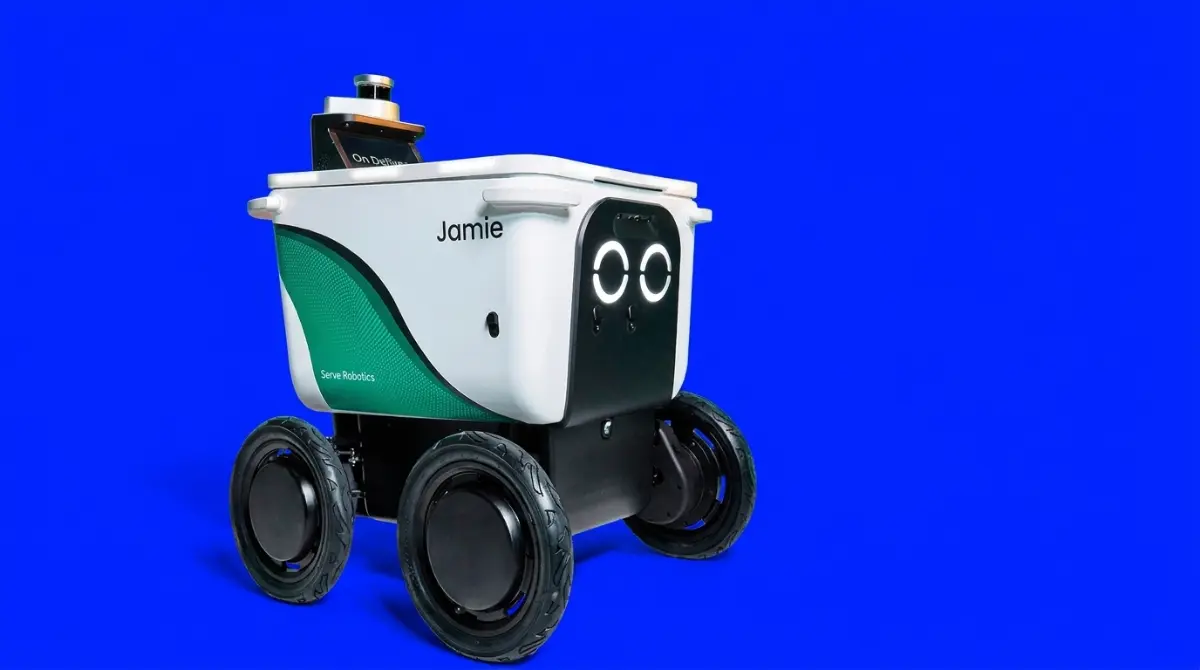
Serve Robotics Launches Modular Platform as AWS for Robots
Sidewalk delivery pioneer Serve Robotics announced a new commercial division to license its proprietary autonomous software, sensor hardware, and remote teleoperations platform to third-party manufacturers, positioning itself as an infrastructure utility for physical robotics.
Inioluwa Ademidun | · 7 min read

Building a physical robot from scratch is one of the most expensive ways to burn venture capital. When an engineering startup sets out to build an autonomous delivery cart, a security patrol rover, or a municipal inspection machine, founders spend three years solving solved problems. They spend millions designing custom metal chassis, testing motor controllers, writing camera perception algorithms, and setting up remote teleoperations centers simply to get a prototype rolling down a sidewalk. By the time the physical hardware functions reliably, the company has exhausted its seed funding, leaving nothing for commercial deployment. Sidewalk delivery pioneer Serve Robotics moved to eliminate that redundant hardware cycle on Thursday, November 5, 2026. The Los Angeles robotics firm announced the launch of an independent commercial division engineered to act as an infrastructure provider for third-party robotics companies, pitching itself as an outsourced platform for physical automation. By licensing its proprietary ServeOS software stack, modular sensor suites, and remote operations infrastructure to outside manufacturers, Serve aims to transform from an operator into an infrastructure utility for the robotics sector. The business expansion arrives as physical automation ventures seek capital efficiency, continuing deeptech startup developments we tracked when Machenta raised $40M to train robots in virtual worlds.
The strategic expansion marks an important operational evolution for Chief Executive Officer Ali Kashani and his executive team. Spun out of delivery giant Postmates following its acquisition by Uber in 2020, Serve Robotics established itself as an established sidewalk delivery operator in the United States. Its friendly, two-eyed robotic carts have completed hundreds of thousands of autonomous food deliveries across Los Angeles, Miami, and Chicago, partnering with major restaurant delivery networks including Uber Eats, Shake Shack, and 7-Eleven. Operating physical delivery fleets in crowded urban environments taught Serve hard engineering lessons: mastering pedestrian obstacle avoidance, surviving curb drops, and managing fleet batteries throughout winter blizzards. Kashani recognized that dozens of emerging robotics companies: building agricultural sprayers, industrial warehouse rovers, and campus security robots: require those exact same baseline capabilities. Rather than keeping its technology proprietary, Serve is opening its hardware and software architecture to external commercial clients. The move allows partner companies to purchase certified autonomous drive units and software licenses, cutting robot development timelines from three years down to four months. Physical automation platforms match industrial trends we analyzed when Foundry Robotics raised $100M to build autonomous factories.
The Modular Robotics Stack: Decomposing the Physical Machine
To inspect why third-party manufacturers are interested in licensing Serve platform, one must examine how Serve decomposed its robotics stack. In traditional robotics development, hardware and software are tightly coupled: changing a camera sensor requires rewriting the entire obstacle detection codebase.
Serve re-engineered its architecture into three independent, modular layers:
- Serve DriveBase (Physical Chassis): A certified, weatherproof four-wheel mechanical base equipped with electric hub motors, regenerative braking, suspension springs, and hot-swappable battery bays capable of carrying up to one hundred pounds of payload.
- ServeOS (Autonomy Core): A low-latency perception and navigation software stack that fuses inputs from automotive-grade cameras, solid-state lidar sensors, and ultrasonic depth arrays, running local neural models to navigate sidewalks safely.
- Serve TeleOps (Remote Operations Cloud): A centralized cloud dispatch and remote monitoring platform that connects field robots to human safety supervisors, allowing remote pilots to assist robots through complex pedestrian blockages over cellular links.
A third-party enterprise developing a mobile security patrol machine does not need to design electric drive wheels or spend years training pedestrian obstacle algorithms. The partner company purchases Serve DriveBase, mounts its proprietary thermal cameras or chemical sensors on top, and deploys functional machines to customer sites within weeks. Physical sensory hardware and tactile perception were detailed in our report on MoSense raising RMB 100M for robot electronic skin.
The Cloud Provider Analogy: Why the Robotics Sector Needs an Infrastructure Layer
The commercial pitch behind Serve new business unit draws a direct analogy to the early days of cloud computing. In the late 1990s, every internet startup had to buy physical server racks, lease space inside commercial data center cages, and hire systems administrators simply to host a website.
When Amazon launched Amazon Web Services in 2006, it transformed server infrastructure into an outsourced utility. Software developers stopped buying servers; they rented computing capacity by the hour, launching startups in weeks with modest seed capital. The robotics industry in 2026 resembles the internet in 1999: dozens of well-funded teams are wasting capital building duplicate wheel assemblies, battery chargers, and mapping scripts. Serve aims to act as that infrastructure layer for physical robotics. By offering certified hardware components and cloud fleet management as a service, Serve lowers the capital barrier to entry for robotics founders. An early-stage startup with a novel idea for hospital medicine delivery can focus its seed capital on hospital software integrations, relying on Serve for the physical robotic wheels and autonomy. Robot fleet coordination and warehouse automation were explored in our analysis of Destro AI securing seed funding to coordinate warehouse robots.
Comparing Commercial Robotics Development Pathways
| Development Pathway | Time to Commercial Deployment | Initial Hardware R&D Expense | Fleet Operations Management | Primary Corporate Margin Driver |
|---|---|---|---|---|
| Serve Platform Licensing | 3 to 6 months to market | Low (Purchases certified modules) | Turnkey managed TeleOps cloud | High-margin recurring SaaS & hardware margin |
| Full In-House Custom Build | 24 to 36 months R&D | High ($10M to $25M upfront) | Requires building custom call centers | Compressed by heavy ongoing engineering payroll |
| Contract Manufacturer Sourcing | 12 to 18 months tooling | Moderate ($2M to $5M tooling) | Partner must supply all software | Tied to physical unit volume delivery |
| Open-Source ROS Stacks | 18 to 24 months integration | Moderate software integration | Zero native remote teleoperations | Custom enterprise deployments |
| White-Label Asian ODM Imports | 6 to 9 months delivery | Low upfront component cost | Unreliable domestic support | Low; high maintenance failure rates |
The comparative data illustrates why Serve platform expansion holds compelling economics. Operating a pure delivery fleet carries thin margins: vehicles suffer physical wear, restaurant commission rates are negotiated aggressively, and bad weather disrupts operations. Selling hardware modules and recurring software subscriptions generates predictable, high-margin cash flows. By licensing its technology to non-competing industrial sectors: such as airport baggage handling, industrial yard security, and hospital linen transport: Serve expands its revenue base without increasing its direct delivery capital expenditures. Commercial robotics deployments across healthcare facilities match models we tracked in our report on Norbert Health securing $14M for nursing room robotics.
The Teleoperations Safety Net: Why Human Oversight Remains Vital
A central asset included in Serve platform licensing package is its human-in-the-loop teleoperations infrastructure. In autonomous robotics, achieving complete Level 4 autonomy on complex urban sidewalks is difficult: unpredictable construction detours, police tape, fallen tree branches, and street parades will confuse autonomous algorithms.
When a robot encounters an ambiguous obstacle, stopping completely creates a pedestrian blockage; attempting to force its way forward risks human accidents. Serve solved this through low-latency cellular teleoperations. When a field robot encounters an obstacle that exceeds its confidence threshold, the robot stops, flashes polite indicator lights, and pings a remote operator. A human supervisor working in an operations center views live 360-degree video feeds, assesses the scene, and guides the robot around the blockage using a gaming controller in seconds. Once past the obstacle, the robot resumes autonomous driving. Third-party companies licensing Serve platform gain immediate access to this remote teleoperations network, ensuring that their robots never get permanently stuck in customer facilities. Commercial teleoperation testing and safety audits were detailed in our review of Safeworld raising $12M to audit generative robotics systems.
The Long-Term Outlook for the Robotics Utility Model
Serve Robotics decision to launch a platform business marks an important milestone in the maturation of the commercial robotics industry. For two decades, robotics ventures behaved like craft workshops: building bespoke machines by hand and reinventing basic mechanical wheels for every new application.
As autonomous machines enter everyday human environments, the industry must transition into standardized, modular manufacturing. By packaging its proven drive bases, autonomous navigation software, and remote teleoperations network into an accessible utility, Ali Kashani and his team are establishing the foundational building blocks for the robotics economy. The road ahead will require signing industrial manufacturing partners, proving hardware reliability across diverse climates, and supporting third-party developers. If Serve succeeds in becoming the foundational platform for mobile robotics, the company will have built something far larger than a food delivery business: it will have constructed the physical operating system that powers the autonomous machines of the modern world.
Read More on TechRobust:
Tags:Serve RoboticsAli Kashanirobotics platformsidewalk deliveryautonomous robotsSeries Bhardware tech

Inioluwa Ademidun
Inioluwa Ademidun
Expertise:African Tech Ecosystem, Early-Stage Startups, Emerging Market Dynamics, Venture Capital & Tech Reporting, Product Management
Award:TechRobust Contributor of the Year 2025
Inioluwa is a Senior Product Manager by day and an investigative technology reporter by night, bridging the gap between scalable software architecture and high-impact journalism. She delivers deep-dive analysis on venture-backed founders, regulatory shifts, and grassroots tech ecosystems across Africa and global emerging markets.
Related Stories
Ballistic Ventures Targets $490M for AI Cybersecurity AI Inference Platform Fal Secures $1.3B at $16B Valuation
 Trajectory Raises $45M Series A to Democratize AI Training