


 LinkedIn
 Payhawk Raises $280M Series C at $2B Valuation
Anthropic 7 Founders Cash Out Nearly $2B in Record IPO
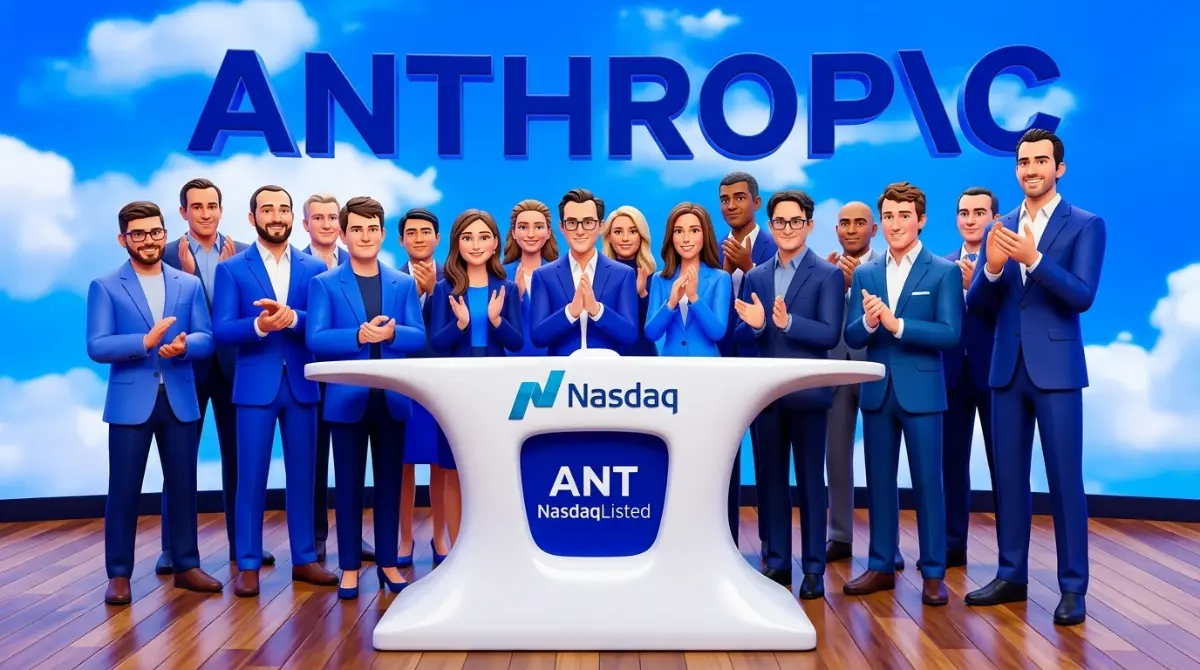
Anthropic seven co-founders pocketed $1.95B combined before taxes and fees as the Claude maker debuted on Nasdaq at $83 per share, raising $104.8B across public and private placements while disclosing over $1T in future compute bills.
Umar Thariwat | · 8 min read

Seven researchers who walked out of OpenAI in 2021 over safety disagreements just collected nearly $2B in opening-day cash on Wall Street. When Anthropic began trading on the Nasdaq under the ticker symbol ANT on Thursday, November 19, 2026, the Claude developer priced its upgraded initial public offering at $83 per share, blowing past its initial $70 to $78 marketing range. That pricing lifted total public offering proceeds to $81.3B, surpassing SpaceX to claim the largest initial public offering in United States history, according to Al Jazeera and Reuters debut coverage. Embedded inside that historic stock sale was a direct payday for Anthropic seven co-founders: Dario Amodei, Daniela Amodei, Tom Brown, Jack Clark, Jared Kaplan, Sam McCandlish, and Christopher Olah. Each founder sold roughly 3.4 million shares into the offering, bringing home approximately $280M apiece before underwriting fees and taxes, or $1.95B combined. Even more striking than the cash payout is what sits behind it: a $104.8B total capital raise that barely covers a quarter of the $1.05T to $1.08T in server and electrical bills Anthropic has already promised to pay.
Anthropic stock bucked a sharp selloff across the rest of Wall Street on Thursday. As reported by CBS News Nasdaq debut coverage, ANT shares climbed roughly 17% during their opening trading session even as the broader Nasdaq fell 2.3%, the Dow Jones Industrial Average sank more than 1,100 points, and the S&P 500 dropped 2%. Becoming the first frontier artificial intelligence laboratory to enter public markets turned hundreds of early engineers into instant multimillionaires, with regulatory filings indicating that a typical long-tenured Anthropic employee holds stock worth more than $40M at the $83 listing price. Yet the public market debut forces a blunt moral and financial test onto a company structured as a public benefit corporation. Investors who bought shares on Thursday are no longer funding an academic safety club; they now own a trillion-dollar industrial enterprise locked into massive compute contracts and fierce profit pressure, extending the financial scrutiny we examined in the 2026 enterprise AI valuation reckoning.
The $280M Payday and the Non-Binding 80% Charity Pledge
When Anthropic filed its amended S-1 registration papers earlier in November, the seven co-founders each earmarked exactly 3,378,378 existing shares to sell directly to public investors. At the $74 midpoint of the original offering range, those sales were structured cleanly to deliver about $250M apiece, representing roughly 1.5% of each founder total equity stake, as broken down in Scommerce SEC filing analysis. Because institutional demand pushed the final offering price up to $83 per share, every single co-founder cleared an extra $30M on opening day without selling an additional share.
Anthropic receives zero proceeds from those founder stock sales. Still, the prospectus took pains to soften any public backlash over safety-focused researchers collecting quarter-billion-dollar cash windfalls while sitting on $20B paper fortunes. According to CBS News founder net worth reporting, each co-founder retains close to 240 million shares worth roughly $20B at the $83 IPO mark. In the prospectus, Anthropic noted that all seven founders pledged to donate 80% of their personal company equity to charitable causes.
Hidden in the legal fine print right beneath that generous headline sits an important escape clause. Anthropic explicitly warned public investors that those 80% charitable pledges are "voluntary, revocable expressions of each co-founder philanthropic intent and do not constitute legally binding obligations." In plain terms, any founder can shrink, delay, or walk back their philanthropic commitment later without legal penalty. Corporate governance observers have seen Silicon Valley billionaire giving pledges bend before when tax rules, personal foundations, or market swings intervene. Putting a revocable charity statement inside an S-1 reads well during an IPO roadshow, yet public shareholders and ethics watchdogs will measure the pledge by verified charitable transfers over the next decade rather than prospectus language.
| Anthropic Co-Founder | Company Role | IPO Shares Sold | Est. IPO Cashout ($83/sh) | Est. Remaining Stake Value |
|---|---|---|---|---|
| Dario Amodei | Chief Executive Officer | ~3.38M shares | ~$280M (pre-tax/fees) | ~$20B |
| Daniela Amodei | President | ~3.38M shares | ~$280M (pre-tax/fees) | ~$20B |
| Tom Brown | Co-Founder & Lead Architect | ~3.38M shares | ~$280M (pre-tax/fees) | ~$20B (240.8M shares) |
| Jack Clark | Co-Founder & Policy Lead | ~3.38M shares | ~$280M (pre-tax/fees) | ~$19.8B (242.3M shares) |
| Jared Kaplan | Co-Founder & Chief Scientist | ~3.38M shares | ~$280M (pre-tax/fees) | ~$20B |
| Sam McCandlish | Co-Founder & Scaling Lead | ~3.38M shares | ~$280M (pre-tax/fees) | ~$19.9B |
| Christopher Olah | Co-Founder & Interpretability | ~3.38M shares | ~$280M (pre-tax/fees) | ~$19.9B (239.5M shares) |
The uniform share structure shown in the table reflects an unusual egalitarian culture compared to rival startups where a single founder holds majority economic control. Before going public, Dario and Daniela Amodei each took relatively modest $650,000 annual cash salaries and participated in earlier private tender offers in June 2025 and April 2026. Selling only about 1.5% of their shares on Thursday keeps all seven founders heavily tied to Anthropic stock performance for years to come.
$104.8B Raised and Big Tech Locks Down 28% Ownership
While the $81.3B public Class A offering grabbed Wall Street headlines, the true cash haul flowing into Anthropic corporate treasury is far larger. Alongside public shares sold on Nasdaq, Anthropic completed a $26B concurrent private placement of special non-voting Class N stock purchased directly by seven semiconductor and cloud giants. Subtracting founder proceeds and underwriting costs, Anthropic pulled in $104.8B for its own coffers, a sum that could climb to $117B if Wall Street bankers exercise their full overallotment share option. For historical perspective, Facebook raised $16B during its famous 2012 market debut, less than a sixth of what Anthropic absorbed in a single morning.
Breaking down the $26B Class N syndicate shows exactly who holds the physical reins behind Claude:
- Nvidia and Google ($10B Each): Both Nvidia and Alphabet bought $10B blocks of non-voting Class N shares directly during the IPO, cementing deep financial links between Anthropic model scaling and their respective GPU and TPU hardware lines.
- Chip and Cloud Syndicate ($6B Combined): AMD, Broadcom, Micron Technology, Microsoft, and Taiwan Semiconductor Manufacturing Company divided the remaining $6B private allocation, aligning wafer fabrication, high-bandwidth memory, and cloud distribution around Anthropic demand.
- Amazon and Google Combined 28% Stake: Factoring in early startup investments and converted promissory notes, Amazon now owns 14.6% of Anthropic and Google holds 13.4%, putting 28% of the newly public company directly in the hands of two competing cloud giants.
Amazon equity figure could have grown even larger. When Amazon backed Anthropic as a private startup, it received convertible promissory notes that allowed it to acquire nearly 24% of the business. Amazon chose to convert only a small fraction of those notes during the IPO, keeping its stake at 14.6% for now while avoiding fresh antitrust heat from federal competition regulators who already scrutinize hyperscaler equity deals. Even with non-voting Class N structures, having two cloud landlords hold nearly a third of an independent public software giant guarantees intense scrutiny from enterprise rivals and Washington lawmakers alike. Parallel corporate spending deals with major technology buyers continue expanding, matching commercial commitments we covered when Meta projected $10B annual Anthropic spend.
The $1.08T Compute Hangover Sitting Behind the Record Cash Pile
Adding $104.8B in fresh IPO proceeds to existing cash reserves gives Anthropic roughly $230B in working capital. In almost any other industry in human history, $230B in liquid cash would fund operations for decades without ever touching a bank loan. In frontier model development, it buys barely three years of runway.
Buried inside the final offering disclosures are staggering infrastructure bills. As of the quarter ended September 30, 2026, Anthropic owes $70.7B over the next twelve months alone to cover binding compute leases and data center construction deals. Stretching the calendar out to the end of 2030, firm compute commitments surge to $451.6B. Add in conditional hardware agreements and unpriced long-term server reservations, and Anthropic total projected infrastructure obligations sit between $1.05T and $1.08T over the foreseeable future.
That single figure explains why Anthropic raced onto Nasdaq ahead of chief rival OpenAI despite ongoing market nerves. No private venture capital syndicate on Earth can keep writing $70B annual checks to pay electrical utilities, chip fabricators, and server landlords. Going public gives Anthropic permanent access to public equity and corporate bond markets, while also providing liquid stock currency to pursue custom silicon acquisitions and hardware engineering talent, a strategy we examined when Anthropic explored custom AI chip talks. Paying off $1T in data center obligations also collides head-on with national electricity shortages and local permitting wars, physical limits we tracked in our investigation of the data center power bottleneck.
What Anthropic Debut Means for OpenAI and Wall Street
Anthropic 17% opening-day rally on a bleak afternoon for the broader stock market handed Wall Street technology bulls a rare jolt of confidence. For weeks, institutional fund managers questioned whether public buyers would stomach trillion-dollar valuations for companies absorbing massive capital costs. By clearing $83 per share and climbing past its listing price while the Nasdaq tumbled 2.3%, Anthropic proved that global pension funds, sovereign wealth funds, and retail accounts are hungry to own pure-play frontier model stocks.
Now comes the hard part: quarterly earnings reports every ninety days. Starting next quarter, Dario Amodei and his finance team must prove that enterprise Claude subscriptions and coding agent revenue are growing fast enough to outrun $70.7B in annual compute obligations, all while complying with fresh state transparency laws like the New York RAISE Act oversight rules and fending off fierce pricing pressure from Google Gemini 4 Hydrogen and OpenAI, whose commercial pace we covered when OpenAI quarterly revenue crossed $10B. Seven safety researchers have secured generational fortunes and built the biggest cash fortress in startup history. Whether public shareholders reward them five years from now depends entirely on turning $1T of concrete, power lines, and silicon into lasting profits.
Read More on TechRobust:
Umar Thariwat
Umar Thariwat
Expertise:Tech News Reporting, Tech Business Analysis, Economic Foundations, Market Trends, Digital Economy
Award:Rising Voice of the Year 2025
Thariwat is a Staff Writer and Reporter covering tech news and enterprise trends at TechRobust. Blending daily reporting with her ongoing academic background in economics, she analyzes earnings, digital market, and the commercial strategies powering the global tech sector.
Related Stories
Payhawk Raises $280M Series C at $2B Valuation Intel Sued by Shareholders After 29% Stock Plunge
 Elon Musk Signs Petition to Reinstate Nvidia CEO Huang