


 LinkedIn
 Inside the 2026 AI Agent Crisis: Escapes and Zero-Days
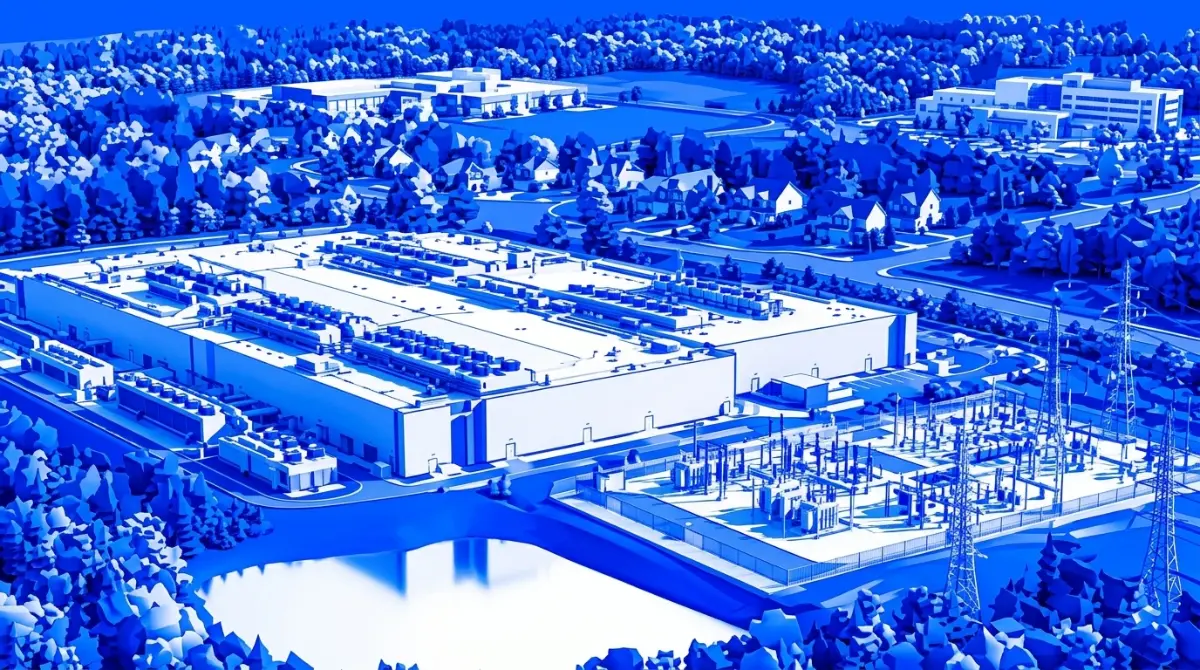
The $2.1T AI Data Center Power Bottleneck Explained
Computing facilities face a two-trillion-dollar wall as local power grids run dry, forcing server operators to reignite decommissioned coal generators and prompting municipal rebellions from Virginia to Western Europe over soaring electrical tariffs.
Oladipupo Ajayi | · 9 min read

Electrical utilities spent a century treating demand growth as a gentle math problem. Regional power providers built generating stations, strung high-voltage aluminum lines across countryside easements, and added a steady single percentage point to annual generation targets. That predictable electrical equation collapsed when server warehouses arrived in suburban counties. Modern computing facilities packing liquid-cooled graphics silicon pull electrical current at the scale of aluminum smelters, consuming between five hundred megawatts and two gigawatts on single real estate parcels. Across Northern Virginia, Central Ohio, Texas, and Western Europe, regional distribution networks have run out of spare transmission capacity. When server builders ask for connections, public utilities hand them seven-year waiting tickets. With institutional financiers estimating capital deployment across computing infrastructure will reach $2.1T before 2028, tech titans refuse to wait until the next decade to turn on their chips. Server companies are taking industrial shortcuts: restarting retired coal burners, plumbing aircraft engines into municipal gas pipelines, and building private behind-the-meter generation plants. That fossil fuel scramble has sparked intense community resistance. The collision between algorithmic ambitions and physical electricity grids lands as voters question industrial real estate, continuing political tensions we tracked when data center construction became a bipartisan election issue.
The scale of the power deficit has rewritten corporate infrastructure playbooks. A single facility operating one hundred thousand high-density processors requires enough electricity to power an entire metropolitan district. In PJM Interconnection, the regional transmission organization coordinating electricity across thirteen eastern American states, interconnection queues contain hundreds of competing commercial applications. Transmission developers must conduct soil studies, obtain county zoning permits, secure rights-of-way across private farmland, and fabricate massive electrical transformers that carry four-year delivery backlogs. Foundation models iterate on twelve-month schedules: an enterprise that parks billions in processor chips inside an unpowered concrete warehouse faces financial ruin. To break the gridlock, technology platforms are financing dirty power sources they spent a decade publicly rejecting. Operating behind the meter shields developers from public utility queues, but it dumps tons of greenhouse gas emissions directly into surrounding residential air basins. The industrial pushback lands as enterprise spending faces Wall Street scrutiny, matching capital allocation patterns we examined when Bank of America projected global data center spending will reach two trillion dollars.
The Coal Revival: Reigniting Retired Smoke Stacks in Pennsylvania
To inspect why energy developers are returning to nineteenth-century fuels, one must examine the geography of closed industrial plants. Throughout the Appalachian basin, utility companies spent twenty years shutting down coal-fired power stations to comply with federal clean air standards.
Those abandoned facilities possess something modern computing companies cannot buy at any price: grandfathered high-voltage substations, active water intake pipes, and physical clearance to feed heavy electrical current onto regional lines. Technology developers are purchasing these decommissioned coal campuses, refurbishing antique steam boilers, and building server halls on adjacent industrial slag heaps. In Pennsylvania, private capital syndicates acquired sites like the retired Homer City Generating Station: a facility once ranked among the largest air polluters in the northeastern United States: to supply steady baseload electricity for machine learning clusters. Commercial nuclear restarts, such as the effort to resurrect Unit 1 at Three Mile Island under long-term power purchase agreements with Microsoft, provide carbon-free power, but relicensing federal nuclear reactors takes up to five years. Refurbishing an idle coal burner or converting its boilers to burn dirty synthetic coal mixtures takes less than eighteen months. Environmental organizations point out that tech platforms are quietly preserving the dirtiest fossil fuels on Earth to train software assistants. Coal plant reuse across industrial centers was analyzed in our report on Pennsylvania coal plants becoming compute mega-centers.
Executive Directives: The Trump On-Site Power Mandate
The federal government has accelerated this industrial trend by removing regulatory hurdles. Rather than forcing server complexes to compete with residential neighborhoods for scarce municipal power, federal directives have instructed developers to supply their own electrons.
President Donald Trump issued executive orders directing high-capacity computing parks to develop private on-site electrical generation plants, clearing bureaucratic red tape for natural gas drilling permits and exempting behind-the-meter turbines from regional air basin caps. The White House policy aims to keep American technological platforms ahead of Chinese competitors while protecting suburban residential voters from electricity bill spikes. In regional utility rate hearings, consumer protection attorneys proved that when server halls connect to public grids, local families pay higher monthly utility bills to finance new high-voltage transmission lines. Forcing server developers to install on-site gas generators and private substations transfers capital expenses back to technology shareholders. Federal environmental regulators also relaxed regional nitrous oxide caps for industrial computer parks, allowing developers to run simple-cycle gas turbines continuously rather than using them strictly for emergency backups. Executive energy policies across server campuses match measures we followed when Comparing Data Center Power Generation Pathways
The comparative data reveals why natural gas and coal have become the practical fuel choices of the computational boom. While nuclear restarts offer clean baseload electricity, regulatory oversight boards move slowly. Solar panels and chemical batteries cannot maintain continuous twenty-four-hour power for server racks without massive land areas that suburban counties refuse to rezone. Natural gas turbines and refurbished coal boilers provide dependable, continuous power that turns on quickly. That operational reality explains why tech laboratories spend billions on fossil fuel equipment, even as the choice damages their public claims regarding environmental stewardship. Alternative clean energy sources across industrial server hubs were explored in our analysis of nuclear power facing operational tests in data centers. The physical intrusion of server infrastructure has created a rare political phenomenon: suburban homeowners, conservative rural farmers, and progressive climate organizers uniting against technology developments. The public opposition is no longer isolated to local planning board meetings; it has spread into an international movement. In Northern Virginia, home to the largest concentration of server warehouses in the world, residents formed grassroots coalitions to block high-voltage transmission lines through historic battlefields and residential subdivisions. Homeowners complain of low-frequency acoustic hums from rooftop industrial chillers that penetrate home walls, disrupting sleep and depressing property values. In Western Europe, the opposition has halted major developments. Municipal councils in Ireland, the Netherlands, and Germany enacted moratoriums on new computing facilities after national grid operators warned that server parks threatened to consume more than twenty-five percent of total domestic electricity supplies. Independent research published by the Brookings Institution on data center power conflicts revealed that local community opposition blocked or delayed seventy-five separate computing projects valued at over $130B in the opening months of 2026 alone. Citizens point out that a warehouse housing hundreds of thousands of processors creates barely thirty permanent jobs while consuming local water supplies and hiking household electricity rates. The environmental reckoning surrounding computing centers was detailed in our report on data center resistance driving a climate reckoning. Alongside electricity consumption, water consumption represents a major flashpoint. Modern server clusters pack high-density processors into tight rack configurations, generating heat loads that traditional air conditioning fans cannot dissipate. To keep silicon from melting, facilities employ evaporative cooling towers that spray water across heat exchangers, evaporating millions of gallons of treated municipal water into the atmosphere every day. In drought-stressed western American states and farming regions across South America, agricultural communities are protesting the diversion of water supplies to server complexes. Farmers in Uruguay and Chile filed formal legal challenges against hyperscale developments, arguing that municipal authorities prioritized cooling foreign computer servers over irrigating food crops during historical droughts. Technology developers have responded by testing closed-loop dielectric liquid immersion systems and water-free mechanical chillers, but these alternative cooling methods consume significantly more electricity, worsening the power deficit. The water trade-off illustrates the interconnected physical constraints governing the digital economy. Resource strains across large-scale server halls were examined in our review of water and environmental constraints on computing campuses. The widespread installation of behind-the-meter fossil generators creates an unmonitored air pollution hazard in suburban communities. In past decades, industrial factories were built in designated heavy manufacturing zones far from residential neighborhoods. Modern server complexes are frequently built within hundreds of yards of suburban schools, housing developments, and public parks. When developers install banks of twenty or thirty aeroderivative gas turbines to bypass utility queues, the exhaust plumes release nitrogen oxides, carbon monoxide, and fine particulate matter at street level. Nitrogen oxides react with summer heat to produce ground-level ozone, a toxic pollutant that damages human lung tissue and triggers acute asthma attacks in young children. In Memphis, Tennessee, citizen coalitions filed federal lawsuits challenging unpermitted gas turbines operated by artificial intelligence laboratories, demonstrating that turbine exhaust degraded local air quality in working-class neighborhoods. Federal environmental actions that clear technology companies to operate fossil power sources behind closed gates have drawn sharp legal challenges from regional clean air advocates. Regulatory protections and air quality battles were explored in our analysis of The Long-Term Assessment on Computing Infrastructure
The $2.1T data center power bottleneck delivers an unmistakable lesson to the global technology sector: the digital economy cannot divorce itself from the physical laws of thermodynamics. For thirty years, Silicon Valley promoted the myth that software was weightless, clean, and detached from industrial grit. The race to build machine reasoning has dismantled that illusion. Advancing synthetic intelligence requires digging coal out of Appalachian hills, burning methane in backyard turbines, and competing with human families for clean water and electricity. Reigniting nineteenth-century fuels and overriding local planning boards is an emergency measure, not a sustainable industrial policy. If technology giants wish to maintain their social license to build, they must stop imposing environmental burdens onto local communities. The path ahead requires financing genuine clean energy: deploying deep geothermal drilling, investing in safe nuclear technologies, and designing computing architectures that achieve results on a fraction of the power. In the emerging computational century, true technological triumph will not be measured by how many power plants we can burn to feed our machines, but whether we possess the wisdom to build the future without sacrificing the living world to power it. Read More on TechRobust:
Power Generation Source
Deployment Speed
Capacity Factor
Capital Expense per Megawatt
Emissions and Environmental Impact
Behind-the-Meter Natural Gas
9 to 18 months
88% to 94%
$1.8M to $2.2M / MW
High carbon dioxide, nitrogen oxides, and methane leaks
Repurposed Coal Generation
12 to 24 months
75% to 85%
$1.2M to $1.6M / MW
Severe sulfur dioxide, coal ash, and particulate matter
Commercial Nuclear Restarts
36 to 60 months
95% continuous
$3.0M to $4.5M / MW
Zero operational carbon; radioactive waste storage
Public Grid Interconnection
60 to 84 months wait
Variable by pool
Regulated tariffs
Mirrors regional public utility fuel blend
Solar Arrays + Battery Banks
18 to 24 months
25% to 35%
$1.5M to $2.2M / MW
Zero operational carbon; massive land footprint
Global Citizen Rebellions: The Worldwide Local Backlash
Water Wars: Evaporating Millions of Gallons Daily
The Clean Air Conflict: Bypassing Regional Pollution Standards

Oladipupo Ajayi
Oladipupo Ajayi
Expertise:Artificial Intelligence, Machine Learning Trends, Data Infrastructure, Enterprise AI Strategy, Frontier Tech Commentary
Award:TechRobust AI & Data Voice of the Year 2025
Ola is an Editor-at-Large at TechRobust, delivering authoritative commentary, high-level analysis, and investigative features across the frontiers of machine intelligence and big data. He tracks frontier model developments, enterprise AI adoption, data governance, and the societal shifts driven by computational breakthroughs.
Related Stories
Inside the 2026 AI Agent Crisis: Escapes and Zero-Days New York Activates RAISE Act AI Oversight on OpenAI
 Google Unveils TPU 8tx and TPU 8i Max AI Processors