
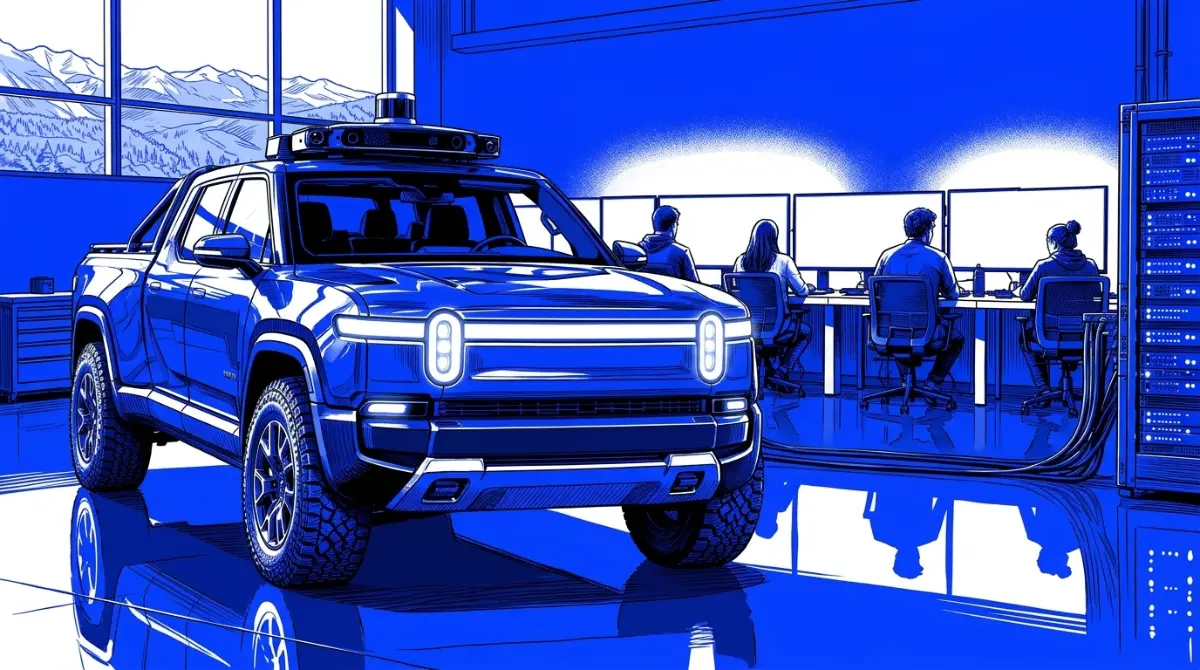


Rivian Acquires Third Dimension AI for Driving Sims
Electric vehicle maker Rivian purchased British generative simulation startup Third Dimension AI to convert ordinary road camera recordings into photorealistic three-dimensional digital environments, accelerating autonomous vehicle safety training without clocking millions of costly physical test miles on public streets.
Caleb Ogunkanbi | · 10 min read

Physical vehicle testing on asphalt roadways costs fortunes and takes years to complete. When automotive manufacturers build autonomous driving software, sending test fleets down suburban avenues and highway loops exposes engineers to legal liabilities, fuel bills, and random weather. A test car can travel fifty thousand miles without meeting an errant deer jumping across an icy bridge or an overturned cement mixer blocking a blind exit ramp. Collecting hazardous road situations through manual driving alone would require decades of continuous travel across millions of vehicles. Irvine electric truck manufacturer Rivian Automotive moved to solve that testing bottleneck on Friday, October 23, 2026. The automaker confirmed the completed acquisition of British spatial computing venture Third Dimension AI. The London startup specializes in turning ordinary forward-facing camera feeds into interactive, photorealistic three-dimensional simulation spaces. By bringing the technology in-house, Rivian aims to train and validate its driver-assistance software inside synthetic computer worlds that mimic the unpredictability of human roads. The corporate transaction arrives as electric car companies reallocate resources toward automated driving technology, an investment priority visible when Musk corporate spending ambitions faced financial scrutiny.
The acquisition represents an important operational step for Rivian Chief Executive Officer RJ Scaringe. While early self-driving developers believed that sheer physical mileage would deliver full vehicle autonomy, automotive engineers now recognize that unusual edge cases govern highway safety. Third Dimension AI, created by machine vision researchers in the United Kingdom, built generative tools that reconstruct real-world environments from standard video clips. The software constructs digital duplicates of streets, intersections, and weather phenomena, allowing software testers to insert digital obstacles, change sunlight angles, and simulate dangerous pedestrian behaviors on demand. Rivian plans to embed the simulation tools into its autonomy development pipeline ahead of the commercial introduction of its mid-size R2 sports utility vehicle and R3 crossover platforms. Buying specialized software builders reflects a wider consolidation trend across private enterprise markets, matching patterns we tracked when software ventures acquired smaller specialized teams.
The Structural Trap of Physical Road Miles
To grasp why Rivian committed capital to purchase a simulation startup, one must examine the mathematics of automotive safety validation. When human drivers commute to work, typical highway miles are uneventful. Cars maintain lane position, follow traffic signals, and maintain steady headway behind preceding vehicles. An autonomous system trained solely on typical highway footage masters standard cruising quickly.
The danger sits in the long tail of rare, unpredictable road events. Human drivers navigate unexpected road hazards using accumulated common sense: identifying a mattress bouncing out of a pickup truck bed, reacting to a broken water main spraying mud across windshield glass, or yielding to a police officer waving traffic through a red light. Physical test cars rarely encounter these dangerous anomalies during scheduled test routes. If an automaker relies exclusively on physical road testing to validate safety models, verifying that a system handles rare hazards requires billions of driven miles. Staging dangerous crashes on public highways with human safety drivers is hazardous and legally indefensible. Synthetic simulation provides an answer: allowing engineers to expose driving algorithms to tens of thousands of extreme crashes, pedestrian near-misses, and sensor-blinding blizzards every night on computer servers. The challenge of validating automated transportation safety on public streets matches regulatory disputes we examined when federal regulators probed autonomous vehicle safety rules.
How Third Dimension AI Reconstructs Real Roadways
The technical insight that made Third Dimension AI attractive to Rivian lies in spatial world modeling. Traditional automotive simulation software relied on manual digital art assets: video game designers built synthetic cities using polygon meshes, hand-painted asphalt textures, and programmed artificial pedestrian scripts inside engines like Unreal Engine or Unity.
Manual environment creation is slow, expensive, and fails to capture the messy optical reality of real asphalt roads. Hand-built digital cities look sterile, lacking oil stains, faded paint markings, pitted potholes, and subtle lens flare artifacts. Third Dimension AI takes a different approach: ingesting raw video recorded by customer vehicle cameras and using neural radiance reconstruction to generate dense three-dimensional volumetric representations of actual highways. The software builds a mathematical representation of the entire scene, separating static geometry like curbs, buildings, and guardrails from moving objects like cyclists, delivery vans, and stray animals. Once an environment is reconstructed, software testers can manipulate variables: removing a parked delivery van, adding heavy fog, or placing an oncoming speeder into the vehicle path. Testing algorithms against photorealistic representations of actual roads ensures that visual models encounter true-to-life reflections, shadow patterns, and sensor noise. Generative world modeling methods match technical approaches we evaluated in our report on world model research laboratories.
Comparing Autonomous Vehicle Validation Strategies
| Validation Strategy | Data Collection Cost | Hazard Encounter Frequency | Optical Visual Fidelity | Scaling Velocity |
|---|---|---|---|---|
| Physical Fleet Driving | High: fuel, vehicle wear, safety drivers | Very low: billions of routine miles needed | Perfect: authentic physical camera sensors | Slow: limited by physical fleet size |
| Traditional Video Game Sims | Moderate: 3D artists and game engine seats | High: scripted crashes on demand | Artificial: clean polygons lack real texture | Moderate: requires manual environment design |
| Static Sensor Log Playback | Low: replaying recorded video drives | Zero: vehicle cannot alter recorded path | High: authentic recorded video frames | Fast: automated batch execution |
| Neural 3D World Generation | Low: automated video ingestion on GPUs | Infinite: dynamic obstacles placed on demand | Near-photorealistic: neural view synthesis | Exponential: runs on cloud compute server clusters |
The comparison matrix makes clear why automakers are adopting neural world generation. Static log playback allows developers to test whether a software patch handles a past driving scenario, but the simulated car cannot change steering inputs without breaking the video feed. Neural world models allow closed-loop simulation: if the driving algorithm swerves left to avoid a hazard, the software renders the new perspective in real time, calculating whether the car remains safely within road boundaries. Public testing programs across commercial mobility fleets were detailed in our coverage of commercial cybercab public trials.
RJ Scaringe Autonomy Vision: The R2 and R3 Imperative
The acquisition of Third Dimension AI connects directly to Rivian consumer product plans. To date, Rivian built its reputation on luxury electric trucks: the R1T pickup and R1S sport utility vehicle, which sell at price points exceeding $75,000. These flagship vehicles attracted affluent outdoor enthusiasts, but scaling into a mass-market automotive manufacturer requires selling higher-volume, affordable vehicles.
Rivian future rests on the R2 platform, slated for commercial deliveries in 2026 with a starting price near $45,000, followed by the smaller R3 and performance-tuned R3X crossovers. In the $45,000 price bracket, consumer expectations for advanced driver-assistance features are uncompromising. Buyers expect smooth highway hands-free driving, automated parking assistance, and responsive collision avoidance. Rivian cannot afford to outsource driver assistance to third-party suppliers like Mobileye if it wants to protect its software profit margins. Developing autonomous software internally gives Rivian complete control over features, enabling over-the-air updates that improve vehicle capabilities over time. Testing software across simulated road networks accelerates feature readiness while keeping development budgets within reason. The macroeconomic imperatives governing electric vehicle manufacturing were examined in our review of America electric vehicle transition.
Challenging the Waymo Lidar Model and Tesla Vision Path
Rivian approach to vehicle automation occupies an interesting middle ground between the two dominant schools of autonomous driving thought. On one side stands Waymo, which relies on expensive sensor arrays combining rotating roof lidar, perimeter radars, and high-definition local mapping. Waymo cars achieve high safety marks, but their sensor suites cost tens of thousands of dollars per vehicle, making them viable for commercial robotaxis but too expensive for consumer passenger cars.
On the opposite side stands Tesla, which abandoned radar, ultrasonic sensors, and lidar completely, relying exclusively on optical cameras and end-to-end neural networks. Tesla approach is cost-effective to manufacture, but validating vision-only safety under blinding sun glare, dense fog, and torrential rain remains difficult. Rivian is pursuing an assisted autonomy strategy that combines cameras with radar sensors, using synthetic simulation to verify that multi-sensor fusion models behave reliably across hostile weather. Using Third Dimension AI software allows Rivian engineers to test how camera algorithms perform when optical lenses are obscured by road salt, mud splatters, or direct headlamp glare, ensuring driver-assist features disengage safely when visibility boundaries are crossed. Municipal regulatory limits on autonomous vehicle operations were documented when cities enforced robotaxi emergency vehicle penalties.
Solving the Sim to Real Transfer Dilemma
The primary technical risk confronting neural simulation is the sim-to-real transfer gap. In robotics and autonomous vehicle engineering, algorithms often perform well inside simulated worlds, only to fail when deployed on physical hardware in the real world.
Simulation artifacts: subtle blurring along boundary edges, slightly inaccurate lighting mathematics, or missing sensor noise: can teach machine models incorrect assumptions about road physics. A vision model might learn to recognize digital pedestrians inside a computer simulator, yet fail to spot a real pedestrian wearing a reflective rain jacket on a dark highway because the synthetic training data lacked accurate light reflection properties. Third Dimension AI addressed this hurdle by training models on real sensor logs captured by production vehicles. By incorporating actual camera sensor noise profiles, lens distortions, and dynamic exposure shifts into the rendering pipeline, the software minimizes the difference between synthetic imagery and authentic camera feeds. Engineers validate model predictions by running parallel tests: comparing how an algorithm behaves when driving a physical test track against its behavior inside a digital duplicate of the identical track. Teaching automation platforms using video streams was analyzed in our report on training physical automation tools from single video inputs.
The Regulatory Wall and NHTSA Digital Testing Mandates
Beyond engineering speed, Rivian investment in simulation software anticipates changing regulatory standards across North America and Europe. The National Highway Traffic Safety Administration and European transport authorities are moving to establish formal safety baselines for automated driver-assistance systems.
Regulatory agencies are scrutinizing how automakers validate software updates before broadcasting patches to customer vehicles. In coming years, transport authorities will require manufacturers to submit certified digital simulation audits proving that a proposed software update successfully avoids common crash scenarios without degrading baseline braking performance. Third Dimension AI gives Rivian an auditable testing platform. Every simulation run generates complete digital logs: recording simulated vehicle speed, steering angles, braking deceleration, and sensor confidence scores. When safety regulators request proof that an updated highway assist algorithm yields properly to emergency vehicles, Rivian can present thousands of recorded simulation runs across diverse road geometries, proving safety compliance without staging dangerous physical demonstrations. Early testing of automated shuttles in controlled business parks was explored in our review of autonomous shuttle deployments.
The London Spatial Computing Cluster
The acquisition also highlights the wealth of spatial computing and machine vision talent concentrated in the United Kingdom. London and Cambridge have produced world-class research ventures in computer vision, neural rendering, and spatial mathematics, anchored by research institutions like Imperial College London, University College London, and Cambridge University.
Following the transaction, Rivian plans to maintain and expand Third Dimension AI engineering presence in London, establishing the facility as an international center for spatial simulation and world modeling. Retaining the London team allows Rivian to recruit European machine learning researchers who prefer working outside American technology corridors. The British engineering team will coordinate closely with Rivian software divisions in Palo Alto and Irvine, ensuring that simulation breakthroughs translate directly into production firmware updates for consumer vehicles. Founding technical teams navigating commercial sales before acquisition transactions match patterns we tracked when Flow Engineering secured growth capital.
The Long Term Outlook for Virtual Driving Worlds
Rivian acquisition of Third Dimension AI confirms that the contest for automotive leadership is no longer determined solely in metal stamping plants, battery cleanrooms, or suspension tuning tracks. The automakers that command the road ahead will be those that master digital reality.
Building vehicles that can navigate human roads safely requires training software across millions of scenarios that no single physical car could ever encounter in a lifetime of driving. By transforming camera recordings into interactive three-dimensional worlds, Rivian has secured the computational tools needed to test, refine, and validate autonomous driving software with unprecedented speed. As RJ Scaringe prepares the R2 and R3 platforms for international showrooms, the simulation engines built in London will ensure that when Rivian trucks take to physical roads, their digital reflexes have already driven those paths thousands of times inside the machine.
Read More on TechRobust:

Caleb Ogunkanbi
 LinkedIn
Caleb Ogunkanbi
Expertise:Practical AI Implementation, Head-to-Head Product Testing, Technical How-To Guides, Data Tools & Automation, Consumer Software Benchmarking
Award:TechRobust Guides & Insights Writer of the Year 2025
Caleb is a Staff Writer and Reporter breaking down the frontiers of artificial intelligence and actionable tech education. He produces rigorous head-to-head comparisons, demystifies data tools, and crafts step-by-step technical guides that help readers navigate complex software and AI workflows with ease.