
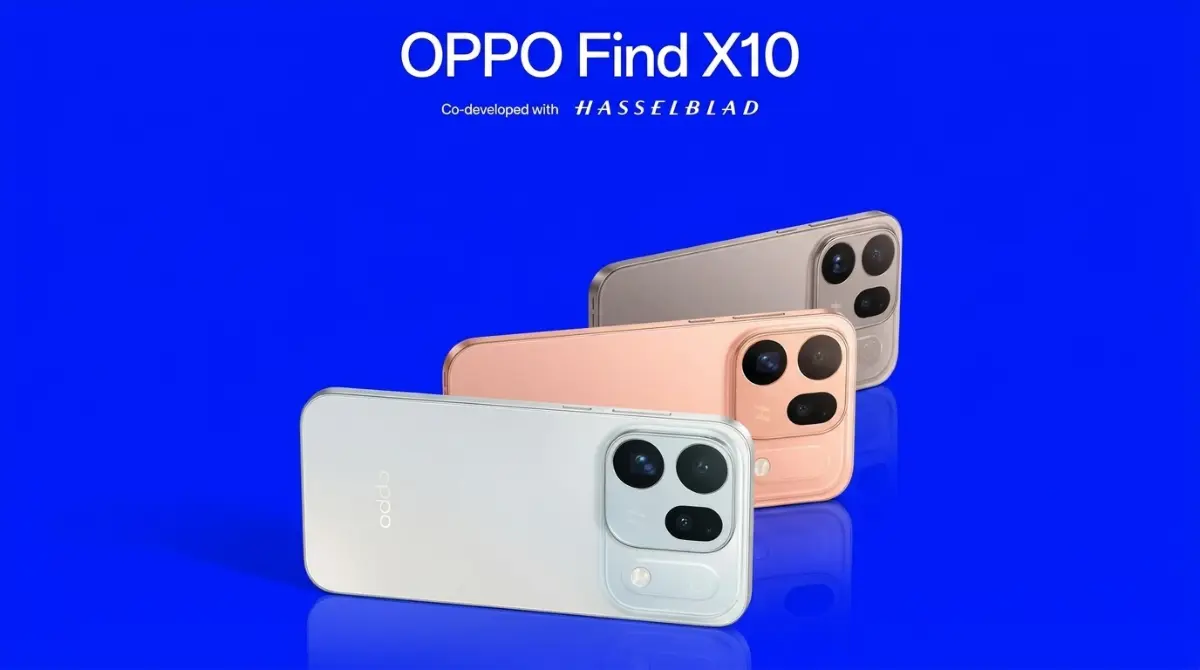


Oppo Find X10 and Pro Max Launch Worldwide With 8000mAh
Oppo released the Find X10 and Find X10 Pro Max outside China, introducing Dimensity 9600 silicon, dual 200MP camera arrays, and massive 8,000mAh batteries to international buyers while European retail variants receive a smaller 7,150mAh power cell.
Goriola Ayankoya | · 8 min read

Mobile phone buyers outside mainland China have spent years watching regional manufacturers save their best hardware for domestic stores. While Chinese shoppers enjoyed high-density silicon-carbon batteries and multi-sensor camera systems, international markets received watered-down models with smaller power packs and cut-rate charging speeds. Mainstream Western brands took advantage of that absence, selling iterative updates with minor processor bumps and conservative 5,000mAh batteries at four-figure price tags. Oppo moved to challenge that market pattern on Wednesday, October 21, 2026. The company officially launched its Find X10 and Find X10 Pro Max smartphones worldwide, bringing MediaTek newest Dimensity 9600 silicon and high-capacity battery hardware to global retail shelves. The flagship Pro Max stands out by packing an enormous 8,000mAh power cell in its international configuration, although European buyers will receive a slightly reduced 7,150mAh version due to local transport regulations. The launch arrives as device makers compete over battery chemistry, a trend visible when OnePlus released the OnePlus 16 with a 9,000mAh battery.
The global debut confirms details that circulated through supply channels over recent weeks. Oppo is positioning the Find X10 family as a direct challenger to top-tier flagships from Apple and Samsung. Rather than relying on software gimmicks, the company is competing on physical hardware: pairing an advanced 2nm processing chip with dual 200MP optical sensors and fast 100W wired charging. In laboratory endurance testing, the global Pro Max edition achieved an active use score above twenty-five hours, placing it among the longest-lasting smartphones ever tested. By offering high-capacity power cells without making the phone thick or uncomfortable to hold, Oppo is forcing competitors to rethink their battery engineering. The commercial rollout follows preview reports we tracked when Oppo scheduled its Find X10 international debut.
The 2nm MediaTek Dimensity 9600 Pro Processor
At the center of the Find X10 Pro Max sits the MediaTek Dimensity 9600 Pro processor, fabricated on TSMC advanced 2nm foundry nodes. The silicon architecture marks an important transition for flagship Android phones, which historically favored Qualcomm Snapdragon chips for top-tier international releases.
The Dimensity 9600 Pro features Arm newest C2 performance CPU cores, delivering a 61% improvement in power efficiency during multi-core processing tests compared to previous chips. Graphical performance is handled by the Mali-G2 Ultra NX GPU, which delivers 27% faster rendering and 18% faster ray-tracing execution while consuming 24% less power. The onboard neural processing unit introduces significant performance gains for on-device machine models, offering 51% faster prompt prefill speeds and a 55% improvement in token generation per watt of power. The standard Find X10 runs on the Dimensity 9600M, built on a 3nm process, providing strong speed for everyday multitasking and mobile gaming. MediaTek growing presence in premium smartphones challenges Qualcomm market position, reflecting chip industry rivalries we examined during the Qualcomm Snapdragon 8 Elite mobile platform release.
The European Battery Divide: 8,000mAh vs. 7,150mAh
The headline hardware feature of the Find X10 Pro Max is its massive battery, but international availability comes with a regional catch. The global version of the handset carries an 8,000mAh silicon-carbon battery pack, representing a substantial step up from last year 7,500mAh unit.
European consumers receive a different configuration. The European version arrives with a 7,150mAh power cell, which is smaller than both the global model and last year European X9 Pro. Oppo engineering representatives explained that European hazardous transport guidelines and strict recycling regulations influenced the decision to use a lower-capacity cell in European shipments. Even with the smaller battery, the European model delivers solid two-day battery life, but global users outside Europe will enjoy noticeably longer runtimes. In standardized battery drain benchmarks, the global 8,000mAh unit ran for more than twenty-five hours of continuous active screen time, easily outlasting flagship competitors that still ship with 5,000mAh batteries. The rapid adoption of high-density battery hardware matches developments we documented when Redmi launched the K100 with a 10,000mAh battery, as well as battery breakthroughs detailed when Honor revealed high-density battery engineering.
Dual 200MP Cameras and the Lumo True Color Engine
Oppo has invested heavily in camera hardware, and the Find X10 series continues that photographic focus. Both the standard Find X10 and the Pro Max feature an advanced camera system built around two separate 200MP sensors, supported by Oppo proprietary Lumo True Color imaging software.
The camera setup on the Find X10 series includes:
- Primary Camera: 200MP Samsung ISOCELL HPE sensor measuring 1/1.4 inches with an f/1.8 aperture and optical image stabilization.
- Telephoto Camera: 200MP ISOCELL HP5 periscope sensor measuring 1/1.56 inches, offering 3x optical zoom and up to 120x digital zoom.
- Ultra-Wide Camera: 50MP ISOCELL JN5 sensor with a 120-degree field of view and macro focus capabilities.
- Front Selfie Camera: 50MP ISOCELL JN5 sensor supporting 4K video recording at 60fps.
Both the main and telephoto cameras can record 4K video at 120fps or 8K video at 30fps with continuous HDR tone mapping. Oppo Lumo True Color software uses multi-spectrum color sensors to measure ambient lighting, producing accurate skin tones and natural color balance without the oversaturated processing common in competing smartphones. Camera hardware trade-offs across premium handsets were explored in our review of Huawei advanced display and chassis engineering.
Comparing Flagship Smartphone Specifications in 2026
| Device Model | Processor Chipset | Display Specs & Size | Battery Capacity | Camera Hardware | Wired Fast Charging |
|---|---|---|---|---|---|
| Oppo Find X10 Pro Max | MediaTek Dimensity 9600 Pro (2nm) | 6.82-inch 144Hz LTPO AMOLED | 8,000mAh (7,150mAh in EU) | 200MP Main + 200MP Tele + 50MP UW | 100W SuperVOOC |
| Oppo Find X10 (Standard) | MediaTek Dimensity 9600M (3nm) | 6.59-inch 144Hz LTPO AMOLED | 6,500mAh silicon-carbon | 200MP Main + 200MP Tele + 50MP UW | 80W SuperVOOC |
| Samsung Galaxy S26 Ultra | Snapdragon 8 Elite Extreme | 6.8-inch 120Hz Dynamic AMOLED | 5,200mAh lithium-ion | 200MP Main + 50MP Tele + 12MP UW | 45W wired |
| Apple iPhone 18 Pro Max | Apple A20 Pro (2nm) | 6.9-inch 120Hz Super Retina XDR | 4,850mAh lithium-ion | 48MP Main + 48MP Tele + 48MP UW | 30W wired |
The comparison table makes the hardware contrast clear. While Apple and Samsung equip their most expensive devices with batteries hovering near 5,000mAh and charging speeds below 50W, Oppo delivers an 8,000mAh battery and 100W charging in the Pro Max. That hardware gap explains why international consumers are increasingly looking at alternatives to traditional Western market leaders.
Display Engineering: Ultra-Thin Bezels and 144Hz Smoothness
Display quality on both Find X10 devices is among the best in the industry. The standard Find X10 features a flat 6.59-inch LTPO AMOLED display with a resolution of 2,768 by 1,272 pixels and an ultra-thin 0.99mm border surrounding the screen.
The Pro Max steps up to a 6.82-inch panel with a 2K resolution of 3,168 by 1,440 pixels. Both screens support variable refresh rates from 1Hz to 144Hz, adjusting speed based on on-screen content to save battery power. Peak HDR brightness reaches an impressive 3,600 nits, ensuring full visibility when reading messages or snapping photos in bright sunlight. High-frequency pulse-width modulation dimming rated at 2,160Hz reduces screen flicker at low brightness settings, protecting eyes during late-night reading sessions. The screen glass uses Oppo Crystal Shield material, offering improved drop protection and scratch resistance compared to standard toughened glass. Display engineering priorities on modern handsets match design approaches we reviewed on the Vivo T5 5G launching with a curved display.
ColorOS 16 and International Software Updates
Software on the global Find X10 lineup runs on ColorOS 16 built on Android 17. The interface features Oppo Trinity Engine, which manages system memory, storage defragmentation, and processor clock speeds to keep apps running smoothly without background slowdowns.
Oppo made significant improvements to its update policy for global markets. The company commits to four major Android operating system upgrades and five years of monthly security patches for the Find X10 series. The software includes built-in Google services, complete language localization, and full compatibility with regional banking applications. Oppo also integrated cross-device tools that let users mirror phone screens onto Windows PCs or share files with Apple Macs using a dedicated desktop companion client. Device longevity and software update schedules were explored in our analysis of Honor confirming its multi-year software update schedule.
Challenging Samsung and Apple in Global Retail
While the hardware specifications are impressive, Oppo faces significant marketing challenges outside Asia. In European markets, Apple and Samsung hold dominant retail positions supported by carrier distribution agreements and deep brand familiarity.
Many European consumers buy phones through mobile network operator contracts, where monthly financing masks high retail prices. To succeed globally, Oppo must convince carrier partners like Vodafone, Orange, and Deutsche Telekom to display Find X10 hardware in physical retail stores. The company is backing the launch with competitive trade-in bonuses, bundled accessories, and direct-to-consumer online discounts. If Oppo can secure carrier shelf space, the combination of two-day battery life, dual 200MP cameras, and 100W charging will attract power users tired of paying luxury prices for modest hardware. Competitive market dynamics across Android sub-brands were analyzed in our leak report on the iQOO 16R and Z12 Turbo specifications, while earbud accessory pairings were detailed in our tested guide to the best wireless earbuds of 2026.
The Final Assessment on Oppo Global Flagship Push
The global launch of the Oppo Find X10 and Find X10 Pro Max proves that high-performance smartphone hardware has moved past incremental updates. By pairing a 2nm Dimensity 9600 processor with dual 200MP cameras and an 8,000mAh battery, Oppo has built one of the most capable Android devices on the market.
While European buyers will feel disappointed by the reduced 7,150mAh battery in their regional variant, the phone still outlasts almost every competitor on European shelves. Oppo global push delivers an unmistakable message to the entire mobile industry: consumers want phones that can take exceptional photos, charge in minutes, and run for two full days without searching for a wall outlet. The Find X10 Pro Max proves that practical endurance and top-tier performance can exist in the same device, setting a fresh benchmark that other phone makers will have to answer in 2027.
Read More on TechRobust:

Goriola Ayankoya
 LinkedIn
Goriola Ayankoya
Expertise:Consumer Hardware, Smartphone Trends, Gadget Reviews, Breaking Tech News, Mobile Ecosystems
Award:TechRobust Hardware Reporter of the Year 2025
Goriola is a Staff Writer and Reporter specializing in consumer technology, breaking tech news, and hands-on hardware analysis. He tracks fast-paced mobile developments, reviews modern gadgets, and unpacks product launches to give readers clear, practical insights into everyday consumer tech.