


Microsoft and Nvidia Launch Surface Laptop Ultra at $2,599
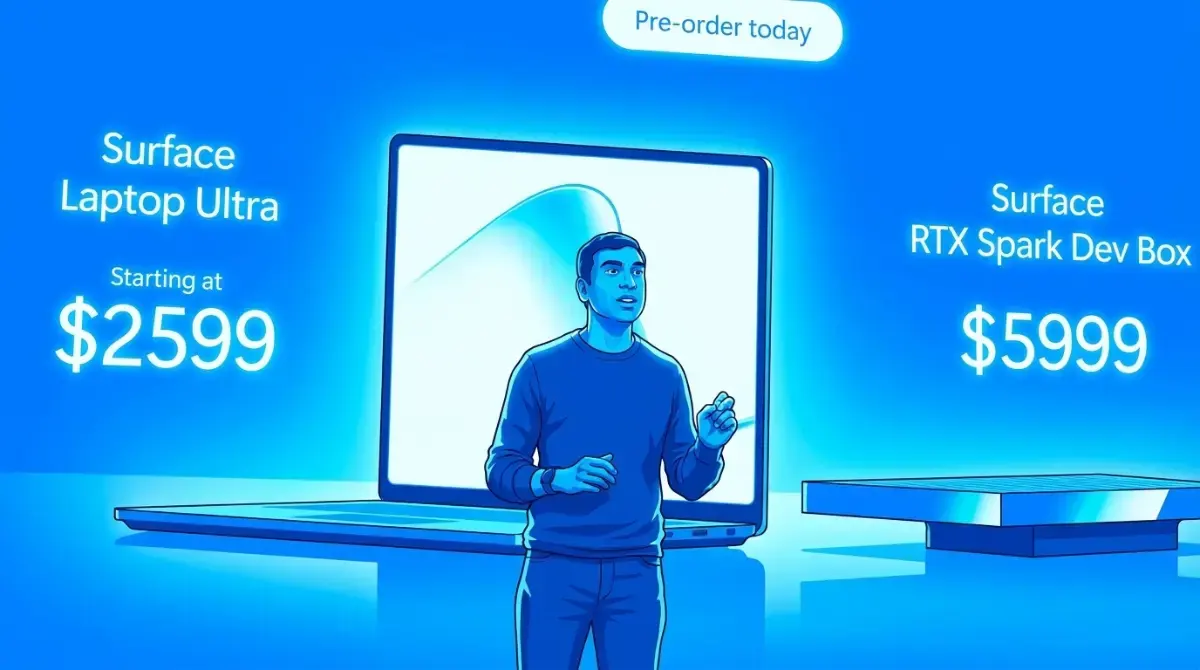
Microsoft and Nvidia introduced the Surface Laptop Ultra starting at $2,599, combining the RTX Spark superchip with up to 128GB of unified memory to challenge Apple workstation supremacy with on-device computing power.
Umar Abubakar | 6 Oct. 2026, 12:22 AM · 8 min read

Workstation computing is shifting away from remote server clusters toward local desk hardware. For years, engineers, graphic creators, and researchers accepted a frustrating compromise when buying mobile computers. If a buyer wanted all-day battery life and quiet fans, they bought Apple silicon. If they needed raw graphics horsepower and compatibility with CUDA programming environments, they purchased thick Windows gaming rigs that drained battery packs in under two hours and required heavy power bricks. On Wednesday, October 7, 2026, Microsoft chief executive Satya Nadella and Nvidia chief executive Jensen Huang appeared together in San Francisco to break that trade-off. The corporate leaders introduced the Surface Laptop Ultra, an aluminum workstation powered by the RTX Spark superchip that starts at $2,599, with customer shipments commencing on October 16.
The joint hardware announcement represents a bold challenge to Apple dominance in the professional creative sector. By integrating Nvidia Blackwell graphics cores, Grace processor cores, and unified system memory into a single piece of silicon, the machine delivers up to one petaflop of computing throughput directly on desk surfaces without connecting to remote server farms. To tempt enterprise creative directors away from macOS workstations, Microsoft introduced a retail trade-in incentive offering up to $1,000 in cash back for functioning MacBook Pro models. The premium machine targets professionals who need local model inference, real-time visual rendering, and heavy code compiling inside a portable chassis. The aggressive hardware pivot arrives as competition among personal computer builders intensifies, a trend we tracked when reporting on Google launching the $899 Googlebook Gemini laptop.
The RTX Spark Architecture and Unified Memory Pools
To understand why this launch marks an engineering shift for Windows hardware, one must examine the silicon layout inside the machine. Traditional Windows laptops pair an Intel, AMD, or Qualcomm processor with a separate discrete graphics card through a narrow PCIe connection. That architecture creates a persistent bottleneck: large dataset files and model weights must travel back and forth across motherboard pins, consuming electricity and slowing execution speeds.
The RTX Spark N1X superchip eliminates that physical bottleneck by adopting unified memory architecture. The entry-level $2,599 configuration packs an 18-core CPU alongside a 5,120-core Blackwell graphics engine, paired with 24GB of unified system memory and a 512GB solid-state drive. Top-tier configurations scale up to a 20-core CPU, 6,144 graphics cores, 128GB of unified memory, and 2TB of high-speed PCIe Gen 5 storage, pushing the retail price to $5,899. Because the processor cores and graphics units access the exact same memory pool simultaneously, developers can load massive neural networks and 3D scenes locally without facing out-of-memory crashes. The move toward integrated workstation silicon matches industry trends we examined when covering how Axelera unveiled custom Europa processing silicon.
Challenging the Apple Silicon Fortress
For four years, Apple held an unchallenged advantage over corporate procurement desks with its M-series Max and Ultra chips. Creative studios and software agencies migrated en masse to MacBook Pros because Apple unified memory allowed video editors to scrub multiple 8K video streams while traveling on airplanes without plugging into wall sockets. Windows laptop makers struggled to compete, offering thin machines that lacked graphics power or bulky workstations that sounded like jet engines.
The Surface Laptop Ultra changes that dynamic by giving Windows users genuine parity in unified memory bandwidth while retaining native support for the global standard in mathematical computing: Nvidia CUDA libraries. Apple silicon runs Metal graphics APIs, forcing developers who build machine learning software to rewrite code or run slow translation layers. By putting 128GB of unified memory directly beside Blackwell graphics cores, Microsoft and Nvidia are delivering a portable machine that runs standard scientific code natively out of the box. Enterprise hardware strategies continue shifting across international markets, similar to dynamics we documented when Apple targeted corporate enterprise computing costs with Mac workstations.
Display Upgrades and the Curious Pen Omission
The physical exterior of the laptop reflects its professional ambitions. The machine features a 15-inch PixelSense Ultra touchscreen with a sharp 262 pixels-per-inch density, a 120Hz refresh rate, and anti-reflective glass coating. Microsoft claims the mini-LED backlighting achieves 1,000 nits of standard brightness and peaks at 2,000 nits during high-dynamic-range video playback, beating the brightness ceiling of competing workstation screens by twenty-five percent. Color accuracy covers one hundred percent of the DCI-P3 gamut, allowing commercial colorists and digital photographers to grade footage on location with absolute visual fidelity.
However, the display design carries an unexpected compromise that will disappoint long-time Surface loyalists: the laptop completely drops digital stylus support. Despite including a capacitive touch glass surface, Microsoft confirmed the display is engineered strictly for finger touch navigation and does not function with the Surface Pen or Surface Slim Pen. For architects, industrial designers, and digital illustrators who purchased prior Surface Book and Surface Studio hardware specifically for on-screen sketching, the lack of active pen digitization is a glaring omission. The trade-off suggests the internal engineering team prioritized thin display layers and high thermal dissipation over stylus digitizer coils. We examined consumer reactions to display compromises in our report on how hardware designers manage screen coatings and display protection.
The Desktop Alternative: Surface RTX Spark Dev Box
Alongside the flagship mobile workstation, Microsoft unveiled a companion desktop computer targeted directly at engineering labs and research institutes: the Surface RTX Spark Dev Box. Priced at $5,999 and scheduled to ship to enterprise buyers in November, the compact metal desktop functions as a direct Windows answer to the Apple Mac Studio.
The Dev Box houses the same top-tier RTX Spark silicon found in the premium laptop, pairing the 20-core CPU, 6,144-core Blackwell GPU, and 128GB of unified memory inside a stationary aluminum enclosure equipped with dual vapor-chamber cooling fans. Without the battery and thermal constraints of a laptop chassis, the desktop unit sustains sustained clock speeds indefinitely, generating over one petaflop of continuous computing throughput. The device provides software teams with an isolated local sandbox where engineers can test autonomous agents and compile proprietary code without paying monthly cloud infrastructure fees or exposing sensitive intellectual property to third-party networks. The demand for private local server boxes mirrors hardware shifts we covered when LM-Kit introduced private local servers for corporate teams.
Data Sovereignty and the Retreat From Cloud Subscriptions
The launch of $2,599 to $5,899 local computing hardware highlights a growing corporate backlash against cloud software dependency. Over the past three years, enterprise software providers pushed companies to run every computational task through remote web APIs. While that model created massive revenue for cloud hosting giants, it introduced staggering monthly bills and severe regulatory headaches. Corporate legal departments in Switzerland, the Netherlands, and across North America are increasingly worried about data sovereignty and unexpected cloud outages.
When a pharmaceutical firm synthesizes chemical compounds or an investment bank calculates trading models, uploading raw files to remote server farms creates compliance liabilities under strict privacy laws. Buying premium workstations with large unified memory pools allows businesses to execute complex mathematical tasks entirely offline. The initial capital expense of a $5,000 laptop is recovered within months by eliminating recurrent cloud API charges. Corporate executives are carefully auditing their infrastructure spending, a reality we analyzed in our coverage of Oracle delaying data center payments during disputes over infrastructure spending.
Thermal Reality in a Fifteen-Inch Chassis
Putting 6,144 Blackwell graphics cores and an 18-core processor inside an aluminum laptop chassis introduces severe thermal physics challenges. When processors crunch mathematical calculations at maximum clock speeds, they produce intense heat. If that thermal energy is not pulled away from the motherboard rapidly, the silicon automatically throttles down its operational frequency to prevent permanent component damage, severely degrading performance.
Microsoft redesigned its internal cooling loop to handle the thermal load, utilizing an ultra-thin copper vapor chamber paired with dual high-static-pressure fans and graphite heat spreaders. The chassis vents air through hidden exhaust ports along the rear display hinge, keeping surface temperatures comfortable around the keyboard palm rest during sustained compile runs. However, real-world battery endurance under heavy compute loads will determine whether the machine functions as a genuine mobile workstation or remains tethered to its 140W USB-C wall charger. How consumer devices manage internal power constraints was explored in our analysis of hardware makers implementing dedicated security chips for battery packs.
The Battle for the Premium Laptop Market
The Surface Laptop Ultra proves that Microsoft hardware division is no longer interested in chasing thin-and-light budget buyers who only browse the web and type text documents. The company is directing its premium engineering resources squarely at the top five percent of high-earning software developers, visual artists, and scientific researchers who demand extreme local compute.
By partnering directly with Nvidia to bring unified memory architecture to Windows, Microsoft has delivered the most serious challenge to MacBook Pro supremacy in a decade. If the RTX Spark silicon matches its performance promises when review units land in customer hands on October 16, Apple will finally face a Windows workstation that combines long battery life with the unmatched power of Nvidia CUDA ecosystem. The workstation market has entered a fierce new era, and the winner will be decided on the desks of the world most demanding creators.
Read More on TechRobust:

Umar Abubakar
 LinkedIn
Umar Abubakar
Expertise:Editorial Leadership, Product Design (UI/UX), Digital Media Strategy, Technology Systems, Product Architecture
Award:TechRobust Visionary Leader of the Year 2025
Umar serves as Editor-In-Chief and CEO of TechRobust, combining editorial vision with senior product design expertise to shape how modern technology stories are built, packaged, and told. Overseeing all editorial verticals, he directs coverage across global and regional tech landscapes while applying deep design thinking to publication strategy and reader experience.