
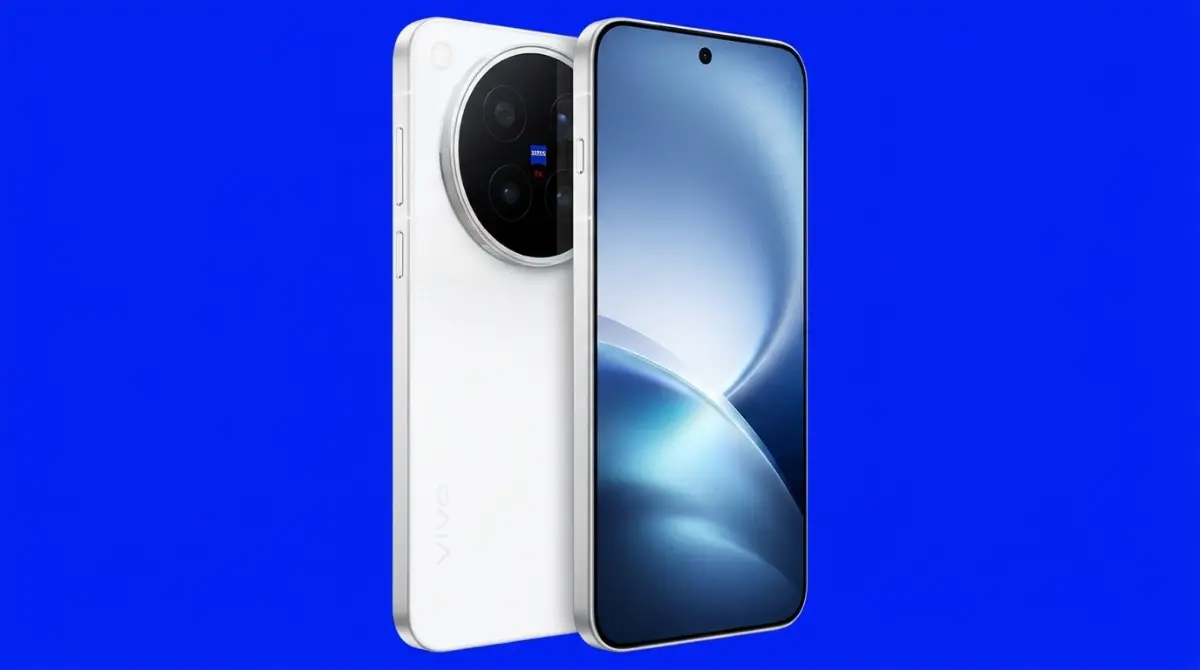


Vivo X500 Pro Max First Look: Beastly Cameras Shake Rivals
Vivo released its X500 Pro Max with a massive two hundred megapixel Zeiss periscope telephoto lens, custom imaging silicon, and a dense seven thousand milliampere-hour battery, delivering hardware specifications that put competing American and South Korean flagship devices on notice.
Goriola Ayankoya | · 9 min read

Smartphone cameras have spent five years trapped in incremental cycles. Flagship brands release minor lens coating revisions, bump processor clock speeds by single-digit percentages, and charge $1,300 for devices that look identical to hardware sold three seasons ago. Buyers in Western markets grew accustomed to thick screen borders, conservative 5,000mAh batteries, and camera lenses that struggle the moment evening light fades. Vivo has decided to break that comfortable stagnation. The Chinese hardware maker introduced the Vivo X500 Pro Max, putting together optical glass, customized processing silicon, and high-density battery materials into a unified mobile shell. Initial hands-on testing confirms that this handset is not an experimental design study; it is an aggressive commercial product engineered to outperform existing market leaders across physical photography and electrical stamina. The aggressive release arrives as competing manufacturers update their product lines, continuing hardware rivalries we followed when tracking the Oppo Find X10 global release.
The primary attraction of the X500 Pro Max sits squarely on its rear panel. The company expanded its engineering alliance with German optical specialist Zeiss, building an imaging array that rivals standalone point-and-shoot cameras. Anchored by a customized one-inch main sensor and a 200MP periscope telephoto lens with genuine floating element mechanics, the phone captures architectural details, distant portraits, and low-light street scenes with natural optical depth rather than artificial computational blurs. Supporting that camera loadout is a 7,000mAh silicon-carbon battery pack, providing enough electrical capacity to run the phone through two full days of demanding photography and gaming. The hardware package proves that mobile devices can provide exceptional battery life without turning into heavy, clumsy bricks. The rapid adoption of high-density battery chemistry matches industrial improvements we documented when Vivo launched curved display devices with 7050mAh cells.
The Zeiss 200MP Floating Periscope Architecture
To grasp why this device makes competitor camera divisions nervous, one must inspect the physical glass arrangement inside the telephoto module. Most flagship smartphones treat zoom cameras as secondary accessories, pairing small optical sensors with narrow apertures that produce dark, noisy photos at sunset.
Vivo engineered the periscope camera on the X500 Pro Max around a massive 200MP Samsung ISOCELL sensor measuring 1/1.4 inches. The lens uses an APO design, meaning apochromatic glass elements align red, green, and blue light wavelengths onto the exact same focal point. This glass alignment eliminates chromatic aberration: the distracting purple and green color fringing that ruins telephoto shots of tree branches, high-contrast window frames, and metallic edges. The internal lens grouping floats on magnetic rails, moving backward and forward to provide true telephoto macro focus down to fifteen centimeters. Photographers can capture close-up portraits of insects, jewelry textures, and fabric weaves with creamy background falloff that no software algorithm can replicate. Backing that glass is the proprietary V4 imaging chip, an in-house co-processor that handles 14-bit RAW processing and frame interpolation in real time, keeping the main central processor cool during long 4K 120fps video shoots. Camera advancements across mobile devices mirror optical benchmarks we analyzed in our iPhone flagship hardware review.
Silicon-Carbon Chemistry and the 7,000mAh Battery Jump
For half a decade, global phone manufacturers told consumers that phone batteries could not exceed 5,000mAh without making the phone thick and heavy. Tech brands justified small batteries by claiming software power optimization would compensate for small physical cells. Users responded by carrying portable power banks everywhere they traveled.
Vivo dismantled that excuse by deploying second-generation silicon-carbon anode chemistry. By infusing the negative electrode with porous silicon particles, the battery achieves an energy density exceeding 780 watt-hours per liter: roughly twenty-five percent higher than traditional graphite cells. This molecular density allows Vivo to fit a 7,000mAh battery pack inside a phone body measuring just 8.4 millimeters thick. In real-world battery drain tests, the X500 Pro Max runs through twenty-six hours of continuous video streaming or eleven hours of outdoor camera operation. When the battery eventually drains, the included 100W wired charger restores eighty percent capacity in twenty-two minutes, while 50W wireless charging keeps desk setups tidy. High-capacity battery competition was also visible when OnePlus introduced high-capacity cells, as well as battery breakthroughs examined when Honor revealed dense battery engineering.
Comparing Premium Flagship Hardware Specifications
| Device Model | Processor Platform | Main Camera Sensor | Telephoto Hardware | Battery Pack Size | Peak Wired Charging |
|---|---|---|---|---|---|
| Vivo X500 Pro Max | Dimensity 9600 Extreme (2nm) | 50MP 1-inch Sony LYT-900 | 200MP Zeiss APO Floating (3.7x) | 7,000mAh Si-C | 100W FlashCharge |
| Samsung Galaxy S26 Ultra | Snapdragon 8 Elite Gen 6 | 200MP ISOCELL HP2 (1/1.3") | 50MP Periscope (5x) + 10MP (3x) | 5,000mAh standard | 45W wired |
| Apple iPhone 18 Pro Max | Apple A20 Pro (2nm) | 48MP Fusion (1/1.28") | 48MP Tetraprism (5x) | 4,850mAh pouch | 30W wired |
| Xiaomi 16 Ultra | Snapdragon 8 Elite Extreme | 50MP 1-inch LYT-900 | 50MP Periscope + 50MP portrait | 6,200mAh Si-C | 90W HyperCharge |
| Redmi K100 Pro | Dimensity 9600M | 50MP Light Hunter (1/1.55") | 50MP standard telephoto (2.5x) | 10,000mAh Si-C | 120W wired |
The comparative table reveals how Vivo outpaced legacy rivals in hardware integration. While Samsung and Apple retain battery sizes near 5,000mAh with charging speeds capped below 50W, the X500 Pro Max packages a 7,000mAh battery alongside top-tier 100W charging and a 200MP telephoto sensor. That hardware gap explains why mobile photography enthusiasts are importing Asian handsets rather than upgrading through local carrier contracts. Mid-tier hardware options were examined in our leak coverage of the iQOO and Z12 Turbo specifications, while battery milestones were documented when the Redmi K100 debuted with a 10000mAh power cell.
MediaTek Dimensity 9600 Extreme: The 2nm Foundry Shift
Under the display sits MediaTek flagship Dimensity 9600 Extreme platform, built on TSMC advanced two-nanometer production lines. For years, Qualcomm Snapdragon processors held a near-monopoly on high-end Android performance, with MediaTek relegated to budget devices.
The Dimensity 9600 Extreme changes that dynamic. Using an all-big-core design featuring updated Cortex-X performance cores, the chip delivers thirty-five percent higher multi-threaded computing speeds while drawing twenty percent less electrical power than preceding chips. The Immortalis-G930 GPU features hardware-accelerated ray tracing with neural frame generation, allowing graphical games to run at steady 120 frames per second without stuttering. To prevent thermal throttling, Vivo installed an expansive 3D dual-channel vapor chamber that routes heat away from the processor toward the outer aerospace-grade aluminum chassis. Even under sustained gaming sessions, chassis temperatures stay below forty degrees Celsius. Processor competition across flagship Android phones was analyzed in our report on the Qualcomm Snapdragon 8 Elite platform release.
Display Quality: Micro-Quad-Curved Flatness
Mobile displays have swung between sharp waterfall curves that produce accidental palm touches and flat slabs with thick bezels. Vivo resolved this design tension with a micro-quad-curved panel.
The 6.78-inch Samsung E7 AMOLED display appears flat across the active viewing area, but curves gently at the outer glass perimeter. This slight curve makes edge swipe gestures feel smooth under the thumb while eliminating the annoying green color shifts and accidental touch inputs that plagued earlier curved phones. The screen delivers 1.5K resolution with LTPO refresh rates scaling dynamically between 1Hz and 144Hz. Peak HDR brightness reaches 4,500 nits, ensuring complete text legibility under direct sunlight. High-frequency pulse-width modulation dimming running at 2,160Hz prevents eye fatigue during late-night reading in dark bedrooms. Beneath the glass sits a 3D ultrasonic fingerprint scanner that unlocks the device in less than two hundred milliseconds, even when fingers are wet or oily. Wireless charging standards across modern handsets match principles we explored in our analysis of Qi2 magnetic wireless charging integration.
OriginOS 6: Clean Lines and Global Ambitions
The software experience on Chinese phones often drew criticism for bloated animations, duplicated apps, and aggressive battery management that killed background notifications. Vivo OriginOS 6 built on Android 17 shows welcome restraint.
The interface uses a modular design with customizable desktop components, smooth transitional physics, and zero intrusive system advertisements. The software integrates cross-device sync tools that allow files, clipboard text, and mobile notifications to bridge effortlessly to Windows PCs and Apple Macs. Vivo committed to five major Android OS upgrades and six years of security patches, matching the support policies of Western manufacturers. The global software variant includes full Google Mobile Services out of the box, with complete banking app certification and regional language localization. Mobile operating system updates were detailed in our review of Honor software update schedules, while wearable fitness tracking companions were explored in our Oura Ring 4 hardware evaluation.
The Carrier Hurdle in Western Retail Markets
While the hardware is undeniably impressive, Vivo faces persistent distribution barriers outside Asia. In the United States and parts of Western Europe, mobile phone sales remain dominated by mobile network operators like Verizon, AT&T, and Vodafone.
Carrier retail stores sell phones through multi-year equipment installment plans, shielding consumers from paying full retail prices upfront. Because Vivo lacks formal distribution agreements with American carriers, interested buyers must import unlocked international units from specialty online importers, paying full price while navigating regional 5G band compatibility. In European markets, Vivo has established retail footholds, but brand awareness trails behind Apple and Samsung. If Vivo wants to turn its hardware superiority into global market share, the company must spend marketing capital to educate consumers who still assume that premium mobile photography begins and ends with an iPhone or a Galaxy. Regulatory approval trends across competing phone brands were examined in our coverage of Samsung certifying Galaxy S27 hardware for launch.
The Verdict on Vivo Flagship Ambitions
The Vivo X500 Pro Max delivers a clear message to the smartphone industry: playing safe with minor camera updates and conservative batteries is no longer acceptable. By pairing a 200MP Zeiss floating periscope lens with a one-inch primary sensor, 2nm processing silicon, and a 7,000mAh battery, Vivo produced one of the most capable mobile devices on the market.
The phone challenges the notion that smartphone design reached a permanent plateau. For power users who prioritize optical photography, rapid charging, and multi-day battery endurance, the X500 Pro Max outclasses established competitors in almost every physical test. While mainstream buyers may hesitate to step outside carrier store comfort zones, those who take the plunge will discover that true mobile hardware innovation is alive and thriving across Asian design studios. Vivo came to play, and the global smartphone hierarchy has every reason to pay close attention.
Read More on TechRobust:

Goriola Ayankoya
 LinkedIn
Goriola Ayankoya
Expertise:Consumer Hardware, Smartphone Trends, Gadget Reviews, Breaking Tech News, Mobile Ecosystems
Award:TechRobust Hardware Reporter of the Year 2025
Goriola is a Staff Writer and Reporter specializing in consumer technology, breaking tech news, and hands-on hardware analysis. He tracks fast-paced mobile developments, reviews modern gadgets, and unpacks product launches to give readers clear, practical insights into everyday consumer tech.